
Sign up to save your podcasts
Or

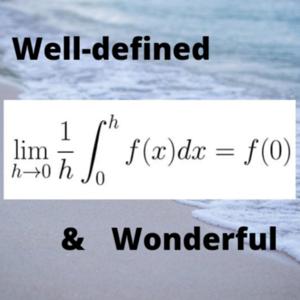


In the first part of a mini-series about properties of continuous functions we discuss the intermediate value theorem. We shall conclude that intervals are preserved under continuous mappings and provide another proof of the discontinuity of functions jumping from 0 to 1. Proving the intermediate value theorem, we have the occasion to revisit an argument we used to prove that the reals are uncountable.
Picture: Steven Baltakatei Sandoval, CC BY-SA 4.0, via Wikimedia Commons
This episode is devoted to the study of actual mathematical examples of continuous mappings. The arguably easiest example will be a constant function. We shall discuss a function having a jump at 0 in order to have a non-example at hand. Finally, we prove that the exponential function introduced earlier defined a continuous function. We will exploit this property later on, when we provide an answer on how to raise 2 to the power of root 2.
In this episode we discuss one of the most important concepts in mathematical analysis -- the concept of continuity for mappings. With great patience and attention to detail we describe the exact definition for a map f to be continuous at some point a in a metric space into a possibly different metric space. We highlight some examples from everyday life and conclude with the property that continuous maps are precisely those maps mapping convergent sequences with some limit a to the same with limit f(a) from one metric space into another.
The icon is taken from https://www.flickr.com/photos/150411108@N06/38663730944
The second episode on metric spaces is focussed on a concept derived from the convergence of sequences of real numbers. Knowing what distances between elements in metric spaces are, we immediately realise that we also know, when two elements of a metric spaces are close. Namely, when the metric evaluated at those elements is small. Thus, we introduce convergence of sequences in metric spaces to some limit element by asking for the metric evaluated at the sequence elements and the limit form a null sequence of real numbers. We illustrate the versatility of the developed ideas by looking at an example in image processing.
In this episode of well-defined & wonderful, we introduce the concept of a metric space. In order to rationalise the definition of this abstract concept, we go through elementary examples from ``practice’’ to build up our intuition. The core concept we want to mathematically describe and understand is the notion of distance. A metric space is then a mathematical object where distances of the elements in this space can be measured using a metric. In order to be justifiable as a mathematical model of distances in practice we single out a couple of properties we want the metric to satisfy. These properties and why detours are really detours and no shortcuts are also explained in this episode. Gladly Fabian Gabel helped again to gather these ides in a structured manner.
This episode is concerned with the exponential growth and the exponential function. In our course on mathematical analysis, we introduce the exponential function via an absolutely convergent series. This helps us, using the material from earlier episodes (take also a look into the notes on that), to see that the exponential series/function transforms addition in multiplication; a fact we have seen for power laws already. In consequence, we can also show that for integer n, exp(n) is the same as e multiplied n-times by itself; e being the Euler number. In some future episode we will also understand how to raise 2 to any power, for instance the square root of 2 -- the key for that will be the exponential series introduced here.
In this episode, again with the help of Fabian's, we discuss changing the order of summation in an infinite, convergent series. As a possibly surprising effect we have that for some series changing this order of summation leads to a different limit or even to a divergent series. We discuss this effect in detail looking at the harmonic series with alternating signs -- a series we know converges by the Leibniz criterion. As an upshot of this episode we also learn that absolutely convergent series can be rearranged with no consequences on their respective limit behaviour.
This episode is the accompanying episode to the previous one. Here we dig deep into the different type of infinity of the real numbers. In fact as we set out to prove in this episode there are significantly more real numbers than naturals. More precisely, there is no way to label all the real numbers with distinct natural numbers and to reach to every real number. An absolutely amazing fact showing that our process of filling all those gaps the rationals had was a nontrivial step.
In this episode we learn about the concept of quantifying infinite sets. The first infinite set that comes to mind is the set of natural numbers introduced before. In consequence, we single out this size of infinity as the one we are most comfortable with. This yields the definition of countability. We also explore a little the intricacies of infinity by looking at a fully booked hotel still capable of hosting additional guests. This famous building is called Hilbert's Hotel and helps us to also understand which of the following sets is quantitatively bigger (ignoring the names of the elements): the natural numbers, the integers or the rationals?
In this episode we start with a little correction needed for the episode on the supremum of sets. Then we embark on the cruise to a special type of sequences: series. We define this notion provide the most prominent examples (geometric and harmonic) and some convergence tests. Among these the most important in turn are the comparison test, the ratio test and the root test. As an application of convergent series, we can show that any real number admits a decimal expression. (license of picture under https://commons.wikimedia.org/wiki/File:Meta-image-netflix-symbol-black.png)
From the publisher's feed