
Sign up to save your podcasts
Or



In 1975, Priscilla Blevins vanished from her home in Charlotte, North Carolina. Her parents reported their adult daughter’s disappearance to the police, but investigators didn’t seem very interested. Priscilla’s file was only two pages long. Ten years after her disappearance, human remains were found nearby, but no one connected them to Priscilla. Over the years, it seemed her disappearance had been all but forgotten. Another cold case, destined to remain unsolved.
What is justice? For some people, it’s finding the missing remains of the person they love. For others, it’s convicting the person responsible for taking a life. Sometimes, it’s both. In this episode, we take you into the belly of the criminal justice system and show you how it tries to find resolution for families in some of the most difficult cases. We tell the story of Monica Moynan, a young mother missing and presumed dead – and why the local district attorney believes she can prosecute the ex-husband for murder without a key piece of evidence – Monica’s body. Without human remains, is there a solid case? How do you take a case like that to court when you have no definitive proof a person has even been killed?
Unlike most of this podcast, this is not a story about skeletal remains. In this case, no human remains have been found. Cole Thomas is officially a missing person, but his father knows in his heart his son is dead.
When you think of an artist, drawing dead people is probably not the first thing that comes to mind, but that’s exactly what a forensic artist does. In this episode, we meet two forensic artists who piece together clues allowing them to take a human skull and turn it into a portrait of how a person looked when he or she was alive. Going from skeletal remains to a drawing or 3-D likeness of a person is part science, part art and part magic. In this episode, find out how they interpret the clues to turn a skull into a human likeness that helps solve cold cases and unsolved murders.
In 2005 young boys playing near an abandoned house in Harnett County, North Carolina found skeletal remains. More than fifteen years later those remains are identified thanks to the work of The Carolina Cold Case Coalition. In this bonus episode, the coalition solves its first case, bringing closure to a family and a name to the unidentified. Learn how forensic science – in particular forensic genealogy – helped solve the case.
Sitting in each state is a collection of skeletal remains, unnamed and gathering dust. These are cold cases that have proven to be uncrackable, unwilling to give up the secrets of who they are or what happened to them. Unsolved murders that refuse to be solved.
Each investigator has that one case that haunts them, the one that just won’t budge. For Detective Tim Horne, the Billboard Boy was that case. He was just a young crime scene tech when the skeletal remains of a little boy were found beneath a billboard in his jurisdiction. With no leads, the unsolved murder turned into a cold case. But Horne kept the case in a box beneath his desk where he would literally bump into it for the next 25 years. It was a daily reminder that he needed to solve it. The unidentified remains couldn’t stay unidentified forever.
As a teenager, Todd Matthews had an unusual obsession. He was fascinated by the human remains found along the side of a highway in a small community in rural Kentucky. The woman had been wrapped in a tent bag, and the tale of Tent Girl became a sort of urban legend. He never let go of his obsession with the case. Later in life, while working the assembly line at an auto factory, Todd created an early web page about Tent Girl, asking for the public’s help solving the case. That site helped Matthews do what police could not – solve an unsolved murder. And in doing so, it changed the way investigators across the country handle missing person cases today.
There’s this beautiful place in the mountains of North Carolina where death lives to tell a story. For people who have chosen to donate their body to science, their remains are laid out on the ground and left to decompose. Forensic anthropologists call them “human decomposition facilities,” but most people just call them “body farms.”
Dr. Ann Ross is surrounded by bones, literally. Everywhere you look in her osteology lab at North Carolina State University there are skeletal remains on metal tables laid out like jigsaw puzzles – a mosaic of hundreds of pieces that only she knows how to put together. Ross is a forensic anthropologist, often called on to help solve murder cases using forensic science.
From the publisher's feed
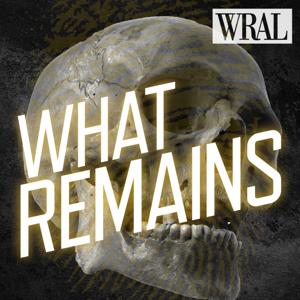
True crime meets forensic science in the What Remains podcast from WRAL Studios. With no ID, human skeletal remains often end up at medical examiners’ offices where they sit in storage closets for…

17,267 Listeners

15,168 Listeners

12,663 Listeners
4,153 Listeners
99,755 Listeners

19,093 Listeners
25,733 Listeners
18,019 Listeners

4,389 Listeners

7,770 Listeners
4,695 Listeners
3,445 Listeners

29,178 Listeners
2,788 Listeners