
Sign up to save your podcasts
Or



This week we pick through a budget that was long on points and short on change, pulling out what matters for pensions, savings and tax, plus three actions worth taking. Then we lighten up with the things that have completely passed us by since leaving the machine, from the clocks going back to Halloween creeping up on us.
Key Takeaways
Most of this budget was about what did not change, and for anyone planning retirement that stability is welcome. ISA allowances stay at £20,000, pension allowances are untouched, and the tax-free lump sum remains capped at £268,275. The state pension rises 3.9% to £13,036, the triple lock survives for now, and pensioners living on the state pension alone will not be taxed on it.
Cash savings sitting outside an ISA will be taxed more heavily, so if you have money in an ordinary savings account, now is the time to get it into a cash ISA or another tax-efficient wrapper. Use every allowance you have, including any unused allowance belonging to your spouse.
The quiet sting is the freeze on income tax thresholds. As pensions, annuities and wages rise, more of us will be dragged into higher tax bands without noticing. If you are still working, increasing your pension contributions or giving to charity can keep you below the next threshold.
The biggest change for retirees is still coming: from April 2027, unused pension pots become subject to inheritance tax, and beneficiaries may pay income tax on top. That flips the usual advice of spending other assets first and saving the pension for last. Talk to a financial adviser about your drawdown plan before then.
On the lighter side, leaving work, the school run and the daily commute means the outside world simply stops telling you things. The clocks changing and Halloween both arrived without warning. Christmas, however, is a different story, and the decorations are going up on Sunday.
We are not financial advisers, so please do your own research before acting on anything here.
Timestamps
00:09 - Welcome and introducing the episode
00:50 - A defensive, "nothing to see here" budget, and our disclaimer
01:30 - What didn't change: income tax, CGT, dividends and ISA allowances
03:30 - Pension allowances and the tax-free lump sum stay put
04:55 - State pension up 3.9% and the triple lock reaffirmed
06:15 - Higher tax on savings interest held outside an ISA
07:18 - A 2% rise in landlord tax
07:50 - The Lifetime ISA becomes the First Time Buyers ISA
09:40 - Household energy payments and scrapping gas standing charges
12:04 - Fuel duty and VAT cuts on electricity extended
12:40 - Frozen tax thresholds and fiscal drag
14:50 - Unused pensions brought into inheritance tax from April 2027
17:00 - Action 1: make the most of your tax-free allowances
17:50 - Action 2: rethink the order you draw down your pension
19:12 - Action 3: dodging fiscal drag with pension contributions and charitable giving
20:00 - The things we miss now we're out of the machine
21:08 - Waking up to find the clocks had gone back
22:30 - Halloween gardens and becoming a grumpy old man
24:15 - Christmas decorations on 1 November, and why
Do you really need goals once you’ve retired? This week we look at why goal setting might matter more after work ends, not less. We unpack retirement drift, take an online quiz to see how far we’re drifting, and share a practical, non-corporate way to set five-year and one-year goals without turning retirement into another job.
Key Takeaways
Losing the structure of work is one of the hardest parts of retirement. Left unchecked it can turn into retirement drift: unmotivated days, shrinking social circles, declining fitness and the nagging question of whether this is all there is. It creeps up slowly, so it is worth checking in on. You can take the free quiz at www.retirementwisdom.com/retirement-drift/. One of us scored 77 out of 100 (thriving), the other 66 (some drift, could do better).
You do not need a rigid schedule to stay on track. A couple of anchor events, like a regular fitness class, give shape to the week and keep weekends feeling special.
Goals work best as a compass, not a performance review. Rather than agonising over your life purpose, try writing three to five statements you want to be true in five years, then work back to what you would like to achieve this year. Use categories that matter to you: passion projects, relationships, health and learning are a start, but finances or travel might fit better. Simply writing them down creates a kind of contract with yourself.
Purpose often is not found by searching for it. It is what is left when you notice the things you keep turning up for, whether that is the dog walk, the football team or the book club where nobody reads the book.
If a goal needs action, break it into small steps each quarter, or it will quietly never happen. And if you are not ready to set goals yet, that is fine. Being lost is a legitimate stage of transition. Just decide how long you will give yourself before you start finding your way.
Timestamps
00:09 - Welcome: why we’re talking about something as dull as goal setting
01:15 - Loss of structure and the idea of retirement drift (Mark and Judy Rollins, Retirement Transformed)
02:34 - The symptoms of retirement drift
03:40 - How people respond: 5am routines, time chunking and to-do lists
05:15 - Anchor events, and how they keep the weekend feeling like a weekend
07:15 - The retirement drift quiz and our scores
08:45 - What a goal actually is
09:43 - Goals as a way to uncover your dreams, and why not everyone got to imagine retirement
11:45 - Richard and Jackie Pickles: goals as a compass, not a target
12:45 - Life purpose and the laminated mission statement on the fridge
13:50 - Ambition revisited, plus our Ikigai episode coming in November
15:15 - Skipping life purpose: writing a five-year vision
16:34 - One-year goals and choosing categories that mean something to you
18:58 - Our five-year aspirations, from healthy and upright to keeping the toys
20:30 - Seventeen goals versus two, and giving yourself permission to be lost
21:30 - Life purpose as the thing you keep turning up for
22:50 - Turning goals into quarterly action plans
23:40 - Calendar chaos, and the friends spreadsheet
26:15 - Why writing things down works
27:15 - Drift, being lost, and giving it a time limit
What if leaving your career doesn't mean retiring your drive? This week we're joined by Hugo Brooks, author, speaker and guide, who walked away from more than 30 years running marketing businesses after his wife asked one simple question: are you sure you want to do this again? We talk about what ambition really is, why "purpose" has become a buzzword, and how to point your drive at something that genuinely means something to you.
Key Takeaways
Ambition is not the same as your goals. It is an independent drive, a simple human desire for tomorrow to be better than yesterday, and we all have it whether we work or not. Stopping a career does not switch it off. Of the driven people Hugo has spoken to who tried simply slowing down, only two or three in ten found it worked. The rest became uncomfortable and went looking for something new to aim at.
That drive moves through three phases: dissatisfaction, desire and determination. It works the same whether you are reorganising a kitchen cupboard or tackling world hunger. Marketing, and plenty of social media scams, work by igniting the middle phase, showing you a vision of something better so you suddenly feel dissatisfied with what you have.
Purpose has been hijacked. It started in the commercial world and has turned into pressure to do something worthy. What really matters is meaning, and meaning is personal. Curing world hunger and going fishing are equally valid if they matter to you. A useful way in is Hugo's eulogy exercise: imagine your best friend speaking at your funeral. Nobody wants them to mention last quarter's sales figures.
Somewhere in midlife the horizon stops moving. For Hugo it was realising he was older than his father was when he died. The question shifts from what can I do with my time to what will I get done with the time I have left. That can send people into denial (cue the Harley Davidson), or it can be the start of a far more meaningful second life.
Finally, treat goals as a direction, not something to worship. Reaching a goal is like walking through a pair of saloon doors: it takes seconds. Life happens in the corridor on the way there, so make the corridor count.
Hugo's book, Ambition: Redefining Success for a Restless Age, is being published in four parts. Part one is available now on Amazon.
Timestamps
00:09 - Welcome and introducing Hugo Brooks
02:24 - Closing a business on the way down, and the identity crisis that followed
04:47 - Why your drive and your goals are not the same thing
07:06 - Ambition as the desire for tomorrow to be better than yesterday
09:23 - The three phases: dissatisfaction, desire and determination
11:37 - Privilege and deprivation: why both can frustrate ambition
14:00 - A Minister for Ambition, and how marketing (and scams) ignite desire
16:13 - Why purpose has become a buzzword
18:33 - Meaning over purpose: from world hunger to going fishing
21:00 - The eulogy exercise
23:26 - Realigning your drive, and how it changes after 50
25:42 - When the horizon stops moving: outliving a parent
28:02 - A second life, and becoming visible in new worlds
30:22 - The book: Ambition, Redefining Success for a Restless Age
32:36 - AI, the future, and why goals are like saloon doors
35:02 - The journey, not the destination, and wrap up
Hugo's book part 1 https://www.amazon.co.uk/s?k=9781067640828
This week we head to Morocco for a week-long motorcycle tour through the Atlas Mountains, taken at 62 and finishing on the very first day of retirement. With video diaries recorded on the road, we look at the difference between a holiday and an adventure, why saying yes can stop your world shrinking once work ends and what happens when 2 Brits join 8 Frenchmen on Royal Enfields.
Key Takeaways
Holidays and adventures serve different needs. A holiday is about rest, comfort and predictability. An adventure, as Richard and Jackie Pickles describe in Retirement Wanderlust, is about novelty, challenge and personal growth, and it comes with far more logistics and unpredictability. Knowing which one you want shapes the trip you choose.
Saying yes more often helps you grow, builds resilience, strengthens relationships and sparks new ideas. But it needs policing. Saying yes to everything is the road to burnout, so protect your energy and your boundaries.
Retirement can quietly make your world smaller. Fewer daily interactions, no work travel and no reason to leave the house all add up. Deliberately saying yes to new experiences is one of the easiest ways to push back.
Giving up control can be liberating. Handing the planning to someone else made the trip stress free, even through sketchy off-road riding, a country where you can rarely get a glass of wine, and long days of functional French.
Multi-generational adventures are worth planning for. One family in the group spent three years organising the trip so fathers, uncles and sons, aged 30 to 70, could ride together while everyone was still able.
Endings deserve marking. Three very different trips ended up bookending the end of a working life, and a rooftop Fête de la Retraite in Marrakesh turned out to be the perfect send-off. Next stop: possibly Madagascar.
Timestamps
01:42 - The Morocco montage
03:31 - Holiday or adventure? Insights from Retirement Wanderlust
07:54 - Why say yes to an adventure at 62?
10:11 - Saying yes: growth, resilience, relationships and creativity, plus avoiding burnout
12:38 - Why your world can shrink in retirement
15:00 - From Rwanda to Morocco: choosing a Vintage Rides tour
17:21 - The route: Marrakesh, Aït Ben Haddou, the Dades Gorge, Imilchil and Ouzoud
19:43 - The Atlas Mountains and the edge of the Sahara
22:01 - Getting by on functional French
24:20 - Meet the group, and a chance meeting with Sam
26:34 - Sketchy off-roading, a dry country and giving up control
28:54 - A multi-generational tour, from 30 to 70
31:15 - Shared experiences with an old friend
33:37 - Why we planned three big trips around retirement
36:00 - Engineering a work exit that didn't go to plan
40:21 - La Fête de la Retraite: a rooftop retirement party in Marrakesh
42:45 - Next stop Madagascar?
www.vintagerides.com
The Wonders of the Atlas: Atlas Mountains Motorcycle Tour
The Great Red Island: 11-Day Motorcycle Tour of Madagascar
This week we talk body confidence and ageless style, from older models leading the autumn/winter 2026 catwalks to a Sunday Times piece asking whether you can still fit into the clothes of your youth. We look at why your waistline matters more than your BMI, how two sixty-somethings kept theirs and give an honest (and slightly sweary) update from week two of our own eight-week gym programme.
Key Takeaways
Older models are finally on the catwalk, with Chanel alone featuring 15 over-40s this season. That is real progress, and the silver pound is almost certainly part of the reason. But Kate Moss, Gillian Anderson and Mary Berry are all slim. Until catwalks show older bodies of different shapes and sizes, many of us will still struggle to see ourselves in them.
Wearing a bikini or PVC trousers later in life is not really about the clothes. It is about having enough confidence in your own body to make that choice and feel comfortable with it.
Your waist tells you more than your BMI. If your waist measures more than about 0.6 of your height, that is the danger zone. One study of 7,000 over-65s found a high waist circumference was linked to a 24% higher mortality risk, regardless of BMI.
Muscle is the key to keeping your metabolism going, because it burns calories even at rest and we naturally lose it from our 30s. Lifting weights matters far more than endless crunches, which build your core but do nothing for belly fat. And sadly, you cannot out-train a bad diet.
As for our own eight-week programme, having someone hold you accountable genuinely helps. But logging every blueberry is tedious, skipping meals to avoid the app only leads to bingeing at dinner, and one good day out can undo a week of effort. We are aiming for less heavy and a bit more toned, not a six-pack. Tune in to find out how we get on.
Timestamps
01:05 - Older models on the AW26 catwalks: Chanel, Tom Ford, Givenchy, Kate Moss for Gucci and Gillian Anderson for Miu Miu
02:34 - Burberry's campaign with Mary Berry, Olivia Colman and Lesley Manville, ageing designers and the silver pound
04:50 - Still a way to go on body size and relatability
05:40 - The Sunday Times article: bikinis, PVC trousers and the courage to wear them
06:30 - Digging out our 30-year-old leather trousers
07:13 - Clubbing in Soho, Destroy T-shirts and an accidental vibe
09:36 - Bikinis, cover-ups and body confidence
11:00 - How Alice Hart-Davis kept her waistline after three pregnancies and menopause
11:55 - Why waist measurement matters: cancer risk and the waist-to-height ratio
13:20 - Why metabolism slows as we age: it's all about muscle mass
14:23 - HRT and fat around the middle, plus Phil Hilton's approach
14:50 - The study of 7,000 over-65s linking waist size to mortality
16:50 - Why crunches won't shift belly fat
17:50 - Our eight-week gym programme and why we signed up
19:10 - Armoured motorcycle jeans for Morocco that don't quite fit
21:33 - Three apps, calorie targets, 10,000 steps and weigh-ins
23:52 - What we like and don't like so far
25:52 - Skipping meals to avoid logging food, and the pre-start Sunday binge
28:11 - 10,000 steps while moving the kids into uni, and "cheating steps"
30:37 - Why fun costs a pound and a Times reader's joyless toning diet
32:58 - Our goals and wrap-up
This week we are joined by George Goulburn, a straight male companion based in Sydney, who left a 25-year corporate career at 51 to work in what he calls the caring economy. We talk about what his clients actually want, why women over 50 are his core clientele, the loneliness epidemic and why making someone feel seen can change everything.
Key Takeaways
The thing women book George for most is not sex. It is companionship: someone who is completely present, puts their phone away, pays attention, and actually sees them. Many of his clients have been in relationships where there has been no intimacy or real connection for years, sometimes decades. They feel invisible. Two hours of genuine attention can be more transformative than years of waiting for something to change.
The work is nothing like how male escorting is typically imagined. George will not take a booking without a phone call first, asks for photographs because the women have already seen him, and turns down clients he does not feel a connection with. His minimum booking is two hours because women need time to feel safe and to arrive at whatever the session becomes. Sex, if it happens at all, is rarely the point.
The narrative that women become non-sexual after menopause is, as George puts it, a really messed up narrative. Most of his clients are 50 plus and at various points in their menopause journey. Many of them are financially independent, done being told what to do, and clear-eyed about what they want. The issue is not desire. The issue is that dating apps are soul-destroying and the options for meaningful connection are genuinely poor.
George also works with people society rarely acknowledges as having needs at all: people with disabilities, mature virgins, and couples who want help reigniting their connection. His eldest client was 82. He has seen a woman in her mid-50s who had never kissed anyone before. He discounts his rates for clients with disabilities because, as he says, everyone deserves touch and affection.
Timestamps
00:09 - Welcome and introducing George Goulburn, straight male companion
02:35 - How it started: a lover on Bumble who wanted to pay him
03:20 - How family and friends reacted, including his son and his mum
04:59 - Lovers versus clients, and why George lives ethically non-monogamous
06:30 - Pricing strategy: finding a mentor who had already done the work
08:20 - What he got wrong early on, and how it differs from dating
09:51 - Why his minimum booking is two hours, and what women actually want
12:14 - Who books him: divorced, widowed, in sexless marriages, and feeling invisible
14:35 - Online dating, the transactional culture, and why women go to a professional
16:30 - What he does to make women feel seen and beautiful
18:30 - The client who withdrew from her mortgage and went to work transformed
19:27 - Bette Midler, energy, and why confidence is not about looks
21:52 - The narrative that menopause means shutting up shop, and why that is wrong
24:18 - What he would say to a woman thinking about booking, and to men who want to do this work
26:44 - The loneliness epidemic beyond older women
27:10 - Mature virgins, disabilities, and people society does not see
31:34 - Seeing couples: helping reignite connection and showing partners what is possible
33:59 - How to find George, and wrap up
If you want to find George:
https://www.georgegoulburn.com/
https://www.instagram.com/georgegoulburnofficial/
He travels internationally (except the USA, for obvious reasons) and is happy to answer questions.
What if retirement wasn't a single event at the end of your working life, but something you did two or three times along the way? This week we dig into the HSBC Quality of Life Report 2025, which surveyed 11,000 affluent investors across 12 countries, and unpack the emerging trend of mini retirements: intentional career breaks of six to twelve months designed to recharge, redirect and realign, not just rest.
Key Takeaways
The traditional model of working solidly until you retire at 65 is quietly being replaced by something more fluid. Nearly half of the people surveyed aspire to take at least one intentional career break, and for many, that means two or three across their working life, roughly every six years, starting around 47 on average, with Gen Z aiming as early as 42.
The shift is not just logistical, it is philosophical. Younger generations in particular are redefining what wealth actually means, moving away from purely financial measures toward quality of life, personal development and the freedom to live differently before you are too old to enjoy it.
But the financial reality is significant. On average, people want half a million dollars of investable assets before they feel comfortable stepping away, and expect to spend anywhere from under 100,000 to over 300,000 on a single break. That requires dedicated planning, alternative income streams and a clear strategy well before the pause begins.
The people who make it work treat the break as a deliberate career redirection, not a holiday. They go in with a plan for what they will do, how they will re-skill and exactly how they intend to return to work afterwards. The ones who struggle are the ones who figure it out as they go.
Timestamps
00:09 - Welcome: introducing the mini retirement trend and why it matters now
02:32 - About the report: 11,000 affluent investors across 12 countries and how they broke down by generation
04:57 - What a mini retirement actually is: how it differs from a sabbatical or parental leave
07:21 - How many retirements are people planning and at what ages? Generational breakdown
09:44 - The new definition of wealth: why nearly half of Gen Z measure success by work-life balance
12:06 - Motivations by generation: family, travel, passion, entrepreneurship and personal reassessment
14:34 - 87% of people who tried a mini retirement said it had a positive impact on their quality of life
15:47 - How much does a mini retirement cost and what savings level do people feel they need first?
17:01 - How each generation plans to fund it: savings, property, pensions and part-time work
19:20 - Gen Z's fifth funding source: income from digital products and social media
21:43 - Confidence levels across generations and why Gen X feels the most squeezed
23:46 - The three biggest concerns: financial security, family obligations and re-entering the job market
26:09 - What successful mini retirees do differently: re-skilling with intent and planning the return before you leave
27:33 - Why building alternative income streams is the real foundation
28:33 - Three steps to start your own mini retirement blueprint
Full report: HSBC Quality of Life Report 2025
This week we explore why the transition into retirement is one of the most underestimated triggers for silver divorce, and what the research says you can actually do about it. Plus, seven tools from Bruce Feiler's Life is in the Transitions to help you navigate any major life change without losing yourself or each other.
Key Takeaways
The decisions we think we make freely throughout life, who to date, which jobs to take, where to live, are almost always made within a far smaller set of constraints than we realise. Work, children, parents, geography: these things quietly shape every choice. Retirement strips all of that away at once, and most of us are completely unprepared for what that freedom actually feels like.
That sudden freedom is not only liberating. It is destabilising. And when one partner is energised by it while the other feels adrift, or when one person starts making plans that do not naturally include the other, that is where relationships can quietly begin to fracture. The classic drivers of silver divorce, constant togetherness, mismatched retirement visions, loss of identity, financial anxiety, and issues buried under decades of busyness, are well documented. The freedom factor is the one people rarely see coming.
Bruce Feiler's seven tools offer a practical framework for any major life transition: name the emotion, mark the ending, put down the old story, try new things without pressure, talk it through with others, declare a direction, and eventually tell a new story about who you are becoming. You do not have to do all seven, and you certainly do not have to do them in order. But the ones you skip tend to find you anyway.
We are both at the beginning of a new chapter. It turns out that is harder, and more interesting, than either of us expected.
Timestamps
00:10 - Welcome: retirement as a trigger for silver divorce
02:32 - The illusion of free choice: how constrained our decisions really are
09:41 - When every constraint drops at once: retirement and the arrival of real freedom 12:06 - The freshers' crisis parallel: what sudden freedom actually feels like
14:29 - How new freedom can quietly threaten a relationship
16:50 - The documented drivers of later life divorce: togetherness, identity, finances and unmasked issues
21:28 - When one partner feels liberated and the other feels lost
23:55 - The books we read on holiday: Ikigai and Life is in the Transitions
25:58 - Tool 1: Accept it - name what you are actually feeling
27:45 - Tool 2: Mark it - ritualise the end of one chapter
28:22 - Tool 3: Shed it - let go of the story you have been telling about yourself
30:46 - Tool 4: Create it - try things without committing to anything
31:55 - Tool 5: Share it - say the messy bit out loud to someone else
33:08 - Tool 6: Launch it - declare a direction even when you are uncertain
35:17 - Tool 7: Tell it - compose a fresh story about who you are becoming
36:30 - Where does all of this leave us?
https://www.brucefeiler.com/books-articles/life-is-in-the-transitions/
We're recording this one from a wellness retreat in Kefalonia, Greece and it felt like the perfect place to dig into the 5 hottest wellness trends for 2026. From social fitness and luxury retreats to digital detoxes, biological age obsession and habit stacking gone too far, we share what the research says, what we've seen at home and what we've experienced first-hand this week.
Key Takeaways
The social fitness trend is backed by real data. Nuffield Health found that half of us are more likely to stick to exercise if we do it with other people, and Strava reports that UK run clubs on its platform tripled in the first half of this year compared to 2024.
On digital detox, 72 hours offline and in nature is scientifically proven to reduce stress and curb phone dependency. Unplugged, a UK company with 50 cabin locations all within two hours of a major city, has built an entire business on that insight. Over half their guests book specifically because of burnout and screen fatigue. You do not have to go that far.
Biological age is the new status symbol and the markers that matter are grip strength and bone density, not the number on the scales. The good news, according to longevity expert Dr Sophie Schotter, is that the best interventions cost nothing: strength training, a gut-friendly diet and decent sleep. You do not need a hyperbaric oxygen chamber.
Habit stacking is a useful concept that is being stretched well past its limits. Stacking 16 habits on top of each other will not make any of them stick. If your wellness routine is relatively simple and it is working, that is enough.
Timestamps
01:30 - What the resort offers: yoga, pilates, functional fitness, paddle boarding and spa
03:20 - Kev breaks his toe, Jo hurts her back: our first week in numbers
04:58 - Spa treatments: hammam, sea salt scrub, clay body wrap, collagen facial and red light therapy
07:22 - Trend 1: Social wellness fitness, the shift from solo to community-based exercise
09:00 - Nuffield Health research: 50% of us are more likely to stick to fitness if we do it socially
09:43 - Paddle tennis dating nights, park runs, Sweat Society run club and Strava data
11:00 - Sauna raves, group ice baths, Pilates parties and Hyrox
12:06 - Forbes: the move from self-optimisation to multi-generational community wellbeing spaces
13:30 - Our tip: keep it local if you want to actually make friends
14:18 - Trend 2: Luxury fitness retreats and the wellness travel boom
15:10 - Soho House, Daylesford, Lululemon, Sweaty Betty and Alo's St Tropez yacht
17:30 - Globetrender CEO on vacations as skills development and sporting exploration 18:52 - Noah's Surf House in Portugal, and what else is on offer in Kefalonia this week 19:50 - Trend 3: Digital detox and the return of the analogue
20:30 - Dumb phones, physical journaling and forest bathing on the rise
21:15 - Unplugged: 50 UK cabin locations, phone lockbox, 72 hours offline proven to reduce stress
24:30 - The Brick: the device that selectively locks your smartphone apps
25:46 - The Dose Effect by TJ Power and taking phones off the dinner table
26:50 - Trend 4: Biological age as a status symbol
27:00 - Longevity expert Dr Sophie Schotter: grip strength and bone density are the new bragging rights
27:53 - Why strength over skinniness matters, and the osteoporosis risk in ultra-thin celebrities
28:40 - The best biohackers are free: strength training, gut-friendly diet and sleep hygiene
29:30 - Trend 5: Habit stacking getting out of hand
30:00 - James Clear's Atomic Habits and the original stacking concept
31:00 - Yoga with live music, heated studios, red light therapy, Ministry of Sound sweat classes
32:35 - Why simple beats gimmicky, and doing wellness your own way
From the publisher's feed
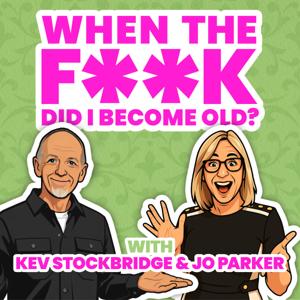
When the Fuck Did I Become Old? is the no-holds-barred podcast for everyone over 55 who is done being invisible. Co-hosted by Jo Parker and her partner Kev Stockbridge, this is real talk…
If you’re over 55 and feel like life is shifting fast physically, emotionally, financially and nobody’s talking about it properly, this is your podcast. Each episode blends Jo and Kev’s raw reflections with unfiltered conversations from guests who have lived a little (and learned a lot).
Jo and Kev’s mission? To break the silence around ageing, smash the stereotypes and make getting older something we can laugh at, cry through and fully own….together.
It’s ageing, without the airbrushing
Season 1 - The Journney Begins...
Season 2 - The Search for a Co-Host
Season 3 - A new Co-Host; my partner Kev Stockbridge
Subscribe to the podcast on Apple Podcasts or Spotify
Follow us on
Instagram https://www.instagram.com/whenthefkdidibecomeold/
Facebook https://www.facebook.com/WhenthefkdidIbecomeold/
TikTok https://www.tiktok.com/@whenthefkdid_i_becomeold
YouTube https://www.youtube.com/@WhentheFdidIbecomeold
Email us [email protected]