
Sign up to save your podcasts
Or

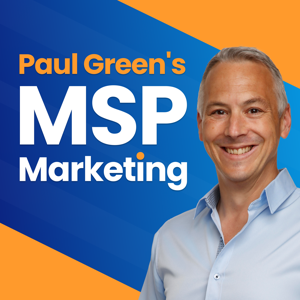

Price shopping often doesn’t start with the prospect, it starts with the MSP… find out why. Also this week, why MSPs feel overwhelmed even when things are good, and clever marketing ideas from outside the channel.
Welcome to Episode 330 of the MSP Marketing Podcast with me, Paul Green, powered by the MSP Marketing Edge.
Have you ever had a prospect say no to you because they believed your MSP was just too expensive? Lots of MSPs think that prospects default to price shopping because they’re cheap, difficult, or just not serious buyers. And it’s so easy to blame the economy or your competition or how the market is right now. But here’s the uncomfortable truth… prospects usually aren’t born price shoppers… they’re trained. And more often than not, they’re trained by the MSP itself through marketing and sales behaviour that’s well-intentioned, but hits in the totally wrong way.
Let me give you some examples so you can see if you are doing this by accident. I believe the problem of price shopping doesn’t start with the prospect, it starts with the MSP. In fact, it starts with the signals that you send through your marketing and your sales process, often without even realising it. Every interaction either trains a prospect to compare or it trains them to trust. And most MSPs accidentally train comparison, price comparison especially. Let me show you how.
One of the biggest ways that MSPs create price shoppers is by leading with services instead of leading with outcomes.
So when you talk about monitoring, patching, backups, antivirus, response times and tickets and stuff like that, you’re just listing features and that makes you look identical to every other MSP. And when things look identical, you’re just making it too difficult for the prospect to differentiate you from all the other MSPs. So the only logical way to choose is price from their point of view. You’ve taught the prospect that MSPs are interchangeable, bad, bad, bad.
Another big one is quoting too early. MSPs do rush in sometimes to give a price because they want to be helpful or they want to keep momentum or they want to avoid awkward conversations. But when you give a big number before establishing value, context, and fit, you’re effectively saying this decision is mostly about cost. So the prospect does exactly what you’d expect a rational human to do… they shop around. And by the way, that’s not a reason to not have a price estimator on your website. A price estimator that gives them a rough price in seconds is good, but jumping straight from initial conversation to quote, that’s bad. You’ve got to give them a specific quote at the very end of the process when you’ve got to know them and what they’re looking for and their outcomes and whether or not you guys are a good fit.
Then there’s the problem of treating every lead the same. If you have the same proposal template, the same pitch, you’re using the same language, it’s the same packages for everyone. If there’s no sense of personalisation, how can it feel relevant to your prospect? There’s no emotional anchor there. And when there’s no emotional anchor, again, price just floats to the top.
MSPs also train price shoppers by apologising for their pricing. People say phrases like, “Oh, I know we’re not the cheapest…” or, “Oh, we might be a bit more expensive, but…” why would you do that? ” In fact, the moment that you say that, you have framed price as the objection, you’ve invited the prospect to challenge it, which is crazy.
Another subtle one is overexplaining and justifying. When you feel the need to defend your price, line by line, then you kind of signal uncertainty and that encourages comparison.
And then there’s websites. So if your website focuses really heavily on your packages, your plans and your prices, but without anchoring value, outcomes or consequences of not doing what you suggest, then again, you’ve just built a comparison tool and not a trust building asset. You’re helping prospects to shop you by price.
Here’s the uncomfortable truth, price shoppers are rarely the problem, they are the symptom. They are the result of marketing and sales processes that remove differentiation and replace it with comparison. And the fix isn’t any kind of clever pricing tactics or discounting or handling objections better or something like that. The fix is training prospects differently from their very first touchpoint with you. That means anchoring outcomes before costs. It means talking about risk, disruption, peace of mind, predictability, and the value of sleeping well at night. It means actually slowing down sales conversations instead of rushing to get a quote out and in front of them. It means qualifying them more, making sure that the fit is right. A good fit is more important than speed. It means positioning yourself as a guide, as a trusted expert, and not a vendor.
When prospects trust you, they don’t shop you. When they believe that you understand their world, they will never compare you line by line. And when they see you as the safe choice, price becomes secondary. The MSPs who struggle the most with price shoppers are usually the ones trying the hardest to be easy to buy from. And ironically, the MSPs who make buying feel more deliberate, more thoughtful, more slower, more selective. They’re the ones who tend to attract better clients and fewer comparisons.
So if prospects are always asking you for price, always shopping around, always disappearing after proposals, don’t ask what’s wrong with them. Ask, “What have I accidentally trained them to do? ” Because once you change the training, the behaviour changes too.
Every MSP, in fact, every business owner walks around with a hassle bucket inside their head. And when that bucket overflows, everything suddenly feels harder than it should. Decisions take longer, small problems feel bigger and even tiny extra demands can tip us over the edge. If you felt that recently, you need to hear what I’ve got to say in the next three minutes.
So let me explain what I mean by the hassle bucket, because once you understand this, it does change how you look at work, stress, and leadership. The hassle bucket is simply a measure of how much hassle you can deal with at any one time. And some people seem to have very, very deep buckets. They can take on enormous amounts of pressure before they start to struggle. Other people have shallower buckets and they reach their limit much faster. And here’s the important thing. You’re not born with a fixed bucket. You can deepen it over time. And equally, it can become more shallow sometimes without you even realising. But whenever that bucket overflows, your ability to cope drops dramatically.
As business owners, especially in the channel, we tend to have deep hassle buckets. We learned that in the first few years of running a business. In fact, the depth of your bucket is often what separates people who can run a business for decades from those who burn out early. But here’s the catch. Even if your bucket is deep, it’s usually about 80% full most of the time. Just think about everything you’re juggling right now. Cashflow… which when it’s not right can be mentally destructive, staff… which is a bit like having extra children who all look to you for answers, winning new business, keeping existing clients happy, solving problems, making big decisions, and carrying responsibility. If a completely sane person looked at that list, they’d run a mile. And yet you and I, we don’t run a mile, we take it on willingly because the positives outweigh the negatives by a massive margin.
We get freedom, flexibility, and personal growth, and the opportunity to build something meaningful, the chance to change your family’s future. All of that makes it worth it. But there are points in the year, often around now actually, as we’re sort of a few months past Christmas, when the hassle bucket gets dangerously close to the top. And I know this. And the reason I wanted to talk about this in this video and on this podcast is because my hassle bucket is right near the brim right now, and it’s completely self-inflicted. Right now, I’ve got too many projects on. I’ve done too much travel. And on top of that, there’s the emotional and the time pressure of accompanying my daughter to a whole load of open days and auditions because she’s working towards going to drama school in September.
So normally I’d say my hassle bucket sits at around about 80% full, and I’ve got to be honest right now, it feels like 95% full. So here’s a simple but powerful question for you… how full is your hassle bucket today? In fact, it might be a question that you might ask yourself every single morning because when the bucket overflows, it’s rarely the big things that cause that overflow, it’s the small extra straw that breaks the camel’s back.
The answer is not to try and stop more stuff coming into the bucket, that’s unrealistic, the real answer is to install a relief tap further down the bucket.
Now, I call this the DOA relief tap, and we usually hear that acronym, DOA, on crime shows, where it means “dead on arrival”. Well, that’s not what we want as business owners. For us, DOA means delegate, outsource, automate. It’s about acknowledging that even though you’re capable, even though you’re very good at what you do, and even though part of you believes that no one can do it as well as you, there are still many things you don’t personally need to do anymore. A great mantra to live by is this… You should only do what only you can do. Let me say that again because it’s so important… You should only do what only you can do.
The business owners who thrive for decades are not the ones who try to carry everything themselves. They’re the ones who constantly look at all of the work in front of them and ask, “Who on my team could do this better, quicker, or easier than me? ” Or they ask, “Who could I outsource this to? ” Or they ask, “How can this be automated?” So maybe now is a good time for you to think about your own DOA relief tap. What does it look like? What are the tasks still sitting on your plate that don’t really need to be there anymore? What could you let go of without the business falling apart? Because the goal here is not just to remove hassle, it’s to simplify your life and protect your thinking space.
And here’s the important second part. If freeing up time means you’re just tempted to cram more work in, you’ve missed the point. The real prize is working more on the business and less in it. Take a proper lunch, go for a walk, switch off occasionally, give your brain the space it needs to think clearly. I do this whenever my hassle bucket isn’t overflowing and every time I do, I make better decisions. Because when your mind isn’t focused on desperately scooping things out of the top of the bucket, it can focus on the questions that really matter like, How do I win more clients? How do I get them to buy more? And how do I get them to choose to spend more? As the business owner, that’s where your brain does its best work.
Featured guest: Kyle Bailey is the founder of Frontburner Marketing, agency offering Local SEO, SEO, AI SEO, sales enablement, and content strategy for Home Service Businesses like Roofers, Remodelers, HVAC, Plumbers, etc… With over 15 years of experience in marketing, sales leadership, and strategic consulting, Kyle has built a reputation for helping businesses transform their online presence into sustainable growth engines.
Kyle goes by the nickname “The Home Service Hammer”, and he and his team focus on building sound websites, driving qualified traffic, improving conversion rates, and aligning digital strategies with real revenue outcomes. Every campaign is rooted in data, guided by strategy, and executed with accountability.
I recently connected with another marketing expert who really knows his stuff. In fact, the only thing he doesn’t know is the MSP world, but that’s okay because you and I are always looking for new ideas, right? And he’s got a ton of really good ideas that are working for other types of businesses, which we’re going to share with you right now. Oh, just a heads up by the way, in this interview I mention a live event that the author, Chris Voss, was due to be doing in London here in the UK. And about two days after I did this interview, that event was canceled.
I’m Kyle Bailey. I own Frontburnermarketing.net, and we specialise in sales training and online marketing for home service businesses.
And just from that very description, you might think, What are you doing on Paul’s podcast, because what’s that got to do with MSPs? And we are trying an experiment today. You see, for the last six and a half years or so, almost every single guest we’ve had on has either been from within the channel or they know the channel really, really well. Now, Kyle, you do know the channel and I know you’ve worked with MSPs in the past, but primarily these days, your focus is outside of the channel. And as you say, you work with home service businesses like HVAC, which is air conditioning for those of us that are British and plumbers and builders and all that kind of stuff. And I know you’ll tell us about that in a second.
The reason I’ve got you here is because you’ve got great marketing knowledge. And just in the 10 minutes you and I have been talking before this interview, you’ve given me some really cool ideas and I know you’re going to do exactly the same on our interview today. So an expert from outside of the channel giving advice to us here inside the channel, welcome to the show. Just tell us a little bit about your marketing career and what kind of stuff you do now for what kind of businesses.
Yeah. So I’ve been in sales and stuff for a long time before 2010. 2010 is when I started my agency. It was right when Facebook began their business page movement. Everybody thought that Facebook was going to replace Google, which has been said many times, and that didn’t happen, but that’s what launched me into the business. And I was almost immediately serving home service businesses. I grew up in the trades. So I always say I’ve been a lumberjack and a framer, but I’ve actually done everything that touches the house. I’ve installed AC, I’ve done roofing, remodeling, the whole nine yards. So I love the trades. And so I love serving them and helping them out.
Yeah, and you help them with their marketing. So that’s the websites. It’s the same problems that MSPs have, right? Which is a really good presence, credibility, authority, traffic, leads, all of those kind of things.
Right. I deal a lot with folks who have a great IRL, as the kids might say, in real life presence. They do great work, they have great reviews, but then when the customer comes to the website, there’s a letdown because that online presence doesn’t match it. So we primarily are pulling people into the 21st century as far as look and feel the website, the execution of the website, and the content piece is really big because those key points of problem solutions that they offer, that needs to be present on the website early and often. And so that’s what we’re doing most of the time for our folks.
I think it’s interesting, you and I, as I’m going to label us, marketing professionals, you and I know that many of the marketing things that MSPs need are exactly the same marketing ingredients that an HVAC firm would need. And obviously there are some differences because they’re a B2C, they’re a business to consumer business, whereas obviously the vast majority of MSPs are B2B. But yeah, you and I know the basic core ingredients are the same for any business. And it is absolutely about engaging with the right people in the right way and influencing them emotionally to pick you as well as giving their brain the right information it needs to make a decision as well.
Let’s talk about the one thing that I think your world and my world has most in common, which is differentiation. So you work with businesses that are up against quite aggressive businesses. And do you see the same problem that I see that MSPs have, which is it’s very hard for one MSP to differentiate from another?
Yeah. And I would say that MSPs have it a little worse for lots of reasons, mainly because if I’m a business owner, I don’t really know what an MSP does, right? HVAC company fixes my AC. I know that, but that in itself becomes a problem because every HVAC company is saying the same thing. So how do you differentiate? That’s always the thing. How do you make yourself stand out? And I’m actually writing a book that’ll be out here within a couple of weeks and it’s going to be called, What’s Your Story? I don’t have the byline for it yet, but the main title is What’s Your Story, Connecting Your Story to Your Ideal Client’s Story.
One of the podcasts I listened to on your channel was really important because he was talking about how questions that he asked uncovered problems that he didn’t know to ask about.
I think the most important thing for any business and any sales process is to ask questions.
The worst thing you can do going into any type of sales, whether it’s content or an in-person sales presentation, is to go in thinking that you kind of have a handle on everything, and not being curious. Because it’s when you ask that one more question, Tell me more about that. Have you ever heard of Chris Voss, he talks a lot about, sounds like, seems like, feels like. So the two principles he brought to bear for me that just changed my life, even my personal life, because I use it in everything. So sales training, personal life, everything. Sounds like, seems like, feels like. So it sounds like you’re interested in this differentiation thing and you ask it in a curious way, sometimes with an uplift on the back and then mirroring the last three things, the last three to five words they said.
If you use that and then try to work it in even into your content, open up places for curiosity. Are you curious about this? Do you have more questions about this? Those are great places to have engagements on your website and then you want to measure all that so that you’re getting these points of pain being revealed. Pain revelation would be a good way to say it. And so these customers are volunteering this pain that they have. Now you just reverse engineer that and talk about that in the front. Tired of this, tired of not even knowing what your … Do you know what your cap is on your WIFI? That was one of the episodes we were talking about. Did you know you even had one? Did you know that could be killing your business? Things like that, things that like the kind of hook that says I might not know something that’s hurting me is really powerful. And I would think in MSP, there’s a treasure trove of those.
Oh, absolutely. Now I’m going to pause that for two seconds. We are going to come back to that because I have a follow-up question. I must first of all explain who Chris Voss is. So Chris Voss is the former FBI chief negotiator, Hostage Negotiator. He wrote a book, it’s one of the best books. In fact, I’m pretty sure it’s behind me – Never Split the Difference. There we go. For those not watching on YouTube, I’ve just pulled a book off the shelf. Never Split the Difference by Chris Foss. It’s one of the best books on sales you’ll ever read because it’s not about sales. It’s about how to stop hostages getting killed. And actually, I’m going to see Chris in London, I think in like a month’s time, he’s sold out a stadium to do a talk or to do it like a day, which is crazy. So I’m looking forward to that one. It’s amazing. And for all the MSPs watching this, and listening to this, get that book, Never Split the Difference, Chris Voss.
So back to what you were saying. So you’re saying that one of the routes, because obviously there’s always lots of different ways of doing something, but one of the routes for differentiation that you see works well is where you explore someone’s unknown pains. So the example you gave, and I know the interview you’re talking about of one of our previous podcast episodes, and our guest was talking about that the client was frustrated with their WIFI speeds, and they didn’t know that the WIFI speeds were being capped by whatever it was. And then the MSP became the hero by figuring out there’s a cap in the first place and then removing the cap. And so give us a practical example, Kyle, because MSPs are uncovering those kind of things all the time, how do you know which are the ones which will attract other future clients and which are the ones which just a bit too techy and aren’t relevant?
Yeah. I think a strategy session with somebody outside is a great way. Somebody who understands how to ask questions is really, really powerful because it’s the forest for the trees thing, right? You get so close to your business and what you’re doing every day, you don’t realise the difference between this and this. This is the normal thing. This is the one that’s outstanding that will blow the doors open on your business because people don’t know this one as well. And so getting outside counsel, that’s one of those places where it’s really powerful, but getting some kind of breakdown of what you do every day, probably doing this a couple of times a year, just going, “Okay, what are the most common questions we had in the last year?” I would imagine that even MSP is getting hit by the AI questions. Can I just get AI to run my MSP? Will AI do this? Then you start recycling that into producing new content, new interviews, new whatever you’re putting out there, social media post.
So what you’re doing is you’re taking their story because their pains and fears, like what are the top five fears about engaging with the MSP provider? What are the top five horror stories that you already know about? You know this deal well enough, they probably already popped in your head. And so how do you turn that around into content that’s going to be customer facing? And then that encounters them as they’re walking in metaphorically to your business, because they’re going to check you out online first, especially for MSP, right? So what is that welcome map that meets them? Is it just another generic bank of servers? We were talking about people using the same stock photo. Go out there and look at your top 10 competition and what does it look like? How can you be different and still meet their need? You don’t want to put a stuffed animal on the front of your website to be different, right? But you want to find out a way that you’re throwing a curve ball, everybody else is throwing a fastball. That’s kind of where it comes … That’s baseball metaphor. I don’t know if that works.
Yeah, a baseball metaphor works with everything, I think. But yeah, no, I love that. And I think what I like about this approach is it’s so completely different from what most MSPs do. So I’m sure you have the same experience with the industries you serve. In fact, just at the back end of 2025, I did a thing in my MSP marketing Facebook group where I offered a mini website review and I did about 50 of them in a week. And so it was a real reminder for me, just let’s say 47 of those websites were the same. And these are websites of MSPs all over the world and 47 of them very similar. The same tired headline, the same kind of stock images, the same layout, lacking in customer testimonials. There’s no price calculator, which of course you can get from mspriceguide.com, which is one of my services. The call to action was very rarely there… a live calendar, which is best practice for people to book a 15 minute interview. They all felt the same and all looked the same.
And you’ve just given us one completely different approach there to differentiate the business just at the website level, which is actually look at either what are the core problems they have that are holding them back, or a separate approach is what do they fear moving from one MSP to another? Because we know when someone gets onto your website, they’re already in the research phase and they’re thinking of switching MSPs. That’s why something like an IT services buyer’s guide is such a smart thing to have on your website, which you can again, plug, plug, plug, you can get from the mspmarketingedge.com. You’ve got to do it, haven’t you, Karl, right? But someone would only go on your website if they’re thinking of switching to you. So what if your differentiation was right from the get- go of, are you scared of these things? Because we know that people don’t want to leave their MSP. They’re scared of switching. Inertia loyalty keeps them with an MSP they don’t like. So why don’t you address that upfront? I think that’s a really, really smart idea.
Let’s wrap up what we’re talking about here with a quick fire for you. So I think you and I could talk about differentiation for hours, but I want to just throw in some other random ideas. So you work with all of these home service businesses. Throw out for us right now things that you see, whether that be tactics, strategies, small things, big things, paid or organic, paid or free or whatever, stuff you’re seeing right now that’s working. And let’s see if we can just see if any of those would apply to MSPs and could be an idea that we’d perhaps have never thought of.
Yeah. I can think of one right off the top of my head. Local service pages, you were talking about serving different counties and different areas. People search. So I’m 56 and one of the fascinating things to me that I really love to look at is just data of how people search. And so for me, my generation searches . So I’m looking, I live near Cedar Park, Texas. Cedar Park Plumber, Cedar Park HVAC company/AC repairs, what we call it in Texas, because it’s only hot here, it doesn’t really get cold, so we never talk about heaters. So I’m looking for Cedar Park, but what has happened over the last 15 years evidently is that has shifted. Now it’s . That’s how the majority of homeowners search now. And so number one, understand how your market searches. That’s number one. Do not use industry terms and jargon when you’re thinking about keywords. Don’t build your content based on how you think of it. I call it lead a horse to water content. So your concept, you might have some technical concept that’s really important that the customer call it a ASW-1, because if they don’t, then blah, blah, blah, whatever, I’m making stuff up here. But they might call it a water well, right? And they come in on water well, but you lead them over to the idea, actually what you want to call this is an ASW one.
What people fear about, like in Texas, one of the things is this is a no licensed state. And so roofers are big about being scam artists, unfortunately, because I can come to your house, get a check for $7-8,000, throw a couple of guys on your roof, tear off some shingles, “Hey, we’ll be back tomorrow and never come back.” That’s not uncommon whatsoever. So the first fear, my neighbor, Sam over here got ripped off by a roofer the other day, so the first thing I’m thinking when I call you is, Oh, I don’t want that to happen. So I might have content on my website that says, Here’s how you understand a roofing scam. If they ask you for money upfront blah, blah, blah. So what are your top five fears that you’re facing? That’s number one. The other one is the location piece. So like I was talking about before, Cedar Park, roofers or roofers, Cedar Park, you want to build a page with that. And the mistake people make all the time is they put services as the divider. So my mspwebsite.com, and then when I go to list my services, it’s /services. Well, what most people don’t understand is that’s a keyword. Nobody goes online looking for MSP services and searches services. They’re searching for managed service providers. They’re searching for outsourced IT. What are some other common keywords in that space?
So actually a managed service provider is internal jargon. So IT support is what ordinary people call it as a great example. But yeah, you’re right. They might be searching for cyber security, they might be searching for specific problems. Often it’s a problem-based approach, but yeah, that’s a really good example.
So then IT services, Birmingham, I know I’m probably not pronouncing that right.
No, you’re right.
Well, in Texas, we say Birmingham. We spend a lot more time on the Ham in Texas. But yeah, so you want to have that in the actual URL. So my mspwebsite.com /MSP services or IT services, whatever makes the most sense, /IT services Birmingham. That’s how you want to build that page. And that alone will get you traffic. And guess what? Every single person who looks up IT Services Birmingham is interested in buying IT services in Birmingham. But every person who looks up IT services isn’t necessarily a buyer. But once they attach a location name to it, that’s a buyer. And so now your exposure in front of people ready to buy goes way up. Those pages are way easier to rank because you’re not fighting with every .com out there. You’re only fighting with people that are tagged to that page and most people don’t do it. So it’s an easy win.
That’s such great advice. Thank you so much, Kyle. So just for those MSPs that you mentioned sales training a couple of times that you do, and obviously sales training that you would do would be completely applicable to MSPs. So for those MSPs that want to have a chat with you about that, or just reach out to you and connect with you, what’s the best way to get in touch?
My website frontburnermarketing.net, like a front burner on your stove. Just reach out there. LinkedIn and Facebook, I’m the Kyle Bailey. But you can reach me at any of those places. And look for my book here in a couple of weeks, What’s Your Story?
This podcast has been released on the 10th of March, and that means brand new content for the members of my MSP Marketing Edge membership. On the 10th of every month, we release new content. Today, we just dropped it all into the portal, all of the content for April 2026. What we do is we give our members a 3-step marketing system that they can use to generate leads and all of the content they need to implement that system.
That’s videos, blogs, Google business profile updates, LinkedIn newsletters, other social content, including posts, videos, images, PDFs, carousels, and infographics. Plus, there’s a full marketing campaign, including a physical postcard to mail out, emails, and a script for your telephone person. And there’s also a printed newsletter for you to send to your hottest prospects. So much here, and this is just some of the new marketing content that we drop on the 10th of every month.
So if you fancy some of that for your MSP, just be aware that we do only work with one MSP per area. You can check if your area is locked or available by entering your postcode or your zip code at mspmarketingedge.com/membership.
 View all episodes
 By Paul Green's MSP Marketing Edge

4.6
1717 ratings
Price shopping often doesn’t start with the prospect, it starts with the MSP… find out why. Also this week, why MSPs feel overwhelmed even when things are good, and clever marketing ideas from outside the channel.
Welcome to Episode 330 of the MSP Marketing Podcast with me, Paul Green, powered by the MSP Marketing Edge.
Have you ever had a prospect say no to you because they believed your MSP was just too expensive? Lots of MSPs think that prospects default to price shopping because they’re cheap, difficult, or just not serious buyers. And it’s so easy to blame the economy or your competition or how the market is right now. But here’s the uncomfortable truth… prospects usually aren’t born price shoppers… they’re trained. And more often than not, they’re trained by the MSP itself through marketing and sales behaviour that’s well-intentioned, but hits in the totally wrong way.
Let me give you some examples so you can see if you are doing this by accident. I believe the problem of price shopping doesn’t start with the prospect, it starts with the MSP. In fact, it starts with the signals that you send through your marketing and your sales process, often without even realising it. Every interaction either trains a prospect to compare or it trains them to trust. And most MSPs accidentally train comparison, price comparison especially. Let me show you how.
One of the biggest ways that MSPs create price shoppers is by leading with services instead of leading with outcomes.
So when you talk about monitoring, patching, backups, antivirus, response times and tickets and stuff like that, you’re just listing features and that makes you look identical to every other MSP. And when things look identical, you’re just making it too difficult for the prospect to differentiate you from all the other MSPs. So the only logical way to choose is price from their point of view. You’ve taught the prospect that MSPs are interchangeable, bad, bad, bad.
Another big one is quoting too early. MSPs do rush in sometimes to give a price because they want to be helpful or they want to keep momentum or they want to avoid awkward conversations. But when you give a big number before establishing value, context, and fit, you’re effectively saying this decision is mostly about cost. So the prospect does exactly what you’d expect a rational human to do… they shop around. And by the way, that’s not a reason to not have a price estimator on your website. A price estimator that gives them a rough price in seconds is good, but jumping straight from initial conversation to quote, that’s bad. You’ve got to give them a specific quote at the very end of the process when you’ve got to know them and what they’re looking for and their outcomes and whether or not you guys are a good fit.
Then there’s the problem of treating every lead the same. If you have the same proposal template, the same pitch, you’re using the same language, it’s the same packages for everyone. If there’s no sense of personalisation, how can it feel relevant to your prospect? There’s no emotional anchor there. And when there’s no emotional anchor, again, price just floats to the top.
MSPs also train price shoppers by apologising for their pricing. People say phrases like, “Oh, I know we’re not the cheapest…” or, “Oh, we might be a bit more expensive, but…” why would you do that? ” In fact, the moment that you say that, you have framed price as the objection, you’ve invited the prospect to challenge it, which is crazy.
Another subtle one is overexplaining and justifying. When you feel the need to defend your price, line by line, then you kind of signal uncertainty and that encourages comparison.
And then there’s websites. So if your website focuses really heavily on your packages, your plans and your prices, but without anchoring value, outcomes or consequences of not doing what you suggest, then again, you’ve just built a comparison tool and not a trust building asset. You’re helping prospects to shop you by price.
Here’s the uncomfortable truth, price shoppers are rarely the problem, they are the symptom. They are the result of marketing and sales processes that remove differentiation and replace it with comparison. And the fix isn’t any kind of clever pricing tactics or discounting or handling objections better or something like that. The fix is training prospects differently from their very first touchpoint with you. That means anchoring outcomes before costs. It means talking about risk, disruption, peace of mind, predictability, and the value of sleeping well at night. It means actually slowing down sales conversations instead of rushing to get a quote out and in front of them. It means qualifying them more, making sure that the fit is right. A good fit is more important than speed. It means positioning yourself as a guide, as a trusted expert, and not a vendor.
When prospects trust you, they don’t shop you. When they believe that you understand their world, they will never compare you line by line. And when they see you as the safe choice, price becomes secondary. The MSPs who struggle the most with price shoppers are usually the ones trying the hardest to be easy to buy from. And ironically, the MSPs who make buying feel more deliberate, more thoughtful, more slower, more selective. They’re the ones who tend to attract better clients and fewer comparisons.
So if prospects are always asking you for price, always shopping around, always disappearing after proposals, don’t ask what’s wrong with them. Ask, “What have I accidentally trained them to do? ” Because once you change the training, the behaviour changes too.
Every MSP, in fact, every business owner walks around with a hassle bucket inside their head. And when that bucket overflows, everything suddenly feels harder than it should. Decisions take longer, small problems feel bigger and even tiny extra demands can tip us over the edge. If you felt that recently, you need to hear what I’ve got to say in the next three minutes.
So let me explain what I mean by the hassle bucket, because once you understand this, it does change how you look at work, stress, and leadership. The hassle bucket is simply a measure of how much hassle you can deal with at any one time. And some people seem to have very, very deep buckets. They can take on enormous amounts of pressure before they start to struggle. Other people have shallower buckets and they reach their limit much faster. And here’s the important thing. You’re not born with a fixed bucket. You can deepen it over time. And equally, it can become more shallow sometimes without you even realising. But whenever that bucket overflows, your ability to cope drops dramatically.
As business owners, especially in the channel, we tend to have deep hassle buckets. We learned that in the first few years of running a business. In fact, the depth of your bucket is often what separates people who can run a business for decades from those who burn out early. But here’s the catch. Even if your bucket is deep, it’s usually about 80% full most of the time. Just think about everything you’re juggling right now. Cashflow… which when it’s not right can be mentally destructive, staff… which is a bit like having extra children who all look to you for answers, winning new business, keeping existing clients happy, solving problems, making big decisions, and carrying responsibility. If a completely sane person looked at that list, they’d run a mile. And yet you and I, we don’t run a mile, we take it on willingly because the positives outweigh the negatives by a massive margin.
We get freedom, flexibility, and personal growth, and the opportunity to build something meaningful, the chance to change your family’s future. All of that makes it worth it. But there are points in the year, often around now actually, as we’re sort of a few months past Christmas, when the hassle bucket gets dangerously close to the top. And I know this. And the reason I wanted to talk about this in this video and on this podcast is because my hassle bucket is right near the brim right now, and it’s completely self-inflicted. Right now, I’ve got too many projects on. I’ve done too much travel. And on top of that, there’s the emotional and the time pressure of accompanying my daughter to a whole load of open days and auditions because she’s working towards going to drama school in September.
So normally I’d say my hassle bucket sits at around about 80% full, and I’ve got to be honest right now, it feels like 95% full. So here’s a simple but powerful question for you… how full is your hassle bucket today? In fact, it might be a question that you might ask yourself every single morning because when the bucket overflows, it’s rarely the big things that cause that overflow, it’s the small extra straw that breaks the camel’s back.
The answer is not to try and stop more stuff coming into the bucket, that’s unrealistic, the real answer is to install a relief tap further down the bucket.
Now, I call this the DOA relief tap, and we usually hear that acronym, DOA, on crime shows, where it means “dead on arrival”. Well, that’s not what we want as business owners. For us, DOA means delegate, outsource, automate. It’s about acknowledging that even though you’re capable, even though you’re very good at what you do, and even though part of you believes that no one can do it as well as you, there are still many things you don’t personally need to do anymore. A great mantra to live by is this… You should only do what only you can do. Let me say that again because it’s so important… You should only do what only you can do.
The business owners who thrive for decades are not the ones who try to carry everything themselves. They’re the ones who constantly look at all of the work in front of them and ask, “Who on my team could do this better, quicker, or easier than me? ” Or they ask, “Who could I outsource this to? ” Or they ask, “How can this be automated?” So maybe now is a good time for you to think about your own DOA relief tap. What does it look like? What are the tasks still sitting on your plate that don’t really need to be there anymore? What could you let go of without the business falling apart? Because the goal here is not just to remove hassle, it’s to simplify your life and protect your thinking space.
And here’s the important second part. If freeing up time means you’re just tempted to cram more work in, you’ve missed the point. The real prize is working more on the business and less in it. Take a proper lunch, go for a walk, switch off occasionally, give your brain the space it needs to think clearly. I do this whenever my hassle bucket isn’t overflowing and every time I do, I make better decisions. Because when your mind isn’t focused on desperately scooping things out of the top of the bucket, it can focus on the questions that really matter like, How do I win more clients? How do I get them to buy more? And how do I get them to choose to spend more? As the business owner, that’s where your brain does its best work.
Featured guest: Kyle Bailey is the founder of Frontburner Marketing, agency offering Local SEO, SEO, AI SEO, sales enablement, and content strategy for Home Service Businesses like Roofers, Remodelers, HVAC, Plumbers, etc… With over 15 years of experience in marketing, sales leadership, and strategic consulting, Kyle has built a reputation for helping businesses transform their online presence into sustainable growth engines.
Kyle goes by the nickname “The Home Service Hammer”, and he and his team focus on building sound websites, driving qualified traffic, improving conversion rates, and aligning digital strategies with real revenue outcomes. Every campaign is rooted in data, guided by strategy, and executed with accountability.
I recently connected with another marketing expert who really knows his stuff. In fact, the only thing he doesn’t know is the MSP world, but that’s okay because you and I are always looking for new ideas, right? And he’s got a ton of really good ideas that are working for other types of businesses, which we’re going to share with you right now. Oh, just a heads up by the way, in this interview I mention a live event that the author, Chris Voss, was due to be doing in London here in the UK. And about two days after I did this interview, that event was canceled.
I’m Kyle Bailey. I own Frontburnermarketing.net, and we specialise in sales training and online marketing for home service businesses.
And just from that very description, you might think, What are you doing on Paul’s podcast, because what’s that got to do with MSPs? And we are trying an experiment today. You see, for the last six and a half years or so, almost every single guest we’ve had on has either been from within the channel or they know the channel really, really well. Now, Kyle, you do know the channel and I know you’ve worked with MSPs in the past, but primarily these days, your focus is outside of the channel. And as you say, you work with home service businesses like HVAC, which is air conditioning for those of us that are British and plumbers and builders and all that kind of stuff. And I know you’ll tell us about that in a second.
The reason I’ve got you here is because you’ve got great marketing knowledge. And just in the 10 minutes you and I have been talking before this interview, you’ve given me some really cool ideas and I know you’re going to do exactly the same on our interview today. So an expert from outside of the channel giving advice to us here inside the channel, welcome to the show. Just tell us a little bit about your marketing career and what kind of stuff you do now for what kind of businesses.
Yeah. So I’ve been in sales and stuff for a long time before 2010. 2010 is when I started my agency. It was right when Facebook began their business page movement. Everybody thought that Facebook was going to replace Google, which has been said many times, and that didn’t happen, but that’s what launched me into the business. And I was almost immediately serving home service businesses. I grew up in the trades. So I always say I’ve been a lumberjack and a framer, but I’ve actually done everything that touches the house. I’ve installed AC, I’ve done roofing, remodeling, the whole nine yards. So I love the trades. And so I love serving them and helping them out.
Yeah, and you help them with their marketing. So that’s the websites. It’s the same problems that MSPs have, right? Which is a really good presence, credibility, authority, traffic, leads, all of those kind of things.
Right. I deal a lot with folks who have a great IRL, as the kids might say, in real life presence. They do great work, they have great reviews, but then when the customer comes to the website, there’s a letdown because that online presence doesn’t match it. So we primarily are pulling people into the 21st century as far as look and feel the website, the execution of the website, and the content piece is really big because those key points of problem solutions that they offer, that needs to be present on the website early and often. And so that’s what we’re doing most of the time for our folks.
I think it’s interesting, you and I, as I’m going to label us, marketing professionals, you and I know that many of the marketing things that MSPs need are exactly the same marketing ingredients that an HVAC firm would need. And obviously there are some differences because they’re a B2C, they’re a business to consumer business, whereas obviously the vast majority of MSPs are B2B. But yeah, you and I know the basic core ingredients are the same for any business. And it is absolutely about engaging with the right people in the right way and influencing them emotionally to pick you as well as giving their brain the right information it needs to make a decision as well.
Let’s talk about the one thing that I think your world and my world has most in common, which is differentiation. So you work with businesses that are up against quite aggressive businesses. And do you see the same problem that I see that MSPs have, which is it’s very hard for one MSP to differentiate from another?
Yeah. And I would say that MSPs have it a little worse for lots of reasons, mainly because if I’m a business owner, I don’t really know what an MSP does, right? HVAC company fixes my AC. I know that, but that in itself becomes a problem because every HVAC company is saying the same thing. So how do you differentiate? That’s always the thing. How do you make yourself stand out? And I’m actually writing a book that’ll be out here within a couple of weeks and it’s going to be called, What’s Your Story? I don’t have the byline for it yet, but the main title is What’s Your Story, Connecting Your Story to Your Ideal Client’s Story.
One of the podcasts I listened to on your channel was really important because he was talking about how questions that he asked uncovered problems that he didn’t know to ask about.
I think the most important thing for any business and any sales process is to ask questions.
The worst thing you can do going into any type of sales, whether it’s content or an in-person sales presentation, is to go in thinking that you kind of have a handle on everything, and not being curious. Because it’s when you ask that one more question, Tell me more about that. Have you ever heard of Chris Voss, he talks a lot about, sounds like, seems like, feels like. So the two principles he brought to bear for me that just changed my life, even my personal life, because I use it in everything. So sales training, personal life, everything. Sounds like, seems like, feels like. So it sounds like you’re interested in this differentiation thing and you ask it in a curious way, sometimes with an uplift on the back and then mirroring the last three things, the last three to five words they said.
If you use that and then try to work it in even into your content, open up places for curiosity. Are you curious about this? Do you have more questions about this? Those are great places to have engagements on your website and then you want to measure all that so that you’re getting these points of pain being revealed. Pain revelation would be a good way to say it. And so these customers are volunteering this pain that they have. Now you just reverse engineer that and talk about that in the front. Tired of this, tired of not even knowing what your … Do you know what your cap is on your WIFI? That was one of the episodes we were talking about. Did you know you even had one? Did you know that could be killing your business? Things like that, things that like the kind of hook that says I might not know something that’s hurting me is really powerful. And I would think in MSP, there’s a treasure trove of those.
Oh, absolutely. Now I’m going to pause that for two seconds. We are going to come back to that because I have a follow-up question. I must first of all explain who Chris Voss is. So Chris Voss is the former FBI chief negotiator, Hostage Negotiator. He wrote a book, it’s one of the best books. In fact, I’m pretty sure it’s behind me – Never Split the Difference. There we go. For those not watching on YouTube, I’ve just pulled a book off the shelf. Never Split the Difference by Chris Foss. It’s one of the best books on sales you’ll ever read because it’s not about sales. It’s about how to stop hostages getting killed. And actually, I’m going to see Chris in London, I think in like a month’s time, he’s sold out a stadium to do a talk or to do it like a day, which is crazy. So I’m looking forward to that one. It’s amazing. And for all the MSPs watching this, and listening to this, get that book, Never Split the Difference, Chris Voss.
So back to what you were saying. So you’re saying that one of the routes, because obviously there’s always lots of different ways of doing something, but one of the routes for differentiation that you see works well is where you explore someone’s unknown pains. So the example you gave, and I know the interview you’re talking about of one of our previous podcast episodes, and our guest was talking about that the client was frustrated with their WIFI speeds, and they didn’t know that the WIFI speeds were being capped by whatever it was. And then the MSP became the hero by figuring out there’s a cap in the first place and then removing the cap. And so give us a practical example, Kyle, because MSPs are uncovering those kind of things all the time, how do you know which are the ones which will attract other future clients and which are the ones which just a bit too techy and aren’t relevant?
Yeah. I think a strategy session with somebody outside is a great way. Somebody who understands how to ask questions is really, really powerful because it’s the forest for the trees thing, right? You get so close to your business and what you’re doing every day, you don’t realise the difference between this and this. This is the normal thing. This is the one that’s outstanding that will blow the doors open on your business because people don’t know this one as well. And so getting outside counsel, that’s one of those places where it’s really powerful, but getting some kind of breakdown of what you do every day, probably doing this a couple of times a year, just going, “Okay, what are the most common questions we had in the last year?” I would imagine that even MSP is getting hit by the AI questions. Can I just get AI to run my MSP? Will AI do this? Then you start recycling that into producing new content, new interviews, new whatever you’re putting out there, social media post.
So what you’re doing is you’re taking their story because their pains and fears, like what are the top five fears about engaging with the MSP provider? What are the top five horror stories that you already know about? You know this deal well enough, they probably already popped in your head. And so how do you turn that around into content that’s going to be customer facing? And then that encounters them as they’re walking in metaphorically to your business, because they’re going to check you out online first, especially for MSP, right? So what is that welcome map that meets them? Is it just another generic bank of servers? We were talking about people using the same stock photo. Go out there and look at your top 10 competition and what does it look like? How can you be different and still meet their need? You don’t want to put a stuffed animal on the front of your website to be different, right? But you want to find out a way that you’re throwing a curve ball, everybody else is throwing a fastball. That’s kind of where it comes … That’s baseball metaphor. I don’t know if that works.
Yeah, a baseball metaphor works with everything, I think. But yeah, no, I love that. And I think what I like about this approach is it’s so completely different from what most MSPs do. So I’m sure you have the same experience with the industries you serve. In fact, just at the back end of 2025, I did a thing in my MSP marketing Facebook group where I offered a mini website review and I did about 50 of them in a week. And so it was a real reminder for me, just let’s say 47 of those websites were the same. And these are websites of MSPs all over the world and 47 of them very similar. The same tired headline, the same kind of stock images, the same layout, lacking in customer testimonials. There’s no price calculator, which of course you can get from mspriceguide.com, which is one of my services. The call to action was very rarely there… a live calendar, which is best practice for people to book a 15 minute interview. They all felt the same and all looked the same.
And you’ve just given us one completely different approach there to differentiate the business just at the website level, which is actually look at either what are the core problems they have that are holding them back, or a separate approach is what do they fear moving from one MSP to another? Because we know when someone gets onto your website, they’re already in the research phase and they’re thinking of switching MSPs. That’s why something like an IT services buyer’s guide is such a smart thing to have on your website, which you can again, plug, plug, plug, you can get from the mspmarketingedge.com. You’ve got to do it, haven’t you, Karl, right? But someone would only go on your website if they’re thinking of switching to you. So what if your differentiation was right from the get- go of, are you scared of these things? Because we know that people don’t want to leave their MSP. They’re scared of switching. Inertia loyalty keeps them with an MSP they don’t like. So why don’t you address that upfront? I think that’s a really, really smart idea.
Let’s wrap up what we’re talking about here with a quick fire for you. So I think you and I could talk about differentiation for hours, but I want to just throw in some other random ideas. So you work with all of these home service businesses. Throw out for us right now things that you see, whether that be tactics, strategies, small things, big things, paid or organic, paid or free or whatever, stuff you’re seeing right now that’s working. And let’s see if we can just see if any of those would apply to MSPs and could be an idea that we’d perhaps have never thought of.
Yeah. I can think of one right off the top of my head. Local service pages, you were talking about serving different counties and different areas. People search. So I’m 56 and one of the fascinating things to me that I really love to look at is just data of how people search. And so for me, my generation searches . So I’m looking, I live near Cedar Park, Texas. Cedar Park Plumber, Cedar Park HVAC company/AC repairs, what we call it in Texas, because it’s only hot here, it doesn’t really get cold, so we never talk about heaters. So I’m looking for Cedar Park, but what has happened over the last 15 years evidently is that has shifted. Now it’s . That’s how the majority of homeowners search now. And so number one, understand how your market searches. That’s number one. Do not use industry terms and jargon when you’re thinking about keywords. Don’t build your content based on how you think of it. I call it lead a horse to water content. So your concept, you might have some technical concept that’s really important that the customer call it a ASW-1, because if they don’t, then blah, blah, blah, whatever, I’m making stuff up here. But they might call it a water well, right? And they come in on water well, but you lead them over to the idea, actually what you want to call this is an ASW one.
What people fear about, like in Texas, one of the things is this is a no licensed state. And so roofers are big about being scam artists, unfortunately, because I can come to your house, get a check for $7-8,000, throw a couple of guys on your roof, tear off some shingles, “Hey, we’ll be back tomorrow and never come back.” That’s not uncommon whatsoever. So the first fear, my neighbor, Sam over here got ripped off by a roofer the other day, so the first thing I’m thinking when I call you is, Oh, I don’t want that to happen. So I might have content on my website that says, Here’s how you understand a roofing scam. If they ask you for money upfront blah, blah, blah. So what are your top five fears that you’re facing? That’s number one. The other one is the location piece. So like I was talking about before, Cedar Park, roofers or roofers, Cedar Park, you want to build a page with that. And the mistake people make all the time is they put services as the divider. So my mspwebsite.com, and then when I go to list my services, it’s /services. Well, what most people don’t understand is that’s a keyword. Nobody goes online looking for MSP services and searches services. They’re searching for managed service providers. They’re searching for outsourced IT. What are some other common keywords in that space?
So actually a managed service provider is internal jargon. So IT support is what ordinary people call it as a great example. But yeah, you’re right. They might be searching for cyber security, they might be searching for specific problems. Often it’s a problem-based approach, but yeah, that’s a really good example.
So then IT services, Birmingham, I know I’m probably not pronouncing that right.
No, you’re right.
Well, in Texas, we say Birmingham. We spend a lot more time on the Ham in Texas. But yeah, so you want to have that in the actual URL. So my mspwebsite.com /MSP services or IT services, whatever makes the most sense, /IT services Birmingham. That’s how you want to build that page. And that alone will get you traffic. And guess what? Every single person who looks up IT Services Birmingham is interested in buying IT services in Birmingham. But every person who looks up IT services isn’t necessarily a buyer. But once they attach a location name to it, that’s a buyer. And so now your exposure in front of people ready to buy goes way up. Those pages are way easier to rank because you’re not fighting with every .com out there. You’re only fighting with people that are tagged to that page and most people don’t do it. So it’s an easy win.
That’s such great advice. Thank you so much, Kyle. So just for those MSPs that you mentioned sales training a couple of times that you do, and obviously sales training that you would do would be completely applicable to MSPs. So for those MSPs that want to have a chat with you about that, or just reach out to you and connect with you, what’s the best way to get in touch?
My website frontburnermarketing.net, like a front burner on your stove. Just reach out there. LinkedIn and Facebook, I’m the Kyle Bailey. But you can reach me at any of those places. And look for my book here in a couple of weeks, What’s Your Story?
This podcast has been released on the 10th of March, and that means brand new content for the members of my MSP Marketing Edge membership. On the 10th of every month, we release new content. Today, we just dropped it all into the portal, all of the content for April 2026. What we do is we give our members a 3-step marketing system that they can use to generate leads and all of the content they need to implement that system.
That’s videos, blogs, Google business profile updates, LinkedIn newsletters, other social content, including posts, videos, images, PDFs, carousels, and infographics. Plus, there’s a full marketing campaign, including a physical postcard to mail out, emails, and a script for your telephone person. And there’s also a printed newsletter for you to send to your hottest prospects. So much here, and this is just some of the new marketing content that we drop on the 10th of every month.
So if you fancy some of that for your MSP, just be aware that we do only work with one MSP per area. You can check if your area is locked or available by entering your postcode or your zip code at mspmarketingedge.com/membership.

32,246 Listeners

30,609 Listeners
362 Listeners
5 Listeners
8,077 Listeners
2 Listeners
9 Listeners