
Sign up to save your podcasts
Or


How do we learn? Usually from experience, of course. Maybe we visit some new place, or encounter a new tool or trick. Or perhaps we learn from someone else—from a teacher or friend or YouTube star who relays some shiny new fact or explanation. These are the kinds of experiences you probably first think of when you think of learning. But we can also learn in another way: simply by thinking. Sometimes we can just set our minds to work—just let the ideas already in our heads tumble around and spark off each other—and, as if by magic, come away with a new understanding of the world. But how does this happen exactly? And does it only happen in humans?
My guest today is Dr. Tania Lombrozo. Tania is a Professor of Psychology at Princeton University; she and her research group study learning, reasoning, explanation, belief, and more. In a recent paper, Tania outlines this puzzling alternative form of learning—learning by thinking, as it's known—and presents evidence that it happens in both humans and AIs.
In this conversation, Tania and I talk about her longstanding work on explanation, and how it led her to study this less-obvious form of learning. We zoom in on four flavors of learning by thinking—learning through explanation, through simulation, through analogy, and through reasoning. We talk about the evidence that machines also learn in this way, and we consider whether animals could, too. We discuss how to resolve the paradox at the heart of "learning by thinking": how it could be that reshuffling old bits of knowledge can actually lead to new understanding. Along the way, Tania and I touch on: chain-of-thought prompting in LLMs, the Reddit community 'Explain Like I'm Five,' the illusion of explanatory depth, the power of thought experiments, Darwin and Galileo, imagination and rationalization, how psychology and philosophy complement each other, and whether we can also learn—not just by thinking in our proverbial armchairs—but also by writing and talking.
So, happy 2025, friends! We've got some great stuff lined up for the coming year. If you like what we're doing with the show, we would—as ever—appreciate your support. And the main way you can support us is just by helping us get the word out—by telling a friend about us, or a colleague, or a student, or your thousands of social media followers.
Alright, without further ado, on to my conversation with Dr. Tania Lombrozo. Enjoy!
A transcript of this episode is available here.
Notes and links
3:30 – An influential early paper on "chain-of-thought prompting" in Large Language Models. A recent preprint by a team, including Dr. Lombrozo, exploring the cases where "chain-of-thought prompting" actually impairs performance in LLMs.
8:00 – For some of Dr. Lombrozo's important earlier work on explanation, see here and here.
11:15 – The Reddit community 'Explain Like I'm Five.'
13:00 – An early paper on the "curse of knowledge"—the difficulty of ignoring what you know.
19:00 – Dr. Lombrozo's recent review article on "learning by thinking" is here. Another article of hers on the same topic is here.
20:00 – The original report of the "self-explanation" effect. The original report of the "illusion of explanatory depth."
30:00 – For a basic description of Galileo's falling bodies thought experiment, see here. A discussion of this thought experiment by philosopher Tamar Gendler.
38:00 – For analysis of Darwin's analogy between artificial and natural selection, see here and here.
42:00 – A paper on rationalization by Fiery Cushman.
48:00 – A paper from Dr. Lombrozo's lab on "need for explanation." The original paper describing the construct of "need for cognition."
52:00 – The original report of "framing effects" by Tversky and Kahneman.
54:00 – A paper by Annette Karmiloff-Smith discussing "representational redescription."
1:02:00 – A recent overview of issues surrounding "explainable" AI.
Recommendations
Alison Gopnik, Andrew Meltzoff, & Patricia Kuhl, The Scientist in the Crib
Frank Keil, Wonder: Childhood and the Lifelong Love of Science
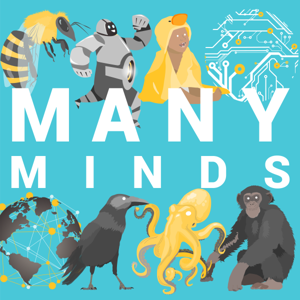
Many Minds is a project of the Diverse Intelligences Summer Institute, which is made possible by a generous grant from the John Templeton Foundation to Indiana University. The show is hosted and produced by Kensy Cooperrider, with help from Assistant Producer Urte Laukaityte and with creative support from DISI Directors Erica Cartmill and Jacob Foster. Our artwork is by Ben Oldroyd. Our transcripts are created by Sarah Dopierala.
Subscribe to Many Minds on Apple, Stitcher, Spotify, Pocket Casts, Google Play, or wherever you listen to podcasts. You can also now subscribe to the Many Minds newsletter here!
We welcome your comments, questions, and suggestions. Feel free to email us at: [email protected].
For updates about the show, visit our website or follow us on Twitter (@ManyMindsPod) or Bluesky (@manymindspod.bsky.social).
 View all episodes
 By Kensy Cooperrider – Diverse Intelligences Summer Institute

4.9
6262 ratings
How do we learn? Usually from experience, of course. Maybe we visit some new place, or encounter a new tool or trick. Or perhaps we learn from someone else—from a teacher or friend or YouTube star who relays some shiny new fact or explanation. These are the kinds of experiences you probably first think of when you think of learning. But we can also learn in another way: simply by thinking. Sometimes we can just set our minds to work—just let the ideas already in our heads tumble around and spark off each other—and, as if by magic, come away with a new understanding of the world. But how does this happen exactly? And does it only happen in humans?
My guest today is Dr. Tania Lombrozo. Tania is a Professor of Psychology at Princeton University; she and her research group study learning, reasoning, explanation, belief, and more. In a recent paper, Tania outlines this puzzling alternative form of learning—learning by thinking, as it's known—and presents evidence that it happens in both humans and AIs.
In this conversation, Tania and I talk about her longstanding work on explanation, and how it led her to study this less-obvious form of learning. We zoom in on four flavors of learning by thinking—learning through explanation, through simulation, through analogy, and through reasoning. We talk about the evidence that machines also learn in this way, and we consider whether animals could, too. We discuss how to resolve the paradox at the heart of "learning by thinking": how it could be that reshuffling old bits of knowledge can actually lead to new understanding. Along the way, Tania and I touch on: chain-of-thought prompting in LLMs, the Reddit community 'Explain Like I'm Five,' the illusion of explanatory depth, the power of thought experiments, Darwin and Galileo, imagination and rationalization, how psychology and philosophy complement each other, and whether we can also learn—not just by thinking in our proverbial armchairs—but also by writing and talking.
So, happy 2025, friends! We've got some great stuff lined up for the coming year. If you like what we're doing with the show, we would—as ever—appreciate your support. And the main way you can support us is just by helping us get the word out—by telling a friend about us, or a colleague, or a student, or your thousands of social media followers.
Alright, without further ado, on to my conversation with Dr. Tania Lombrozo. Enjoy!
A transcript of this episode is available here.
Notes and links
3:30 – An influential early paper on "chain-of-thought prompting" in Large Language Models. A recent preprint by a team, including Dr. Lombrozo, exploring the cases where "chain-of-thought prompting" actually impairs performance in LLMs.
8:00 – For some of Dr. Lombrozo's important earlier work on explanation, see here and here.
11:15 – The Reddit community 'Explain Like I'm Five.'
13:00 – An early paper on the "curse of knowledge"—the difficulty of ignoring what you know.
19:00 – Dr. Lombrozo's recent review article on "learning by thinking" is here. Another article of hers on the same topic is here.
20:00 – The original report of the "self-explanation" effect. The original report of the "illusion of explanatory depth."
30:00 – For a basic description of Galileo's falling bodies thought experiment, see here. A discussion of this thought experiment by philosopher Tamar Gendler.
38:00 – For analysis of Darwin's analogy between artificial and natural selection, see here and here.
42:00 – A paper on rationalization by Fiery Cushman.
48:00 – A paper from Dr. Lombrozo's lab on "need for explanation." The original paper describing the construct of "need for cognition."
52:00 – The original report of "framing effects" by Tversky and Kahneman.
54:00 – A paper by Annette Karmiloff-Smith discussing "representational redescription."
1:02:00 – A recent overview of issues surrounding "explainable" AI.
Recommendations
Alison Gopnik, Andrew Meltzoff, & Patricia Kuhl, The Scientist in the Crib
Frank Keil, Wonder: Childhood and the Lifelong Love of Science
Many Minds is a project of the Diverse Intelligences Summer Institute, which is made possible by a generous grant from the John Templeton Foundation to Indiana University. The show is hosted and produced by Kensy Cooperrider, with help from Assistant Producer Urte Laukaityte and with creative support from DISI Directors Erica Cartmill and Jacob Foster. Our artwork is by Ben Oldroyd. Our transcripts are created by Sarah Dopierala.
Subscribe to Many Minds on Apple, Stitcher, Spotify, Pocket Casts, Google Play, or wherever you listen to podcasts. You can also now subscribe to the Many Minds newsletter here!
We welcome your comments, questions, and suggestions. Feel free to email us at: [email protected].
For updates about the show, visit our website or follow us on Twitter (@ManyMindsPod) or Bluesky (@manymindspod.bsky.social).
15,255 Listeners

10,742 Listeners

5,534 Listeners

2,455 Listeners
770 Listeners
546 Listeners

824 Listeners
315 Listeners
4,181 Listeners
114 Listeners

5,541 Listeners

16,236 Listeners

357 Listeners
122 Listeners

44 Listeners