
Sign up to save your podcasts
Or



Often described as one of Australia’s weakest Prime Ministers, Billy McMahon nevertheless makes for a fascinating biographical subject. A notorious leaker who made far more enemies than friends, McMahon’s climb to the top position of Australian political leadership is one of the most surprising and remarkable achievements in Australian politics. For all of his flaws, McMahon was a man of great perseverance, work-ethic, and drive, and on a number of policy positions, particularly that of free trade, he was actually more perceptive and forward thinking than his colleagues. While McMahon is best remembered for losing 1972 election, even that epoch defining result was a far closer fight than the popular memory would allow.
At the heart of Robert Menzies’s appeal to the ‘Forgotten People’ was the family, the essential basis of a healthy society. Menzies described the instinct to be with one’s family as ‘the great instinct of civilised man’. This was no mere rhetoric, Menzies was at heart a family man and cherished every moment that he got to spend with his close relatives. They in turn remember him fondly, and can provide insights into the real man that would otherwise remain forever hidden.
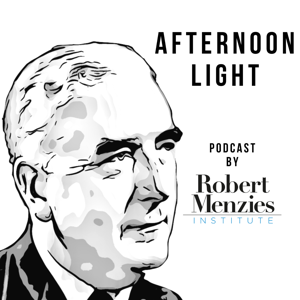
In this week’s episode of the Afternoon Light podcast, Robert Menzies Institute CEO Georgina Downer talks to Tom Frame about Menzies’s Liberal deputy and immediate successor Harold Holt.
In this week’s episode of the Afternoon Light podcast, Robert Menzies Institute CEO Georgina Downer talks to Western Sydney University Lecturer Dr Bridget Brooklyn about the intricacies of the pivotal 1954 election.
In this week’s episode of the Afternoon Light podcast, Robert Menzies Institute CEO Georgina Downer talks to Peter Drysdale AO, architect of the Asia-Pacific Economic Cooperation Forum, about his personal reflections on how the Australia-Japan relationship has developed over the years.
In this week’s episode of the Afternoon Light podcast, Robert Menzies Institute CEO Georgina Downer talks to barrister and public commentator Gray Connolly about the history of Australian conservatism.
In this week’s episode of the Afternoon Light podcast, Robert Menzies Institute CEO Georgina Downer talks to former Foreign Minister Alexander Downer about his personal recollections of Robert Menzies and his views on contemporary politics, with a particular emphasis on the troubled geopolitical landscape.
In this week’s episode of the Afternoon Light podcast, Robert Menzies Institute CEO Georgina Downer talks to best-selling biographer Troy Bramston about the comparisons to be made between Robert Menzies and Bob Hawke, the longest serving prime ministers for each side of Australian politics.
When it comes to political longevity, Robert Menzies and Bob Hawke are record-breakers who are frequently held up as leadership models for successors to emulate. But despite their competing political philosophies, Menzies and Hawke have far more in common than simply winning elections. Both were born in remote townships on either side of the Victoria-South Australian border, both came from families containing active politicians and had fathers who served as religious ministers, both were filled with talent, ambition and drive from an early age, and both were able to adapt and learn over their careers. In an Australia that seems to be yearning for enduring and successful leadership, there are many lessons to be learned from their stories, and they come out all the clearer through a discussion of Plutarch-style ‘parallel lives’.
Troy Bramston is a senior writer and columnist with The Australian. He has interviewed politicians, presidents and prime ministers from multiple countries along with writers, actors, directors, producers and several pop-culture icons. He is an award-winning and best-selling author or editor of 11 books, including Bob Hawke: Demons and Destiny, Paul Keating: The Big-Picture Leader and Robert Menzies: The Art of Politics. He also co-authored The Truth of the Palace Letters and The Dismissal with Paul Kelly.
In this week’s episode of the Afternoon Light podcast, Robert Menzies Institute CEO Georgina Downer talks to our Visiting Fellow Dr William Stoltz about the history of the Australia Secret Intelligence Service (ASIS), which recently celebrated the 70th anniversary of its foundation under the Menzies Government.
You can read Dr Stoltz’s opinion piece on the creation of ASIS here.
In this week's episode of the Afternoon Light podcast, Robert Menzies Institute CEO Georgina Downer talks to Dr Darius von Güttner, a historian of Eastern Central Europe from the University of Melbourne, about the ‘deep history’ that underpins the current conflict in the Ukraine.
Vladimir Putin’s flagrant invasion of the Ukraine has famously been justified on the pretext of NATO expansionism, but it is also based on a historical fiction which seeks to undermine the legitimacy of the sovereign nation which is currently under attack. Putin has claimed that Ukraine ‘never had a tradition of genuine statehood’, deliberately trying to erase a national story that stretches back over one thousand years. Such is often the case with global conflicts; they almost invariably have historical underpinnings and they serve to demonstrate that historical memory is a contested domain with real world consequences. This issue is closely related to the purpose of the Robert Menzies Institute, which is part of a network of prime ministerial libraries dedicated to keeping alive Australia’s national story, a tale of peaceful liberal democracy that we hope will long continue.
Dr Darius von Güttner is a Principal Research Fellow with the School of Historical and Philosophical Studies at the University of Melbourne. He is a historian of East Central Europe with broad interest in cultural aspects of the transmission of ideas across time and space. He is interested in global history and pursues interdisciplinary research and teaching subjects which examine history from a global perspective. Darius is the General Editor of Brepols publishing’s book series on “East Central Europe”. His publications cover diverse aspects of history from the Middle Ages to early modern and the modern eras.
From the publisher's feed

152,855 Listeners

3,164 Listeners
86 Listeners
87 Listeners

123 Listeners

42 Listeners

4,040 Listeners
303 Listeners

2,155 Listeners

7,133 Listeners

65 Listeners

15,568 Listeners

338 Listeners
23 Listeners