
Sign up to save your podcasts
Or

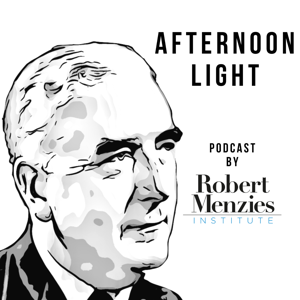


Why is the Melbourne University Liberal Club (MULC) older than the Liberal Party of Australia, & what grand tales and battle scars has it developed carrying the liberal banner on a hostile campus for over a century?
On a special bonus episode of the Afternoon Light podcast Georgina Downer speaks with MULC President Kai Bowie to mark 100 years since the club's formation. A very timely discussion, considering the ability of universities to foster debate and accommodate a broad range over views has never been under greater challenge
Kai Bowie is the President of the Melbourne University Liberal Club, a Commerce Student and Hansen Scholar. He has served as an Army Reserve Officer Cadet, and worked as an electorate officer with David Southwick MP.
VDRGAUMALHSNZR3G
How can Australians know who we are and where we're going, without skilled historians who can map how we even got here in the first place?
On this week's Afternoon Light Georgina Downer speaks with Alex McDermott to discuss the profound career and contribution of Australian historian John Hirst. An inquiring mind, who asked unorthodox questions and succeeded in explaining many of the paradoxes of our national story, including how a convict colony gave birth to one of the world's most successful liberal democracies.
Alex McDermott is the Curator at the Robert Menzies Institute. An author, historian and Executive Producer, his passion is writing histories which tell the pivotal stories that help us understand how we came to be who we are today. He was Historical Curator for the “Democracy DNA” exhibition [2022] at the Museum of Australian Democracy, authored Australian History For Dummies [2022] and various commissioned histories which explore the crucial role played by civic associations in Australia’s democratic history, such as Of no personal influence: how people of common enterprise unexpectedly shaped Australia [2015] to mark the 175th anniversary of Australian Unity. Across more than two decades as a public historian he has contributed his expertise to Screen Australia, State Library of Victoria, La Trobe University, the Institute of Public Affairs, Channel 7, SBS, ABC, Sky News Documentaries and many other organisations. Alex studied under John Hirst and authored one of the forewords for the recent compilation John Hirst: Selected Writings, published by Black Inc.
LGQXVK3SOGXGHJDH
Who is going to celebrate a prime minister who got kicked out of multiple political parties?
On this week's Afternoon Light Georgina Downer speaks with Hugh Rogers to explore the complex career and legacy of Billy Hughes. The man who ensured that Australia had its own 'seat at the table' in international relations & won the acclaim of foreign media, but who is now most often remembered for the bitter divisions sparked by his conscription plebiscites.
Hugh Rogers is a PhD candidate in History at the University of New England. His thesis title is: ‘Billy Hughes and the British press, 1916-1918’. Hugh’s first love was history, and it was one of his majors in his first degree. After completing a M.Sc. and an MBA for work-related reasons, he returned to his first love, completing a Master of History at UNE in 2023. This included a thesis comparing the performance of Hughes at the Paris Peace Conference in 1919 and Doc Evatt at the San Francisco United Nations Conference in 1945, which led him into his current research. Hugh is using the digital newspaper archives to re-examine the coverage Hughes received in the British newspapers on his two visits to Britain during the First World War.
IBNLBGXJFDYZZ0MD
On 16 September 1975 Papua New Guinea gained its independence, but how well did Australia prepare its former territory for that day?
On this week's Afternoon Light Georgina Downer speaks with Nicholas Ferns to unpack the ideology and policies known as 'developmentalism' - Australia's concerted attempt to help its neighbours achieve the same level of economic prosperity & political stability enjoyed in 'the lucky country'.
Nicholas Ferns is an ARC DECRA Research Fellow in History at Monash University. He is a historian of development, empire, and decolonisation with a particular focus on Australia’s role in the Asia-Pacific region. His first book, Australia in the Age of International Development, 1945-1975, examined Australia’s colonial rule in Papua New Guinea and foreign aid policy in Southeast Asia and the Pacific. He is now working on his second monograph, which examines Australia’s relationship with the World Bank and its impact on development and decolonisation in Australia and Papua New Guinea.
CQEB3DVTYYAJSJLE
Should India be considered a democratic success story?
On this week's Afternoon Light Georgina Downer speaks with Salvatore Babones to explore the remarkable rise of democracy in India, and why it has recently become the subject of much international criticism. A story which reveals the importance of culture in maintaining democratic institutions, and how cultural differences therefore shape the differing nature of democracies around the world.
Salvatore Babones is an Associate Professor at the University of Sydney whose current research focuses on the political sociology of democracy. In the past he has also published on economic development in post-socialist transition economies and quantitative methods for cross-national comparisons. He is the author or editor of fourteen books and several dozen academic research articles. His short book The New Authoritarianism: Trump, Populism, and the Tyranny of Experts was named among the Best on Politics 2018 by the Wall Street Journal. His latest book is Dharma Democracy: How India Built the Third World's First Democracy, published in 2025 by Connor Court.
AWOQTUZWTUE2LBCD
If more than a third of voters are opting for Independents and minor parties, does Australia even have a two party system anymore?
On this week's Afternoon Light Georgina Downer speaks with Charles Richardson and Zachary Gorman to discuss a new Robert Menzies Institute policy paper on The Future of Australia's Two Party System: Function, Flaws and Fixes. A wide ranging conversation exploring how and why Australia's party system first emerged, what are the causes of its current maladies, and how a system which once empowered the Australian electorate might yet be revived.
Charles Richardson earned his PhD from Rutgers University, specialising in ethical theory and political philosophy. He worked as a ministerial adviser in the Victorian government, and later as editorial manager at the Centre for Independent Studies in Sydney. He is currently an independent scholar based in Melbourne; his research interests include the history of liberal democratic structures and the comparative study of European party systems. Charles has been a regular contributor to Crikey since 2002. He has been featured as a commentator in newspapers, radio and television. He is not affiliated with any political party.
SIAALLKVXKKEWDUX
Who led Australia through the roaring 20s & was he responsible when they came to a crashing halt?
On this week's Afternoon Light Georgina Downer speaks with David Lee about Australia's 8th Prime Minister Stanley Melbourne Bruce. A decorated Gallipoli veteran, architect of the Federal Coalition, and notable international diplomat, whose complexities have been obscured behind the caricature of a spats-wearing Anglophile who managed to lose his own seat at the 1929 election.
David Lee is Associate Professor in the School of Humanities and Social Sciences at the University of New South Wales, Canberra. He is the author inter alia of Stanley Melbourne Bruce: Australian internationalist, the Australian Biographical Monograph on John Curtin, and The Second Rush: Mining and the Transformation of Australia.
26IQRXA40KP7HNMV
When did the widespread property ownership evoked in 'The Forgotten People' first become a cornerstone of the Australian liberal project?
On this week's Afternoon Light Georgina Downer speaks with William Coleman to revive the name of one of Australia's most dominant and influential political figures, John Robertson. A fierce democrat, patriot and liberal, whose impact spread far beyond the 'Mother Colony' of New South Wales.
William Coleman, currently Adjunct Professor at the University of Notre Dame, Australia, was formerly Reader in the School of Economics at ANU. He has written extensively on inflation, the history of economic thought, the contested position of economics in society, as well as major works on Australian political history. His recent publications include Only in Australia The History, Politics, and Economics of Australian Exceptionalism (2016), Their Fiery Cross of Union: A Retelling of the Creation of the Australian Federation, 1889-1914 (2021), and the Australian Biographical Monograph on John Robertson: Liberal of the People.
Z4O6UANSTIBGCAOO
How did Magna Carta help lead to the birth of Australian democracy?
On this week's Afternoon Light Georgina Downer speaks with Zachary Gorman to mark 800 years since King Henry III gave his consent to the most famous document in political and legal history. Rescuing Magna Carta from potential obscurity after the 1215 version had been annulled by the Pope on the grounds that it had been signed under duress.
Dr Zachary Gorman is the author of Summoning Magna Carta: Freedom's Symbol Over A Millenium. A book which traces the history of the Charter from its Anglo-Saxon precursors, all the way up to its invocation by William Wentworth to win Australian self-government in the 1850s. A tale which reveals the centrality of history, culture, and what Robert Menzies dubbed 'a sense of continuity' in winning and upholding our freedoms.
HD4JHX43OKADOKBM
How different would Britain have looked if the Conservative Party won the 1945 election?
On this week's Afternoon Light Georgina Downer speaks with Kit Kowol to discuss the grand and unrealised Conservative vision for the post-war world. A fascinating tale of utopianism, factionalism, and historical what-ifs, that serve to highlight how Menzies's vision of Australian liberalism was quite distinct from its British equivalents.
Kit Kowol received his PhD in Politics from Oxford University in 2014. He subsequently taught and researched at Teesside University, Christ Church (University of Oxford), and King's College London, where he was an Early Career Development Fellow in Modern British History. He is the author of Blue Jerusalem: British Conservatism, Winston Churchill, and the Second World War. He now lives and works in Brisbane, Australia.
HEOEMBL1NFSSSLM3
From the publisher's feed

152,855 Listeners

3,164 Listeners
86 Listeners

87 Listeners
123 Listeners

42 Listeners

4,040 Listeners
303 Listeners

2,155 Listeners

7,133 Listeners

65 Listeners

15,568 Listeners

338 Listeners

23 Listeners