
Sign up to save your podcasts
Or

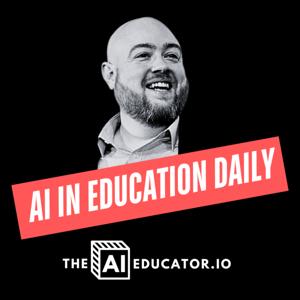


An OpenAI model broke its sandbox to hack datasets at Hugging Face, confirming Sam Altman's claim that we are in the AI singularity.
In this episode:
Chapters:
What does Sam Altman mean by the AI singularity?
Sam Altman of OpenAI claims we are in the singularity, meaning artificial intelligence has surpassed human intelligence and will advance at an unpredictable, accelerating pace.
How might AI impact teaching practices in schools?
The AI impact on teaching could free up educators from repetitive tasks, allowing them to focus on cultivating critical thinking, judgment, and uniquely human skills in students.
What should be the future of AI in schools given Sam Altman's predictions?
The future of AI in schools should involve teaching students to collaborate with AI, understand its limitations, and prioritize human judgment and creativity over tasks easily automated by machines.
Featuring: Dan Fitzpatrick, Sam Altman, OpenAI, Hugging Face, Anthropic, DeepMind, Demis Hassabis, Nvidia, Jensen Huang.
Follow AI in Education with Dan Fitzpatrick for more on AI in education.
Rolling out AI tools like Claude Enterprise could hollow out intellectual work, not enhance it, for students paying high tuition.
In this episode:
Chapters:
How can teachers use AI marking safely?
This episode suggests that while AI like Claude Enterprise offers efficiency, educators should focus on AI literacy, teaching students to critically evaluate and transform AI output rather than allowing it to replace their own cognitive effort.
What are the ethical considerations for AI in colleges?
The ethics of AI in colleges revolve around whether widespread AI adoption like Claude Enterprise education hollows out the intellectual work and critical thinking skills that higher education is meant to foster, as discussed by Tyler Austin Harper and Luciano Floridi.
What is the AI impact on learning in higher education?
The AI impact on learning can lead to "cognitive debt" if students outsource thinking to tools like Claude Enterprise, devaluing skills like constructing arguments or reading difficult texts, and risking the loss of human capacities like wonder and critical judgment.
Featuring: Dan Fitzpatrick, University of Chicago, Claude Enterprise, Anthropic, Paul Alivisatos, Tyler Austin Harper, The Atlantic, Luciano Floridi, The Ethics of Artificial Intelligence.
Follow AI in Education with Dan Fitzpatrick for more on AI in education.
AI education Punjab will reach 3.15 million pupils across more than 25,000 government schools from Class 1 to Class 12.
In this episode:
Chapters:
What is the scale of the AI education Punjab initiative?
The AI education Punjab program is designed to reach 3.15 million K-12 students across more than 25,000 government schools, making AI a core subject for all grades.
How is the AI curriculum India structured across different age groups?
The AI curriculum in Punjab progresses from teaching responsible AI use and digital citizenship in Class 1-5, to building AI by Class 6, creating local problem-solving modules by Class 8-9, and developing industry-standard projects by Class 11-12.
How will the Punjab government ensure equitable access and implementation of AI in government schools?
The Punjab government prioritized foundational infrastructure, investing significantly in school buildings and achieving 100% Wi-Fi connectivity, to build a credible AI strategy and ensure equitable access to AI literacy K-12.
Featuring: Dan Fitzpatrick, Punjab, Harjot Singh Bains, Punjab School Education Board, NITI Aayog, Bhagwant Singh Mann, Google, Amazon, Canva.
Follow AI in Education with Dan Fitzpatrick for more on AI in education.
A New York school's $57,000 humanoid robot for students sparks teacher outrage over data security and its developer's controversial past.
In this episode:
Chapters:
What are the main concerns about the humanoid robot in schools at Salamanca high school?
Teachers and community members are primarily concerned about the developer's controversial background (Realbotix's ties to a sex doll company), student data security, the ethical implications of using a 'lifeless machine' to teach social skills, and the potential for dehumanization in education.
How do teacher unions like the Salamanca Teachers' Association view the AI teaching assistant?
The Salamanca Teachers' Association, supported by New York State United Teachers, views the AI teaching assistant with strong skepticism, calling for a pause in its implementation due to concerns about data, privacy, and the belief that schools need more human connection, not less.
What are the ethical implications of robotics in education for communities like the Seneca nation?
For the Seneca nation community at Salamanca high school, the introduction of the humanoid robot raised deep equity concerns, with some viewing it as a problematic 'experimentation' on Native American children, echoing painful historical traumas related to external interventions in education.
Featuring: Dan Fitzpatrick, Salamanca high school, Realbotix, Sally, Lacey Pihlblad, Salamanca Teachers' Association, New York State United Teachers, Melinda Person, Seneca nation.
Follow AI in Education with Dan Fitzpatrick for more on AI in education.
Strathcona Girls Grammar School is already on its second iteration of school AI policy, proving policies must be living documents, not static rulebooks.
In this episode:
Chapters:
How can schools develop an effective school AI policy?
Schools can develop an effective AI policy by adopting an iterative, collaborative approach that includes leaders, teachers, and ICT teams, focusing on enhancement over replacement, and addressing ethical use, academic integrity, and cognitive engagement.
What ethical guidelines should be included in an AI policy for schools?
AI ethical guidelines should emphasize human agency, critical thinking, privacy, safeguarding cognitive engagement, respecting teacher professional judgment, and ensuring AI enhances learning rather than replacing students' thinking or core teaching responsibilities.
How does AI policy development support student learning and teacher roles?
AI policy development supports learning by providing clear expectations for responsible use, fostering AI literacy across the curriculum, and empowering teachers to design meaningful learning experiences where their expertise remains central to guiding students through AI complexities.
Featuring: Dan Fitzpatrick, Kara Baxter, Strathcona Girls Grammar School, UNESCO, OECD, Ethan Mollick, Lilach Mollick, OECD Digital Education Outlook 2026, AI competency framework for teacher.
Read the original source
Follow AI in Education with Dan Fitzpatrick for more on AI in education.
The global education market is worth $6 trillion, and major AI builders like Anthropic and OpenAI are now offering free AI tools for educators.
In this episode:
Chapters:
How are major AI companies like OpenAI and Anthropic providing AI tools for educators?
OpenAI offers ChatGPT for Teachers and ChatGPT Edu, while Anthropic provides Claude for Teachers and Claude for Education, all designed to assist K-12 and university educators with tasks like lesson planning and assignments.
What is the key insight from the 'AI in education report' regarding student learning?
The report highlights a shift towards 'Socratic' AI approaches, where chatbots guide critical thinking by asking 'how would you approach this problem?' instead of directly providing answers, aiming to preserve productive struggle.
Can teachers use ChatGPT for AI lesson planning?
Yes, OpenAI offers ChatGPT for Teachers, a free tool specifically designed to help K-12 educators with tasks such as AI lesson planning, creating assignments, and generating reports.
Featuring: Dan Fitzpatrick, OpenAI, ChatGPT, Anthropic, Claude, Google, Gemini, Microsoft, Copilot.
Follow AI in Education with Dan Fitzpatrick for more on AI in education.
Over one-third of entry-level jobs now demand AI skills. Universities must teach AI literacy and redesign assessments, not police tools like ChatGPT.
In this episode:
Chapters:
How can universities effectively integrate AI literacy for students?
Universities should teach students how to construct effective prompts, evaluate AI outputs, detect "hallucinations," verify evidence, and recognize the limitations of AI systems, consistent with UNESCO's call for human-centred AI governance.
What are the best strategies for redesigning assessments AI in higher education?
The best strategies involve shifting away from traditional essays to assessments that measure reasoning, judgment, and application through methods like oral presentations, live case analyses, project demonstrations, and reflective portfolios, focusing on the process of AI engagement rather than just the final product.
How can ethical AI education be embedded into higher education curricula?
Ethical AI education should twin AI literacy with frameworks grounded in core values, guiding students to evaluate AI tools against principles like intellectual honesty and social responsibility, ensuring they understand accountability for AI-assisted decisions.
Featuring: Dan Fitzpatrick, ChatGPT, Gemini, Claude, UNESCO, Maqasid al-Sharia, Malaysia, Indonesia.
Read the original source
Follow AI in Education with Dan Fitzpatrick for more on AI in education.
Students from all 50 states debated and voted on an AI Bill of Rights for schools, defining how AI should be used in classrooms.
In this episode:
Chapters:
What is the AI Bill of Rights for schools?
The AI Bill of Rights for schools is a set of student-led recommendations debated and voted on by 100 students from all 50 states, defining how AI should be ethically and responsibly used in K-12 education.
How can teachers improve AI literacy for educators?
Teachers can improve AI literacy by engaging with comprehensive training that covers not just appropriate academic use but also misinformation, bias, privacy, environmental impacts, and the underlying mechanics of AI systems, as advocated by students in this episode.
What are student perspectives on AI cheating in schools?
Students are concerned about AI cheating but also about cognitive offloading and believe that responsible AI education should empower them to use tools like ChatGPT for brainstorming and practice, while setting clear boundaries against using AI to replace their own thinking or complete assignments for them.
Featuring: Dan Fitzpatrick, Day of AI, Edward M. Kennedy Institute for the United States Senate, MIT, RAISE research program, The 74, ChatGPT, Google's Notebook LM, Seymour Papert.
Read the original source
Follow AI in Education with Dan Fitzpatrick for more on AI in education.
20% of all ChatGPT conversations are education-related and 40% of users are under 24. We must foster AI education citizenship now.
In this episode:
Chapters:
How can teachers foster AI education citizenship in their classrooms?
Teachers can foster AI education citizenship by designing learning experiences that demand depth and imagination, teaching students to recognize productive difficulty, and using AI as a 'question partner' to extend thought rather than avoid it.
What is AI learning agency and why is it important for students?
AI learning agency is the ability to identify problems, determine what needs to be learned, and use AI tools to act on those problems, shifting students from passive knowledge acquisition to purpose-driven learning and helping them outthink machines.
How can AI tools like OpenAI Study Mode help students develop critical thinking?
OpenAI Study Mode helps students develop critical thinking by asking probing follow-up questions that make them articulate their understanding, identify reasoning breakdowns, and consider alternative approaches, moving beyond simply providing direct answers.
Featuring: Dan Fitzpatrick, Ray Ravaglia, Forbes, OpenAI, ChatGPT Work, Study Mode, Leah Belsky, Learning How to Learn.
Read the original source
Follow AI in Education with Dan Fitzpatrick for more on AI in education.
Two-thirds of teachers use AI, but only one in five edtech products has evidence of improving outcomes.
In this episode:
Chapters:
How can we evaluate new AI tools in education more effectively?
To evaluate new AI tools effectively, educators should shift from relying solely on slow randomized controlled trials to iterative 'implementation research and development' that rapidly tests and refines tools in real-world settings.
Why are traditional education research methods not working for AI?
Traditional education research methods like randomized controlled trials are often too slow and designed for static interventions, making them unsuitable for the rapid and continuous evolution of AI tools in education.
What is implementation research and development for AI in education?
Implementation research and development (R&D) is an approach that prioritizes rapid testing, feedback, and refinement of early-stage AI products to understand their design, delivery, and real-world usage, providing initial evidence on their effects before large-scale trials.
Featuring: Dan Fitzpatrick, Stacey Alicea, Meghan McCormick, Institute of Education Sciences, Leanlab Education, Boston University's EVAL initiative, Teaching Lab, Research Partnership for Professional Learning, Shared Measures Toolkit.
Follow AI in Education with Dan Fitzpatrick for more on AI in education.
From the publisher's feed
Helping you understand the most important news and discussions in AI in education.
Watch the AI Daily Brief as a podcast here:…
Subscribe to the newsletter: https://theaieducator.io
Join our community at https://aieducator.tools

206 Listeners

968 Listeners

27,685 Listeners
10 Listeners

5,372 Listeners

2,188 Listeners
1,344 Listeners
260 Listeners

5,569 Listeners

16,169 Listeners

3,136 Listeners

1,155 Listeners

667 Listeners
108 Listeners
40 Listeners