
Sign up to save your podcasts
Or



Always listening to your feedback, I have had requests for an ep on teachers as co-learners. (In all honesty, I would have done one soon anyway haha.) I am super proud of how St Joseph Traf has put in place structures and support to develop the whole school to be habitual Japanese users. We are not saying at all that this is the pinnacle, just that we've done well so far and are continuing to plan for our next steps. Huge thanks to Trish Mulqueen and Taryn Maxwell-Garratt for staying back late (for the quiet) and sharing their experiences.
In part 2 there is great detail about the types of phrases teachers have been using, accountability and motivation. Again, huge thanks to Trish Mulqueen and Taryn Maxwell-Garratt for staying back late (for the quiet) and sharing their experiences.
Is the point of education to develop agile thinkers with the capacity to meet unknown future global challenges? If so, then Language learning perhaps should be the centre of 'essential', above the 3 Rs, and not an add on. This article by David Marsh et al, "The Bilingual Advantage: The Impact of Language Learning on Mind and Brain" (2020), shows that its in Language learning that our brains get turbo charged (my way of saying it) - in 6 ways - the flexible mind, the problem solving mind, the metacognitive mind, the learning mind, the interpersonal mind and the ageing mind. In two parts I reflect on some of the points.
Is the point of education to develop agile thinkers with the capacity to meet unknown future global challenges? If so, then Language learning perhaps should be the centre of 'essential', above the 3 Rs, and not an add on. This article by David Marsh et al, "The Bilingual Advantage: The Impact of Language Learning on Mind and Brain" (2020), shows that its in Language learning that our brains get turbo charged (my way of saying it) - in 6 ways - the flexible mind, the problem solving mind, the metacognitive mind, the learning mind, the interpersonal mind and the ageing mind. In two parts I reflect on some of the points.
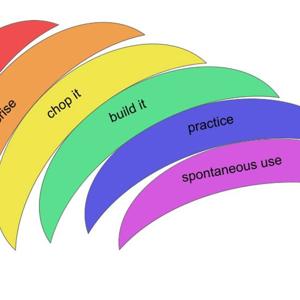
How do we support students towards spontaneous unscripted Language use? I’ve been exploring in my teaching how to allow students time to workshop as well as use Japanese. In particular to ‘chop it’ and ‘build it’, allowing students control over constructing their own meanings, even if those sentences are not yet completely correct. So I thought of the rainbow image. Here is a link to my “spontaneous use rainbow” on a miro board. Zoom in and out as you explore it.
I've always known that the 3 literacy curricula - Language, English and EAL are talking about the same skills, but with the different formats, the clunky wordiness of them all, it hasn't been until now that I have sat down to make the connections. In particular I look at the sound-shape connection - phonics, and the meaning making or comprehension. Not surprisingly, they are the topics of my first two podcasts in the reading series.
Here are my notes - the written version of what I talk about. And the link the Department of Education and Training website with comprehension strategies like the Building Reading document on the MACS Languages website.
The magic of reading really is more than just what is on the page. It is so much about how we interact with the text. What strategies might your students use to read? This is my thoughts about how I might use the Reading Toolbox of strategies that has been developed by the MACS Languages Team.
The book referred to in this podcast is "Ushiro ni iru no dare" うしろ に いるの だれ and is read by Redcatreading.com.
The MACS Reading Toolbox with the reading strategies link.
The MACS BUILD reference for teachers link.
Thank you to Melbourne Archdiocese Catholic Schools for creating this and allowing me to talk about it.
Language IS Literacy. In part 1 I talk about reading as the intersection of sound shape and meaning, then explain how I structure reading activities in my Language classroom. I describe some fun, easy and super effective activities too, In part 2 I talk about the MACS building blocks for reading. In part 3 I talk about the links in the Victorian Curriculum between Language EAL and English
In this episode I talk about Dr Kathryn McFarlane 's summary of her PhD findings titled
"Autonomous Language Learners Approach: Developing Oral Language Skills for Spoken Interaction in the Classroom". I think about what the 8 Key strategies mean to me and my students.
I have a new idea for students using Japanese with each other everyday, some honesty about how I might be sabotaging students' creativity by delivering them full sentences and what I changed about my use of gesture. I hope that my thinking out loud helps trigger some creative thinking that suits you in your context.
You can find Kathryn's work on the CEM Languages website. https://languages.cecv.catholic.edu.au/professional-reading/the-all-approach-research-2020
You are welcome to email me, [email protected]
Language mats have been developed by the MACS (Melbourne Archdiocese Catholic Schools) Languages team, with webinars about how to use them. In this podcast I talk with Margaret Gatehouse who teaches French at St Lawrence O Tool in Leongatha, about how she has used the Language mats in her class. I also describe my experience of them, and I hope you will share your ideas and experiences too.
Here is a link to the Language Mats. https://sites.google.com/cecv.catholic.edu.au/languages/teacher-resources/language-mats?authuser=0
Please feel free to email me with any thoughts.
[email protected]
From the publisher's feed
USING a language is the point of Language learning. What can Language teachers do to create the space in our classrooms for students to become confident spontaneous users of Language? This honest,…