
Sign up to save your podcasts
Or



"If Henry Ford had asked the people what they want, they would have said 'faster horses'." There is an interesting dynamic between creating a new invention or idea, and the user group that it might benefit. This episode and the next look at the things that might make it hard for teachers to use scenario practice, and some possible solutions.
Input vs output.
I have so many thoughts always circulating, so I have decided to bring back the podcast. In 10 minute blocks, the aim is for me to chat, unedited, to hopefully prompt your thinking about all things Languages. The views in this podcast do not necessarily reflect the views of DOSCEL.
This episode touches on TPRS (teaching proficiency through reading and story telling) and CI (comprehensible input) and mulls the question of the optimal balance between input and output in language learning.
If you want a quick introduction to TPRS, then listen to the first 3 episodes of Liam Printer's podcast The Motivated Classroom.
Meaning making.
This episode looks at communication as meaning making, and bounces ideas around a quote from a book Henshaw, F. G., & Hawkins, M. D. (2022). Common Ground; Second Language Acquisition Theory Goes to the Classroom. Hackett Publishing.
If communication is about meaning making, how might this inform teaching approaches?
A whole school approach to Language learning means that there is a commitment to use your school's Language throughout the week. The books and the activity ideas on the FCL-hub (Functional Classroom Language - hub) make this really easy. They provide the structure and the input for teachers who are not Language trained to learn some words you the USE them throughout the day.
I also seek your response about creating 15 minute lesson plans that include a book, focus language, an activity and how it relates to scaffolding spontaneous use. Is this too proscriptive or would it be really helpful? Here is an example of one to see the idea.
One way to help students be successful in Language learning is to bust it out of the Language classroom by creating a whole school approach to Languages. While that is a great idea, what might it look like in terms of achievable first steps? This podcast talks through a very simple and do-able process. I am happy to support you by chatting with your leadership and/or joining a staff meeting (online at this stage). Just send me an email. [email protected]
Here are some links:
Slides with Japanese phrases that I have used at St Angela's Warragul.
Whole school approach LAUNCH slides.
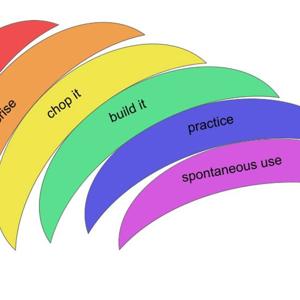
Chloe Briand, the new MACS Language Leader, and thank you to her for sending me Dylan Vinales' summary of EPI (Extensive Processing Instruction). I noticed some very strong similarities with the Spontaneous Use Rainbow, and the types of activities that I have been using to help students move from a modelled text to spontaneous use. So if you have another look at the FCL-hub (Functional Classroom Language hub), you will see a lot more activities that show the progression through the rainbow. This is a work in progress, which I will continue to update (the numbers are currently wrong). Also updated recently, the "What Irio Wants" book in the book tab, now has 7 levels WITH ACTIVITIES at the end of each book.
During this year I aim to have these books available in Italian, French and Mandarin. (Hopefully, wish me luck). [email protected]
If you are a Secondary Language teacher and text books are a big part of life, then this podcast is for you. It describes how to support students towards spontaneous use of the Language. I chose an Italian text book today, as I'm guessing you are sick of the constant Japanese examples, and to offer the perspective of a student. You will see I am very much imperfect in my Italian!! I chose a page from an Italian text book Ecco! Due student book. I also shared my thoughts about a bit of a progression from passive to active engagement with the textbook's oral practice suggestion, because spontaneous use doesn't just happen, it needs to be scaffolded and practiced.
Let me know what you are doing with oral Language practice, and what part of that progression your students are currently engaging with?
[email protected]
Spontaneous use of Language in the classroom doesn't just happen. The books I have been developing are great because they model classroom use of Language. However this time, I have chosen to set my book in the Camargue wetlands in France. So this episode describes how to make the bridge for students from a modelled example that might not be a classroom context, towards Language that students could use with each other where they are, which is of course the classroom.
Next week I will explore how to create this bridge using an examples from textbooks.
I look forward to hearing your thoughts.
[email protected]
"You shall know a word by the company it keeps" was quoted in a this term's teaching and learning network meeting by Martin Keogh. This podcast is my reflection on how Language learning helps develop problem solving, pattern identification, hypothesising and agile thinking. My thought is that experience of a different linguistic system and the un-translatables helps shift reading skills from 'barking at text' to 'comprehension'.
These podcasts are very much me thinking aloud and inviting you to do your own thinking.
I hope you will email me, or put on the Sale Language Space any thoughts you might have.
[email protected]
It seems to me that 'speaking' a Language is in the moment, in a context and in a relationship. These moments can't be scripted. So to feel like you can share your thoughts in the beautiful variety of situations that life offers, you have to be able to be spontaneous in constructing that language.
But spontaneity doesn't just happen. It needs memorising time, then workshopping time, then opportunity for unscripted use.
This podcast describes the activity I ran in my class yesterday where students created their own 'crazy words'.
Let me know what you think. How do you help students develop active use?
[email protected]
From the publisher's feed
USING a language is the point of Language learning. What can Language teachers do to create the space in our classrooms for students to become confident spontaneous users of Language? This honest,…