
Sign up to save your podcasts
Or



How do you know what your students know? What is actually retained in their memory by the end of the class? Especially what they can say rather than what they might be able to repeat or read. What about an oral exit ticket?
Do you sometimes find that students mis-pronounce words and get the intonation, emphasis and rhythm wrong? Perhaps more time saying things out loud would help. It also helps students to hear their own voice saying the words, which I think helps them feel that they own it. I do this every class.
How might we help students to see their learning growth in Languages? Another idea is to create a five point scale with an 'I can' statement taken from the Victorian Curriculum Achievement Standards. Show the students this near the beginning of the unit, and allow them to suggest where they are on the five point scale, then do it again after they have done some more learning to see how they have progressed.
How might we help students to see their learning growth in Languages? One idea is to list the words, phrases or sentences that you have been working on, and let students identify how well they know each one. Then do it again after they have done some more learning to see how they have progressed.
What percentage of your class time do your students use the language they are learning with other students? How could we increase that? This podcast expands on the practice of 'repeat after me' to include 'repeat with me' then 'say without me', as a whole group. Then followed by pair work where the students say the new words with each other. I usually find that this takes around 10 minutes and offers around 50 repetitions. Most importantly, though, it is student to student, so it removes the anxiety of one student 'answering' a question in front of the whole class.
Do your students write independently? Genuinely independently, or are they actually copying from the board, the room displays, the textbook, and/or hand outs? Are they copying from themselves as they re-write similar sentences? This podcast chats about the evolution from reading to writing.
If we teach the letter shapes in isolation, it is hard to connect all the pieces of the puzzle. But if we teach the letters that are in the words and sentences that we are saying, then they have immediate context and use. They connect to each other a lot more strongly.
Then if we also have some fun with it, the emotional engagement helps with long term memory. Here are a few simple ideas for engaging activities to teach reading and writing.
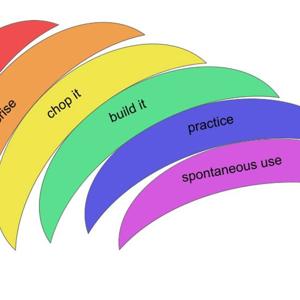
Scenario practice is, I believe the missing link between memorising language and being able to use it spontaneously. It is the workshopping phase of putting together a response to any potential situation. It promote the problem-solving skills needed to use a new language to communicate any meaning.
"If Henry Ford had asked the people what they want, they would have said 'faster horses'." There is an interesting dynamic between creating a new invention or idea, and the user group that it might benefit. This episode and the last one look at the things that might make it hard for teachers to use scenario practice, and some possible solutions.
2024 3 To grammar or not to grammar
Following from the meaning making thoughts, this episode considers how grammar might be part of language teaching. It also launches from a quote from Henshaw, F. G., & Hawkins, M. D. (2022). Common Ground; Second Language Acquisition Theory Goes to the Classroom. Hackett Publishing.
Is a grammar formula the most effective way to learn a language?
The views in this podcast do not necessarily reflect the views of DOSCEL.
From the publisher's feed
USING a language is the point of Language learning. What can Language teachers do to create the space in our classrooms for students to become confident spontaneous users of Language? This honest,…