
Sign up to save your podcasts
Or



Based on Podcast App listening data
It’s early August–it’s hot and sunny. And for many people, it’s sunburn season. But the long-term consequences of sun exposure can be a lot worse than just a sunburn. Americans have fewer and worse sunscreen options than their counterparts abroad–and those options mean fewer people will wear it. Abdul speaks with Amanda Mull, staff writer at the Atlantic, about the bureaucratic issue standing in the way.
50 years ago, it was discovered that the United States Public Health Service and the CDC–the federal government–had left nearly 400 Black men with syphilis untreated for 30 years to study the long term consequences of the disease. They told these men that they were providing them free healthcare. The consequences of this inhumane, disgusting study still echoes among Black Americans today–leaving many deeply mistrustful of the healthcare institutions that are supposed to provide treatment. Worse still, the same attitudes about Black people continue to shape medical and public health interactions. Abdul sits down with Dr. Rueben C. Warren, Director of the National Center for Bioethics in Research and Healthcare at Tuskegee University and former Associate Director of Minority Health at the CDC, to talk about the history of the study and its lasting implications for health inequities.
The president of the United States has COVID. Again. Abdul reflects on what this signals in the pandemic–and our politics. Then he sits down with Dr. Megan Ranney, Emergency Medicine physician and Academic Dean of Public Health at Brown University.
The fall of Roe has opened up the risk that authorities could use data from period tracking apps or internet searches in legal proceedings in abortion ban violations. But Big Tech may already be tracking a lot more about your health than you know. Todd Feathers and Simon Fondrie-Teitler of The Markup join Abdul to share their reporting.
For most of human history, people believed that blood flow was a one-way thing. The discovery that blood flowed two ways–that there was a circulatory system–didn’t happen until the mid-1600s. And it took more than a century for that discovery to be formally adopted by most scientific institutions. Abdul goes back in history to help us understand the resistance to science in the present. He interviews Dr. Dhun Sethna, a cardiac anesthesiologist and author of “The Wine Dark Sea Within” about the discovery of the human circulatory system and it’s implications for our time.
As HIV/AIDS ravaged the gay community in the 1980s, the federal government was slow to respond owing to anti-LGBTQ stigma. ACT UP–the “AIDS Coalition to Unleash Power”–sprang up to hold government officials, pharmaceutical companies, and society at large accountable. One offshoot of that movement was Gran Fury, which weaponized art and graphic design in the fight against HIV/AIDS. Abdul speaks with Jack Lowery, author of the “It Was Vulgar and It Was Beautiful,” about Gran Fury and its legacy.
Roe v. Wade — the Supreme Court Decision protecting reproductive rights in America for half a century — was dashed last week. Abdul sits down with Prof. Kate Shaw, co-host of Strict Scrutiny to answer your questions about the ruling and its implications for reproductive health. Then he interviews Attorney General Dana Nessel of Michigan — a state with a draconian abortion ban on the books — about how she and her colleagues are working to protect reproductive rights in that state.
Another school shooting, more thoughts and prayers. But maybe this time its different. Abdul talks about the way that school shootings have shaped the lives, fears, and anxieties of a whole generation of young people. Then he sits down with John Woodrow Cox, author of “Children under Fire,” to talk about the blast radius of gun violence among children.
A global monkeypox outbreak has infected over a thousand people worldwide. Monkeypox is nowhere as transmissible as COVID, but the choices our public health system makes now could shape how many people could be infected in the long term. Abdul interviews Prof. Anne Rimoin, an infectious disease expert, about monkeypox, what it is, why it’s spreading, and how we should be thinking about in the wake of COVID-19.
It’s pride month – a moment when LGBTQ+ Americans ought to feel out and proud. And yet that is becoming harder to do in an America where politicians are attacking the community through discriminatory policies designed specifically to stigmatize and exclude. Abdul talks about the way that exclusionary policy shapes mental health and speaks with Heather Zayde, a mental health provider who specializes in LGBTQ+ mental health about the challenges the community is facing and what it will take to overcome them.
From the publisher's feed
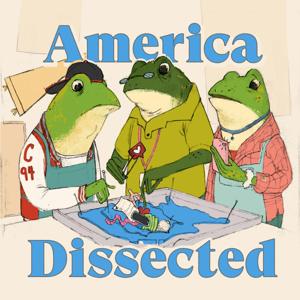
Wellness isn’t just about mindfulness, exercise, or the right skin routine. Science, politics, media, culture, tech — everything around us — interact to shape our health. On America Dissected, Drs.…
Ranked by our users in the last 21 days

7,853 Listeners

3,547 Listeners

14,640 Listeners

88,018 Listeners

24,765 Listeners

25,122 Listeners

8,752 Listeners
4,147 Listeners

6,183 Listeners

9,769 Listeners

12,904 Listeners

7,288 Listeners

16,346 Listeners

7,892 Listeners

5,726 Listeners

12,365 Listeners

89 Listeners

2,314 Listeners

1,760 Listeners