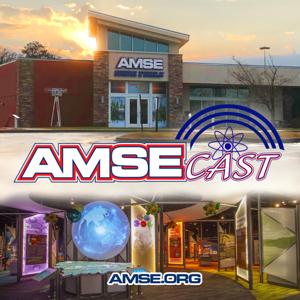
AMSEcast

AMSEcast

By American Museum of Science and EnergyScienceEducation
Download on the App Store

AMSEcast episodes

  • When the River Ran Backward with Jay Feldman
    Author and historian Jay Feldman joins host Alan Lowe to discuss When the Mississippi Ran Backwards, his gripping account of the 1811–1812 New Madrid earthquakes. Alan and Feldman explore the quakes' massive impact, including over 2,000 tremors felt across 1.5 million square miles, and the deep historical context behind them. He explains the ancient origins of the Reelfoot Rift, Tecumseh's eerie quake prophecy, and how early steamboat travel intersected with disaster. Feldman also recounts a horrific crime against an enslaved teenager, exposed by the quakes, and touches on ongoing seismic risk today. He also discusses reflections from his new memoir. Guest Bio Jay Feldman is an author, historian, and storyteller with a uniquely diverse background. Before turning to writing full-time, he worked as a musician and ran a music store specializing in vintage stringed instruments. He also founded Baseball for Peace, an organization promoting international understanding through sports, and has written for both television and the stage. Feldman is the author of Manufacturing Hysteria: A History of Scapegoating, Surveillance, and Secrecy in Modern America and When the Mississippi Ran Backwards: Empire, Intrigue, Murder, and the New Madrid Earthquakes, which explores one of the most powerful and overlooked natural disasters in U.S. history. Show Highlights
    • (4:32) When the earthquakes occurred and how many there were
    • (9:23) The creation of the Reelfoot Rift and how it became the source of the quakes
    • (12:38) What makes intraplate earthquakes different from other kinds
    • (13:57) Why the Mississippi River ran backwards at the height of the quake
    • (16:11) The creation of Reelfoot Lake
    • (17:54) The legend of Tecumseh's prophecy about the earthquakes
    • (21:55) How the Roosevelt family was involved with the event
    • (27:55) The crime that was revealed in the wreckage of the earthquakes
    • (32:44) Seismic activity in the area today
    Links Referenced
    • Manufacturing Hysteria: A History of Scapegoating, Surveillance, and Secrecy in Modern America: https://www.amazon.com/Manufacturing-Hysteria-History-Scapegoating-Surveillance/dp/0307388239
    • When the Mississippi Ran Backwards: Empire, Intrigue, Murder, and the New Madrid Earthquakes: https://www.amazon.com/When-Mississippi-Ran-Backwards-Earthquakes/dp/0743242793
    37 min
  • AMSEcast with guest Norm Augustine

    In this episode, Mr. Lowe interviews Mr. Augustine. They discuss a variety of fascinating roles that Mr. Augustine has served in over the course of his career. At Princeton he was advised to consider geological engineering but would go on to change his major to aeronautical engineering as he was advised by a peer "that is where the future was." The range of topics they discuss include American competitiveness, the challenge of putting people on the moon, international travel, the importance of individual talent and the drive to achieve. Undertaking work in the sciences in the context of historical knowledge gives better perspective and provides access to lessons learned in the past.

    55 min
  • AMSE Science Report with guest Jack Kelly

    In this excerpt from our podcast, AMSEcast, Jack Kelly, author of Gunpowder: Alchemy, Bombards, and Pyrotechnics: The History of the Explosive that Changed the World. Discusses one of the most innovative and compounds ever manufactured.

    5 min
  • STEM of History with Dr. Todd Braje

    Dr. Todd Braje, the Executive Director of the University of Oregon Museum of Natural and Cultural History, discusses his book, Understanding Imperiled Earth. He shows how analyzing data from many disciplines, such as archaeology and history, can help address some of the environmental challenges we face today.

    28 min
  • Connecting Cultures and Cosmos with Ed Krupp
    Dr. E.C. "Ed" Krupp joins Alan on this episode of AMSEcast to discuss the Griffith Observatory and his role as its longtime director. Now in its 90th year, the observatory remains a hub for public astronomy, drawing over 1.6 million visitors annually. Ed shares its educational mission, including a fifth-grade program and immersive exhibits like "Water is Life." He also discusses archaeoastronomy, the cross-disciplinary study of ancient skywatching, and how visiting historical sites deepens our understanding of past cultures. From the Hopi village of Walpi to upcoming lunar livestreams at Chimney Rock, Ed continues to connect humanity's cosmic curiosity across centuries through science, culture, and wonder. Guest Bio Dr. E.C. "Ed" Krupp has served as director of the world-renowned Griffith Observatory in Los Angeles since 1974, guiding it through transformative changes and welcoming over 1.6 million visitors annually. Under his leadership, the observatory has become the most visited public observatory on the planet. Ed is also a leading authority in the field of archaeoastronomy—the study of how ancient cultures understood the sky—and has authored several acclaimed books, including Skywatchers, Shamans & Kings: Astronomy and the Archaeology of Power. Known for his engaging insights and deep knowledge, Ed continues to inspire public curiosity about the cosmos and our place within it. Show Highlights
    • (1:43) When Griffith Observatory was established and its mission
    • (4:38) Exhibits and programs offered at the observatory
    • (8:51) How they work with students
    • (11:37) When archeoastronomy began to develop
    • (17:02) How astronomical knowledge shapes our place in society and culture today
    • (19:45) Places Ed has visited that have had the most impact on his work and life
    • (25:13) What still perplexes Ed Krupp after all his traveling and learning
    • (26:56) What's next for Ed and the observatory
    Links Referenced
    • Skywatchers, Shamans & Kings: Astronomy and the Archaeology of Power: https://www.amazon.com/Skywatchers-Shamans-Kings-Astronomy-Archaeology/dp/0471329754
    • Website: https://griffithobservatory.org
    32 min
  • AMSE Science Report: Walter Borneman recently spoke to us about his book, MacArthur at War: World War II in the Pacific

    Noted historian Walter Borneman recently spoke to us about his book, MacArthur at War: World War II in the Pacific. Few characters loom as large in that war than Douglas MacArthur, and Walt's book gives a terrific look at how this enigmatic man helped lead our nation to victory over the Japanese.

    After his narrow escape from the Philippines as the Japanese invaded, MacArthur set up his headquarters in Australia in a time that looked very bad for the allies. Walt offers unique perspective on MacArthur's field of operations as the allies began to turn the tables against the Japanese empire.

    5 min

About AMSEcast

From the publisher's feed

Produced from the American Museum of Science and Energy, AMSEcast invites guests from the world of science, literature, and technology to share unique perspectives from the realm of the highly trained…

More shows like AMSEcast

99% Invisible by Roman Mars

99% Invisible

26,165 Listeners

On the Media by WNYC Studios

On the Media

9,188 Listeners

2 Bears, 1 Cave with Tom Segura & Bert Kreischer by YMH Studios

2 Bears, 1 Cave with Tom Segura & Bert Kreischer

23,340 Listeners