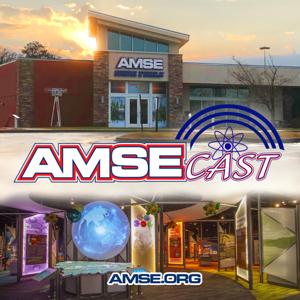
AMSEcast

AMSEcast

By American Museum of Science and EnergyScienceEducation
Download on the App Store

AMSEcast episodes

  • AMSE Science Report Al Romig

    On this episode, being recorded at the National Academy of Sciences Building in Washington, DC, I'm very honored to be joined by Dr. Alton D. Romig, Jr. Al has had a truly exceptional career, full of more awards than I can list today. Most recently, for example, the 2024 IEEE McClure Citation of Honor for engineering leadership, and more positions than I can include today, but they've included leadership roles at Sandia National Lab, service as vice president and general manager of Lockheed Martin's Advanced Development Programs, better known to all of us as the famous Skunk Works. And currently, Al serves as Executive Officer of the National Academy of Engineering.

    5 min
  • Kathleen Carlucci, the Director of the Thomas Edison Center talks history

    We always celebrate at our museums the rich history of American innovation, but we're putting a special spotlight on that history as we approach the nation's semiquincentennial in 2026.

    To help us with that, we spoke on our podcast, AMSEcast, with Kathleen Carlucci, the Director of the Thomas Edison Center at Menlo Park. Thanks to his host of revolutionary innovations and inventions, Thomas Edison changed our world with technologies like the phonograph, motion pictures, electric light, and the list truly goes on and on. Altogether he obtained 1,093 US patents, and 1,250 patents in 34 other countries. At Menlo Park in New Jersey, Edison gathered an incredible team in one place to conceive and create these inventions, starting the whole concept of research and development and what we call today "Big Science."

    5 min
  • Gunpowder: From Alchemy to Empire with Jack Kelly
    Jack Kelly joins Alan on this episode of AMSEcast to talk about his book Gunpowder: Alchemy, Bombards, and Pyrotechnics. They discuss gunpowder's accidental invention in 10th-century China and its explosive mix of saltpeter, charcoal, and sulfur. Kelly explains how gunpowder shaped science and warfare, fueling revolutions in physics, ending the era of castles, and powering colonial empires. Though once too expensive for civilian use, gunpowder later drove mining and infrastructure projects before being replaced by safer, more powerful explosives like dynamite. Kelly also previews his upcoming book on Thomas Paine, highlighting Paine's role as both Enlightenment thinker and Revolutionary soldier. Guest Bio Jack Kelly is an award-winning historian, journalist, and novelist, as well as a New York Foundation for the Arts Fellow. His work has appeared in publications like The Wall Street Journal and American Heritage, and he's been featured on NPR, PBS, and the History Channel. Jack's books explore pivotal moments in history with vivid storytelling and sharp insight. His titles include Heaven's Ditch: God, Gold, and Murder on the Erie Canal and God Save Benedict Arnold: The True Story of America's Most Hated Man. His upcoming book is Gunpowder: Alchemy, Bombards, and Pyrotechnics, an explosive history of invention and empire. Show Highlights
    • (1:24) When the Chinese invented gunpowder and when it arrived in Europe
    • (2:35) The ingredients of gunpowder
    • (3:54) Why saltpeter is such a challenging ingredient to produce
    • (5:43) Challenges faced by European engineers in the production of gunpowder
    • (8:34) What the development of chemistry revealed about how gunpowder works
    • (10:46) How gunpowder influenced sciences like physics in Europe
    • (12:51) When guns and cannons were introduced
    • (14:12) Gunpowder's impact on European architecture, such as castles
    • (16:39) The commercial uses of gunpowder
    • (20:12) Replacements for gunpowder in weapons and other explosives today
    • (22:51) Modern uses for black powder
    • (24:26) What Jack Kelly is currently working on
    Links Referenced
    • Heaven's Ditch: God, Gold, and Murder on the Erie Canal:
    • https://www.amazon.com/Heavens-Ditch-Jack-Kelly-audiobook/dp/B01HU77DIC/
    • God Save Benedict Arnold: The True Story of America's Most Hated Man: https://www.amazon.com/God-Save-Benedict-Arnold-Americas-ebook/dp/B0BQGFMLFK/
    • Gunpowder: Alchemy, Bombards, and Pyrotechnics: The History of the Explosive that Changed the World: https://www.amazon.com/Gunpowder-Alchemy-Bombards-Pyrotechnics-Explosive-ebook/dp/B009IU57IS/
    29 min
  • Tracks Across America with Simon Cordery
    Alan Lowe speaks with Dr. Simon Cordery about the transformative role of railroads in American history. From the Baltimore and Ohio Railroad in 1828 to a national network by 1916, Cordery details how rail shaped commerce, industry, and infrastructure. He also explores regulation, from early oversight efforts to the 1980 Staggers Act, which revitalized the struggling industry. The conversation touches on Amtrak's dependence on subsidies, the challenges of expansion, and the promise of high-speed rail. Cordery also previews his book on Albert Pullman, a largely forgotten innovator behind the Pullman Company's early success and a symbol of overlooked entrepreneurial ambition. Guest Bio Dr. Simon Cordery is Chair of the History Department at Iowa State University and a leading scholar of American labor and transportation history. He previously served as department chair at Western Illinois University and Monmouth College. Dr. Cordery has authored several acclaimed books, including Mother Jones: Raising Cain and Consciousness and The Iron Road in the Prairie State: The Story of Illinois Railroading. His forthcoming work, Gilded Age Entrepreneur: The Curious Life of American Financier Albert Benton Pullman, explores the overlooked legacy of the elder Pullman brother and offers fresh insight into the entrepreneurial spirit of 19th-century America. Show Highlights
    • (2:14) When railroads first arrived in America and how quickly they spread
    • (6:18) Changes in the business world that supported and continued railroad expansion
    • (7:16) The impact of government oversight as the industry develops
    • (14:47) When deregulation of the railroad industry occurred and the effects it had
    • (19:46) The effects railroads had on labor organization and the labor market in America
    • (22:32) How railroad expansion affected how we keep time throughout the U.S.
    • (24:28) The effect of digital technology on the American railroad industry
    • (31:47) Is high-speed rail a profitable enterprise?
    • (35:23) Simon Cordery's upcoming book, Gilded Age Entrepreneur: The Curious Life of American Financier Albert Benton Pullman
    Links Referenced
    • Mother Jones: Raising Cain and Consciousness: https://www.amazon.com/Mother-Jones-Raising-Consciousness-Biography/dp/0826348106
    • The Iron Road in the Prairie State: The Story of Illinois Railroading: https://www.amazon.com/Iron-Road-Prairie-State-Railroading-ebook/dp/B017SJ126Q
    • Gilded Age Entrepreneur: The Curious Life of American Financier Albert Benton Pullman: https://www.amazon.com/Gilded-Age-Entrepreneur-American-Financier-ebook/dp/B0DVMQHYWP
    40 min
  • General MacArthur's War Path with Walter Borneman
    Alan talks with historian Walter Borneman about his book MacArthur at War: World War II in the Pacific. They examine General Douglas MacArthur's early career, his leadership in the Philippines, and his strategic command from Australia. Borneman discusses MacArthur's evolving coordination with the Navy, his key role in island-hopping operations, and his push to reclaim the Philippines. They also explore MacArthur's late awareness of the atomic bomb, his post-war leadership as Supreme Commander in Japan, and his legacy as a pioneering military strategist and symbol of American resolve during World War II. Guest Bio Walter Borneman is an award-winning historian and author with a passion for bringing pivotal moments in American history to life. He earned his history degree from Western State College of Colorado and a law degree from the University of Denver. Borneman is the author of several acclaimed books, including The Admirals: Nimitz, Halsey, Leahy, and King and Polk: The Man Who Transformed the Presidency and America. Show Highlights
    • (1:22) Why MacArthur assumed the role of Field Marshal in the army of the Philippines
    • (7:36) The evolution of MacArthur's role in Australia and the Pacific Command
    • (12:24) MacArthur's role in formulating and then implementing the island-hopping plan
    • (15:07) Why Walter thinks the Battle of Leyte Gulf may have been the greatest victory ever won by the United States Navy
    • (17:39) MacArthur's role in planning the invasion of the Japanese home islands
    • (20:05) When he learned about the atomic bomb and his views on its use in the war
    • (22:13) Why he was appointed the supreme commander of the Allied powers in Japan
    • (25:22) How Walter Boneman would define MacArthur's legacy in World War II
    • (27:20) What Walter is working on next
    Links Referenced
    • The Admirals: Nimitz, Halsey, Leahy, and King: https://www.amazon.com/Admirals-Nimitz-Halsey-King-Five-Star-ebook/dp/B007ME5GYC
    • Polk: The Man Who Transformed the Presidency and America: https://www.amazon.com/Polk-Man-Transformed-Presidency-America-ebook/dp/B0026772GK/
    • MacArthur at War: World War II in the Pacific: https://www.amazon.com/MacArthur-War-World-II-Pacific-ebook/dp/B0151YQV20/
    • American POTUS: https://americanpotus.org/
    31 min
  • AMSEcast with guest Tom Zoellner

    Given the centrality of uranium to the story of the Manhattan Project, the creation of Oak Ridge, and the ongoing nuclear renaissance, I thought it would be good to learn more about that element, so I spoke on our podcast, AMSEcast, with Tom Zoellner about his fascinating book, Uranium: War, Energy, and the Rock that Shaped the World. I started by asking why uranium is so unique and so suited to creating the chain reactions that are central to both nuclear energy production and the workings of nuclear weapons.

    5 min
  • Inside the National Air and Space Museum with Margaret Weitekamp
    Alan Lowe speaks with Dr. Margaret Weitekamp of the Smithsonian's National Air and Space Museum about its transformation ahead of America's 250th anniversary. They explore how new exhibits, immersive storytelling, and iconic artifacts like the Wright Flyer, Space Shuttle Discovery, and Neil Armstrong's spacesuit bring aviation and space history to life. Weitekamp discusses the museum's role as both a public institution and research center, preserving innovations from early flight to modern space exploration. She also reflects on international collaboration, private sector contributions, and how triumph and tragedy alike shape our understanding of humanity's journey beyond Earth. Guest Bio Dr. Margaret Weitekamp is the curator and department chair of the space history department at the Smithsonian's National Air and Space Museum. She holds a BA from the University of Pittsburgh and earned her MA and PhD in history from Cornell University. A former Mellon Fellow in the humanities, she also served as the American Historical Association's NASA Aerospace History Fellow at NASA Headquarters. Since joining the museum in 2004, she has led major curatorial efforts and became department chair in 2019. Dr. Weitekamp is a widely published author, including Space Craze and Spaceships: An Illustrated History of the Real and the Imagined. Show Highlights
    • (2:09) The goals of the renovation and when it's going to be completed
    • (6:28) The Udvar-Hazy Center
    • (8:09) What Margaret Weitekamp does at the National Air and Space Museum
    • (10:49) Key moments of American flight innovation documented at the museum
    • (18:50) Artifacts on display that tell the story of American innovation in getting to the moon
    • (22:12) The space shuttle's impact on our understanding of Earth and space
    • (25:58) How the museum communicates with NASA about adding to their collection
    • (29:32) The role of international competition versus collaboration in forwarding innovation
    • (32:48) The private sector's role in space innovation and how the museum interacts with it
    • (34:57) How satellites are used and what American innovations have contributed to them
    • (38:35) The way the Air and Space Museum teaches about unmanned missions like Voyager
    • (41:13) What we've learned from past mistakes, such as the Challenger explosion
    • (44:59) What's made the biggest impression on Margaret since she's been at the museum
    • (47:11) What we should keep in mind when looking at the next 250 years of space innovation
    • (49:51) How to follow what's going on at the National Air and Space Museum
    Links Referenced
    • Spaceships: An Illustrated History of the Real and the Imagined: https://www.amazon.com/Spaceships-2nd-Illustrated-History-Imagined/dp/1588347265/
    • Space Craze, America's Enduring Fascination With Real and Imagined Space Flight: https://www.amazon.com/Space-Craze-Americas-Fascination-Spaceflight/dp/1588347257
    • National Air and Space Museum: https://airandspace.si.edu
    54 min
  • Inside the Invention Factory with Kathleen Carlucci
    Kathleen Carlucci, director of the Thomas Edison Center at Menlo Park, joins AMSEcast to discuss Edison's lasting impact on American innovation. From his early love of telegraphy to his system-wide inventions in sound, light, and film, Edison redefined how ideas were developed and assembled skilled teams in the world's first "invention factory." Carlucci highlights his resilience, collaborative spirit, and ability to turn failure into progress. Visitors to the Center can explore original artifacts, interactive exhibits, and hands-on demonstrations that bring Edison's legacy to life, reminding us that with perseverance, innovation is within anyone's reach. Guest Bio Kathleen Carlucci is the Director of the Thomas Edison Center at Menlo Park, where she leads efforts to preserve and share the legacy of one of America's greatest inventors. With degrees in history and secondary education, she combines her passion for storytelling with a strong background in management and customer service. Kathleen has played a key role in enhancing the museum experience through engaging tours, educational programs, and community outreach. Her work ensures that visitors of all ages connect with Thomas Edison's innovations and are inspired by his enduring message of curiosity, perseverance, and the power of hands-on learning. Show Highlights
    • (1:14) Edison's process for thinking up ideas and bringing them to fruition
    • (2:40) How Edison overcame hearing loss to accomplish so much
    • (3:42) Edison's improvements to the telegraph and telephone
    • (6:36) How Edison organized and staffed his Menlo Park lab
    • (9:51) Why he moved to West Orange, NJ, and what became of Menlo Park
    • (12:28) Edison's work with light bulbs, motion picture technology, and batteries
    • (19:03) What Edison would do when he hit a wall on a project
    • (20:39) Lessons from Menlo Park that future innovators should learn
    • (22:43) What a tour of the Thomas Edison Center at Menlo Park includes
    Links Referenced
    • Thomas Edison Center at Menlo Park: https://www.menloparkmuseum.org/
    29 min
  • A Library of Treasures in American History with Josh Levy
    Dr. Josh Levy is a historian of science and technology at the Library of Congress. In this episode of AMSEcast, he highlights key figures and artifacts from all across America's innovation history. From Samuel Morse's early telegraph designs to George Washington Carver's advocacy for sustainable farming, Levy reveals stories of invention and resilience. He also discusses aviation pioneer Lt. Thomas Selfridge and Claude Shannon's groundbreaking work in information theory. Josh and Alan finish with Gladys West, whose geoid calculations became foundational for GPS. Her later recognition reflects how major technological advances often depend on unsung, collaborative contributions across generations. Guest Bio Dr. Josh Levy is the historian of science and technology in the Manuscript Division at the Library of Congress, where he helps uncover and share the stories behind key figures in American innovation. He holds a Ph.D. in History from the University of Illinois and brings years of teaching experience at both high school and college levels, including the University of South Florida, the University of Illinois at Urbana-Champaign, and the College of Micronesia. Since joining the Library of Congress in 2020, Dr. Levy has curated collections that illuminate the complex, collaborative nature of scientific and technological breakthroughs. Show Highlights
    • (1:50) What led Samuel Morse to invent the telegraph
    • (4:03) Morse's letter regarding the telegraph
    • (7:36) Booker T. Washington and George Washington Carver
    • (8:47) Carver's letter to John Washington, Booker T. Washington's brother
    • (12:02) Alfred Graham Bell's interest in aviation
    • (15:02) Thomas Selfridge
    • (17:28) Claude Shannon, the Father of the Information Age
    • (18:46) Shannon's schematic of Theseus, the maze-solving robotic mouse
    • (20:11) Gladys West's impact on GPS technology
    Links Referenced
    • Library of Congress website: https://loc.gov
    • For specific questions about manuscripts at the Library of Congress: https://ask.loc.gov/manuscripts
    28 min

About AMSEcast

From the publisher's feed

Produced from the American Museum of Science and Energy, AMSEcast invites guests from the world of science, literature, and technology to share unique perspectives from the realm of the highly trained…

More shows like AMSEcast

99% Invisible by Roman Mars

99% Invisible

26,165 Listeners

On the Media by WNYC Studios

On the Media

9,188 Listeners

2 Bears, 1 Cave with Tom Segura & Bert Kreischer by YMH Studios

2 Bears, 1 Cave with Tom Segura & Bert Kreischer

23,340 Listeners