
Sign up to save your podcasts
Or

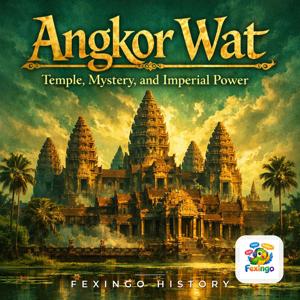


In this episode, Lucas and Luna dive deep into the most famous bas-relief at Angkor Wat: the Churning of the Ocean of Milk. They explore the Hindu myth behind the carving, its intricate details, and the role of the asuras and devas in the cosmic quest for the elixir of immortality. The conversation then turns to the historical context—how Suryavarman II used this narrative to legitimize his reign, blending cosmology with kingship. The hosts also touch on the conservation work by the German Apsara Conservation Project and the challenges of preserving these carvings from weathering and tourism. Along the way, they discuss the symbolism of the churning serpent Vasuki, the tortoise Kurma, and the apsaras that emerge from the ocean. This episode offers a vivid journey into one of the most iconic images of Khmer art, revealing its layers of meaning from mythology to royal propaganda.
#AngkorWat #ChurningOfTheOceanOfMilk #SuryavarmanII #KhmerEmpire #BasRelief #HinduMythology #Vishnu #Apsaras #GermanApsaraConservationProject #MountMandara #Vasuki #Kurma #Devas #Asuras #Amrita #SoutheastAsianHistory #History #FexingoHistory
Keep every episode free: buymeacoffee.com/fexingo
In this episode, Lucas and Luna dive deep into the Churning of the Ocean of Milk bas-relief at Angkor Wat. They explore the Hindu myth's role in Khmer cosmology, the artistry of the carving, and the political message Suryavarman II embedded in stone. They discuss the German Apsara Conservation Project's work, the 88-meter-long panel's depiction of gods, demons, and apsaras, and how the devaraja cult used this story to legitimize power. The conversation also touches on the missing central image of Vishnu and the ongoing debate about whether the relief was ever completed. Listeners will gain a fresh understanding of how Angkor Wat's bas-reliefs served as both sacred narrative and imperial propaganda.
#ChurningOfTheOceanOfMilk #AngkorWat #SuryavarmanII #Devaraja #Khmer #BasRelief #MountMandara #HinduMythology #GermanApsaraConservationProject #Vishnu #Kurma #Apsara #Paramavishnuloka #KhmerEmpire #SoutheastAsia #History #FexingoHistory #TempleArt
Keep every episode free: buymeacoffee.com/fexingo
Angkor Wat is world-famous, but its lesser-known counterpart Preah Khan was just as crucial. Built by Jayavarman VII in the late 12th century, this sprawling temple complex served not only as a Buddhist monastery but as a military base and strategic command center. In this episode, Lucas and Luna explore how Preah Khan was a practical fortress carved into stone, with its walls, moats, and inscriptions that hint at its role in defending the Khmer Empire after the Cham sack of Angkor in 1177. They discuss the temple's founding inscription, which describes a massive army of 100,000 men, the symbolism of its cruciform layout, and how it functioned as a hub for logistics and devotion. The conversation also touches on the temple's later transformation into a Buddhist site under Jayavarman VII's patronage, and its gradual abandonment as the empire shifted. Specific details include the role of the Cham invasion, the temple's 28-meter-wide moat, the inscription's mention of 234 deities, and the modern conservation challenges. A focused look at how architecture and power intertwined at Angkor.
#PreahKhan #JayavarmanVII #KhmerEmpire #Angkor #Cambodia #SoutheastAsianHistory #ChamInvasion #BuddhistMonastery #MilitaryArchitecture #MedievalFortress #12thCentury #AngkorianArchitecture #KhmerInscriptions #Archaeology #History #FexingoHistory #AncientEngineering #TempleFortress
Keep every episode free: buymeacoffee.com/fexingo
Most Angkor Wat visitors notice the famous Churning of the Ocean of Milk on the east gallery, but fewer ask: why do the vast battle reliefs on the west and south galleries face inward, toward the temple, instead of outward where visitors approaching from the west could see them? In Episode 150, Lucas and Luna decode this deliberate architectural choice. They trace the visual narrative from the epic Battle of Kurukshetra on the west wall to Suryavarman II's own Cham campaigns on the south — and show how the king literally inserted himself into the Mahabharata. The discussion draws on inscriptions like K. 380, the bas-relief chronology established by scholars such as Vittorio Roveda, and the spatial logic of Angkor Wat's gallery system. Why would a king who styled himself Paramavishnuloka — the one who has gone to Vishnu's realm — place his own image among gods and heroes? And what does the inward-facing arrangement reveal about who the reliefs were *really* for: the gods, the king, or the monks who walked those galleries? This episode offers a fresh key to Angkor Wat's iconographic program, one that changes how you see the temple's walls.
#AngkorWat #SuryavarmanII #BasRelief #Kurukshetra #Mahabharata #Paramavishnuloka #ChamCampaigns #Vishnu #VittorioRoveda #K380 #KhmerArt #KhmerArchitecture #InwardFacing #Iconography #SoutheastAsianArt #Hinduism #History #FexingoHistory
Keep every episode free: buymeacoffee.com/fexingo
In this episode, Lucas and Luna dive into the engineering and symbolism behind Angkor Wat's massive moat. They explore how the 200-meter-wide water channel wasn't just a defensive barrier but a cosmic reflection of Mount Meru, the ocean of creation, and the Hindu universe. Drawing on inscriptions like K. 380 and the accounts of Chinese envoy Zhou Daguan, they discuss how the moat functioned as a hydraulic system, a ritual boundary, and a statement of imperial power under Suryavarman II. They also touch on the ongoing work of the Greater Angkor Project and how modern LiDAR reveals the moat's connection to the vast water management network that sustained the Khmer capital.
#AngkorWat #SuryavarmanII #KhmerEmpire #Moat #HydraulicEngineering #MountMeru #ZhouDaguan #GreaterAngkorProject #DamianEvans #LiDAR #K380 #Yasodharapura #TonleSap #HinduCosmology #WaterManagement #History #FexingoHistory #SoutheastAsia
Keep every episode free: buymeacoffee.com/fexingo
In this episode, Lucas and Luna explore the most famous bas-relief at Angkor Wat: the Churning of the Ocean of Milk on the east gallery's south wing. Carved around 1150 CE under Suryavarman II, this 49-meter-long panel depicts the Hindu creation myth where devas and asuras churn the cosmic ocean using Mount Mandara as a pivot and Vasuki the serpent as a rope. Lucas explains the iconography of Vishnu as Kurma the tortoise holding the mountain, the hail of divine weapons, and the apsaras that emerge from the foam. He connects the relief to Suryavarman's statecraft—aligning his reign with cosmic order and victory over chaos—and discusses how the relief intentionally mirrors the temple's own structure as a Mount Meru on earth. Luna asks about the historical context: was the relief tied to Suryavarman's military campaigns? Lucas reveals a controversy: some scholars argue the Churning served as political propaganda to legitimize Suryavarman's contested succession, while others see it as purely devotional. The conversation also covers the relief's artistic techniques, including the naturalistic poses of the churning figures and the subtle erosion from centuries of monsoon rains. Finally, Lucas touches on the modern restoration efforts by the German Apsara Conservation Project, which have cleaned and preserved the panel, revealing details lost for centuries.
#AngkorWat #BasRelief #ChurningOfTheOceanOfMilk #SuryavarmanII #KhmerEmpire #HinduMythology #Vishnu #Kurma #MountMandara #DevasAsuras #Apsaras #CambodiaHistory #SoutheastAsianArt #12thCentury #StoneCarving #GermanApsaraConservationProject #History #FexingoHistory
Keep every episode free: buymeacoffee.com/fexingo
Before Angkor Wat rose from the forest, there was Yasodharapura — the sprawling capital city that housed the Khmer Empire's kings, courtiers, and priests. In this episode, we piece together what we know about Suryavarman II's coronation city from inscriptions, Chinese accounts, and recent LiDAR surveys. Lucas and Luna explore the urban layout, the role of the East Baray reservoir, the lost palace complex, and the enigmatic 'Phimeanakas' temple that may have been the king's own residence. They also discuss the controversial theory that Yasodharapura was not one city but a shifting network of royal compounds. Along the way, they touch on the devaraja cult, the brahmin Divakarapandita, and how the city's design embodied Mount Meru. Recorded as part of the Fexingo History network, this episode brings the listener into the streets and canals of a lost metropolis.
#AngkorWat #Yasodharapura #SuryavarmanII #KhmerEmpire #Cambodia #Archaeology #LiDAR #CityPlanning #Devaraja #Divakarapandita #Phimeanakas #EastBaray #MountMeru #ZhouDaguan #SoutheastAsia #History #FexingoHistory #LostCity
Keep every episode free: buymeacoffee.com/fexingo
Suryavarman II, the builder of Angkor Wat, died around 1150 CE, leaving his grand monument unfinished. This episode explores the circumstances of his death during a failed campaign against Champa, the succession crisis that followed, and how the temple was completed posthumously. We examine the stele inscriptions that hint at his final days, the role of his successor Dharanindravarman II, and the religious and political turmoil that nearly derailed Angkor Wat's construction. Learn about the Cham king Jaya Harivarman I's unexpected victory, the Khmer civil war, and how the temple's western causeway and outer enclosure were rushed to completion, leaving visible traces of haste in the stonework. A story of ambition, mortality, and legacy.
#SuryavarmanII #AngkorWat #KhmerEmpire #Champa #DharanindravarmanII #JayaHarivarmanI #Paramavishnuloka #CambodiaHistory #SoutheastAsia #TempleConstruction #UnfinishedTemple #12thCentury #Hinduism #Vishnu #Devaraja #History #FexingoHistory #Archaeology
Keep every episode free: buymeacoffee.com/fexingo
In this episode, Lucas and Luna explore the military campaigns of Suryavarman II that extended Khmer power into the Cham territories of coastal Vietnam. Drawing on the stele inscriptions and the Song dynastic records, they examine the 1145 sack of Vijaya, the Khmer occupation, and the eventual Cham counter-rebellion led by Jaya Harivarman I. They also look at the logistical feat of moving a Khmer army across the Tonlé Sap and Mekong rivers, the role of naval warfare, and how these campaigns shaped the wealth and ambition behind Angkor Wat. The conversation touches on the complex relationship between the two kingdoms, the disputed chronology of events, and the legacy of Suryavarman's imperial vision as recorded in the inscriptions of Angkor Wat itself.
#SuryavarmanII #Champa #AngkorWat #Vijaya #JayaHarivarmanI #KhmerEmpire #SongDynasty #TonleSap #Mekong #NavalWarfare #Inscriptions #SoutheastAsia #12thCentury #MilitaryHistory #Imperialism #History #FexingoHistory #KhmerHistory
Keep every episode free: buymeacoffee.com/fexingo
In the early 12th century, the Khmer king Suryavarman II faced a simmering power struggle with the priestly elite who controlled the devaraja cult. This episode examines the political crisis that nearly derailed the construction of Angkor Wat, focusing on the rivalry between the king and the Brahmin Divakarapandita. We explore inscriptions like K. 380 and K. 235S that reveal tensions over ritual authority, land grants, and the shifting balance between royal and sacerdotal power. Lucas and Luna discuss how Suryavarman attempted to centralize control by elevating Vishnu worship over the traditional Shiva-centered devaraja, and how the priesthood responded by withholding legitimacy. The episode also covers the role of the Sdok Kak Thom stele in framing these conflicts, and the eventual compromise that allowed Angkor Wat to rise as both a temple and a political statement.
#SuryavarmanII #Devaraja #Divakarapandita #AngkorWat #KhmerEmpire #BrahminPower #K380 #SdokKakThom #Vishnu #MountMeru #Paramavishnuloka #Cambodia #12thCentury #Hinduism #TemplePolitics #Inscriptions #FexingoHistory #History
Keep every episode free: buymeacoffee.com/fexingo
From the publisher's feed