
Sign up to save your podcasts
Or

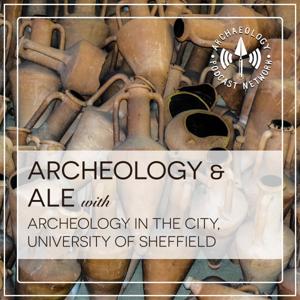


Archaeology & Ale is a monthly series of talks presented by Archaeology in the City, part of the University of Sheffield Archaeology Department’s outreach programme. It's our honour to welcome Professor John Barrett speaking on the 'The Importance and Future of Archaeology: a personal view.' This talk took place on June 16th in-person and online via Google Meets.
John is an accomplished archaeologist with many decades of experience. He graduated from the University of Wales (University College Cardiff) and taught at the Universities of Leeds and Glasgow before joining the University of Sheffield in 1995.
John was appointed to a Chair in Archaeology in 2001, was Head of Archaeology 2002-2006, Dean of Arts 2007-2008, and Acting Head of Department of Biblical Studies 2009-2011. In 2005, he was invited as a Visiting Professor to the University of Heidelberg and has served on the various UK and overseas advisory boards in connection with commercial, museum and university-based archaeology. He is currently an Emeritus Professor at Sheffield's Department of Archaeology. John is currently involved in several research projects and writing programmes.
John continues to be interested in designing new archaeological methodologies that are theoretically sound and capable of empowering field archaeologists. He hopes that this will engage the wider community to participate in the archaeological investigation of historical processes.
In this talk, John will speak on his views about the future of commercial, academic, and community archaeology. In addition, he discusses the study's history and the contribution that archaeology can make to the ongoing climate crisis.
John Barrett, the Uni of Sheffield
https://www.sheffield.ac.uk/archaeology/our-people/academic-staff/john-c-barrett
Save Sheffield Archaeology
https://sites.google.com/view/save-sheffield-archaeology/home
Please sign our Petition!
https://www.change.org/p/university-of-sheffield-save-sheffield-s-archaeology-department
For more information about Archaeology in the City’s events and opportunities to get involved, please email [email protected] or visit our website at archinthecity.wordpress.com. You can also find us on Twitter (@archinthecity), Instagram (@archaeointhecity), or Facebook (@archinthecity)
ArchPodNet
Affiliates
Archaeology & Ale is a monthly series of talks presented by Archaeology in the City, part of the University of Sheffield Archaeology Department’s outreach programme. This month we are proud to host Yvette Marks speaking on "Experimental reconstruction of Roman Bread." This talk took place on Thursday, May 27th, 2021, online via Google Meets.
Yvette is a material scientist with a focus on reconstructing ancient technologies and metallurgy. Yvette started her archaeological career with a degree in Classical Studies at the University of Liverpool before completing an MA in Archaeology at Liverpool and an MSc in Archaeological Materials at Sheffield.
In 2015 Yvette started working for Heritage Doncaster, initially as an Education Officer, then became their Assistant Curator of Archaeology. Yvette worked to enabled their collection to be more accessible; to the public, for teaching and outreach, by cataloguing and interpreting the collection. Since 2019 Yvette has worked at the University of Sheffield's Department of Archaeology as a Laboratory Manager and Teaching Technician (Archaeological Science).
Yvette is currently completing her PhD thesis, 'The inception and transmission of metallurgy: A regional approach' which focuses on the material evidence for the process of copper production in the Aegean and Balkans during the Late Neolithic and Bronze Age. This research aims to understand the material evidence from excavation and reconstruct the technological processes used to smelt and cast metal by combining experimental archaeology and analysis to test these hypotheses.
In this talk, Yvette tells us about a recent experiment she undertook with some students from Sheffield's Department of Archaeology. The experiment explored various methods used by Roman soldiers to bake bread.
LinksFor more information about Archaeology in the City’s events and opportunities to get involved, please email [email protected] or visit our website at archinthecity.wordpress.com. You can also find us on Twitter (@archinthecity), Instagram (@archaeointhecity), or Facebook (@archinthecity).
ArchPodNetArchaeology and Ale is a monthly series of talks presented by Archaeology in the City, part of the University of Sheffield Archaeology Department’s outreach programme. This month we are proud to host Maureen Carroll speaking on "Making Wine for the Emperor on the Roman Imperial Estate at Vagnari (Italy) with Maureen Carroll". This talk took place on Thursday, April 29th, 2021, online via Google Meets.
Maureen is a Roman archaeologist whose key research interests are Roman burial practices, funerary commemoration, and Roman childhood and family studies. She headed up the British team participating in a large EU-funded multi-national project (DressID) on Roman textiles and clothing, her focus being on dress and identity in funerary portraits on the Rhine and Danube frontiers. A further area of interest is the topic of Roman garden archaeology, on which she has published extensively. More recently, Maureen has studied the role of women in votive religion in early Roman Italy.
She has directed excavations in Germany, Italy, Tunisia, and Britain. Her current fieldwork project, funded by the British Academy/Leverhulme Trust, the Roman Society, the Social Sciences and Humanities Research Council of Canada (SSHRC), and the Rust Family Foundation, is the exploration of a Roman rural estate in imperial possession from the first to the third century A.D. at Vagnari in Puglia (Italy).
For more information about Archaeology in the City’s events and opportunities to get involved, please email [email protected] or visit our website at archinthecity.wordpress.com. You can also find us on Twitter (@archinthecity), Instagram (@archaeointhecity), or Facebook (@archinthecity)
AffiliatesArchaeology and Ale is a monthly series of talks presented by Archaeology in the City, part of the University of Sheffield Archaeology Department’s outreach programme. This month we are proud to host Chris Corker speaking on "Making the Armaments Centre of the World (1860-1914)". This talk took place on Thursday, March 25th, 2021, online via Google Meets.
Chris is a business historian and lecturer in Management at the York Management School. He has researched the steel and armaments industry in Sheffield for over a decade and is now branching into research on the metalworking industries in the Hallamshire area from the late 13th Century to the present. He completed his PhD in business history at Sheffield Hallam University in December 2016, titled ‘The Business and Technology of the Sheffield Armaments Industry 1900-1930’. The following year he was awarded the annual Coleman Prize for excellence in new business history research by the Association of Business Historians for his doctoral work. In 2019 he was awarded an Emerald Literati award for his work in the Journal of Management History, and in 2020 was awarded a Vice Chancellors Teaching Award from the University of York for an outstanding contribution to teaching and learning. On Remembrance Sunday in 2018 Chris curated the ‘Sheffield’s Great War’ event at the Sheffield City Hall Memorial Hall in aid of the Royal British Legion, and also worked as an advisor to the ‘Made in Great Britain’ series which aired the same year on BBC2. In the last two years Chris has presented research on Sheffield steel and armaments companies at international business and economic history conferences in Montreal, Canada; Oklahoma City, USA; Detroit, USA; Jyvaskyla, Finland; and across the UK.
For more information about Archaeology in the City’s events and opportunities to get involved, please email [email protected] or visit our website at archinthecity.wordpress.com. You can also find us on Twitter (@archinthecity), Instagram (@archaeointhecity), or Facebook (@archinthecity)
AffiliatesArchaeology and Ale is a monthly series of talks presented by Archaeology in the City, part of the University of Sheffield Archaeology Department’s outreach programme. This month we are proud to host David Templeman speaking on "An Exploration of Sheffield's Ancient Village Suburbs
with David Templeman". This talk took place on Thursday, February 25th, 2021, online via Google Meets.
David is a retired businessman, having worked in the leisure trade most of his working life. With a lifelong interest in history, on retirement, he indulged that passion by joining Sheffield Manor Lodge initially as a guide. Since then he has become an accomplished speaker giving talks all over the country on Elizabethan history with local connotations. In 2016, he became an author when his book “Mary, Queen of Scots the Captive Queen in England 1568-87” was launched to critical acclaim. The book has now sold just under 3,000 copies and has become recognised as the definitive version of the English captivity of Mary, Queen of Scots. David is a Member of the Marie Stuart society of which he has developed close links. He is also chair of the Friends of Sheffield Manor Lodge, which has almost 400 Members, with the current Earl of Shrewsbury as their patron. Over the last few years, David has devoted his research into bringing the old Sheffield- the one prior to the 19th century back into the public domain with a number of very popular talks, none more so than the Ancient Suburbs series.
For more information about Archaeology in the City’s events and opportunities to get involved, please email [email protected] or visit our website at archinthecity.wordpress.com. You can also find us on Twitter (@archinthecity), Instagram (@archaeointhecity), or Facebook (@archinthecity).
AffiliatesArchaeology and Ale is a monthly series of talks presented by Archaeology in the City, part of the University of Sheffield Archaeology Department’s outreach programme. This month we are proud to host Richard Jackson speaking on "Crucibles, Pubs and 'Slums': An overview of Industrial Archaeology in Sheffield." This talk took place on Thursday, January 28th, 2021, online via Google Meets.
Richard Jackson from ArcHeritage is a veteran field archaeologist with 17 years of experience, including community outreach, landscape surveying, building conservation, and excavating management. Richard is an expert in post-medieval ceramics and industrial archaeology. In this talk, Richard speaks on the people, places, and secrets that created Sheffield's unique technique of producing steel during the industrial period.
For more information about Archaeology in the City’s events and opportunities to get involved, please email [email protected] or visit our website at archinthecity.wordpress.com. You can also find us on Twitter (@archinthecity), Instagram (@archaeointhecity), or Facebook (@archinthecity)
Links
Affiliates
Find this show on the educational podcast app, Lyceum.fm!
Archaeology and Ale is a monthly series of talks presented by Archaeology in the City, part of the University of Sheffield Archaeology Department’s outreach programme. Half Pint is a short interview-style format which we will be undertaking during the COVID-19 lockdown. In this first Half Pint interview, we welcome Dr Lizzy Craig-Atkins speaking about the Roots and Futures project.
Lizzy is a senior lecturer at the University of Sheffield's Department of Archaeology. Her work focuses on human osteology and paleopathology with an interest in multidisciplinary approaches to past population structures, health, disease and lifestyle. Currently, Lizzy is involved in the Roots and Futures project which aims to involve members of the community in creating new understandings of Sheffield’s built and buried heritage. For more information on Lizzy and on Roots and Futures please follow the links below.
For more information about Archaeology in the City’s events and opportunities to get involved, please email [email protected] or visit our website at archinthecity.wordpress.com. You can also find us on Twitter (@archinthecity), Instagram (@archaeointhecity), or Facebook (@archinthecity)
Affiliates
Find this show on the educational podcast app, Lyceum.fm!
Archaeology and Ale is a monthly series of talks presented by Archaeology in the City, part of the University of Sheffield Archaeology Department’s outreach programme. Half Pint is a short interview-style format which we will be undertaking during the COVID-19 lockdown. In this first Half Pint interview, we welcome Dr Isabel Cook speaking about the impact of current and future climate change on historic landscapes. Isabel has recently completed her PhD at the University of Sheffield's Department of Archaeology. Her research was on the impacts of climate change on archaeological landscapes and focused on the west coast of Wales. In this episode, Isabel takes us through the design and execution of her work and tells us about how climate change has affected these landscapes and how we can help to mitigate these effects. For more information on Isabel's research please follow the links below.
For more information about Archaeology in the City’s events and opportunities to get involved, please email [email protected] or visit our website at archinthecity.wordpress.com. You can also find us on Twitter (@archinthecity), Instagram (@archaeointhecity), or Facebook (@archinthecity)
Affiliates
Find this show on the educational podcast app, Lyceum.fm!
Archaeology and Ale is a monthly series of talks presented by Archaeology in the City, part of the University of Sheffield Archaeology Department’s outreach programme. Half Pint is a short interview-style format which we will be undertaking during the COVID-19 lockdown. In this first Half Pint interview, we welcome Dr Lenore Thompson speaking on copper production, indigenous communities, and colonialism in Northwestern North America. Having completed her PhD in 2019, Lenore is a researcher specialising in the use and production of copper by indigenous communities of northwestern America. She investigates artefact biographies and the impacts of culture contact as interpreted through changing production strategies of copper among the First Nations of the Northwest Coast of North America.
For more information about Archaeology in the City’s events and opportunities to get involved, please email [email protected] or visit our website at archinthecity.wordpress.com. You can also find us on Twitter (@archinthecity), Instagram (@archaeointhecity), or Facebook (@archinthecity)Affiliates
Find this show on the educational podcast app, Lyceum.fm!
Archaeology and Ale is a monthly series of talks presented by Archaeology in the City, part of the University of Sheffield Archaeology Department’s outreach programme. In this episode, we introduce Half Pint. The short interview-style format which we will be undertaking during the COVID-19 lockdown. For our first Half Pint, we are happy to welcome Dr Bob Johnston from the University of Sheffield speaking about his work on the Lodge Moor POW camp in Sheffield. Bob is a senior lecturer of landscape archaeology at Sheffield's department of archaeology. His work focuses on the archaeology of Bronze Age Britain and Ireland. While being one of the researchers in charge of the ongoing work at the Lodge Moor site in Sheffield Bob is also involved in several public archaeology and heritage projects. For more information on Bob and on the Lodge Moor project please follow the links below.
For more information about Archaeology in the City’s events and opportunities to get involved, please email [email protected] or visit our website at archinthecity.wordpress.com. You can also find us on Twitter (@archinthecity), Instagram (@archaeointhecity), or Facebook (@archinthecity)
Affiliates
Find this show on the educational podcast app, Lyceum.fm!
From the publisher's feed
Archaeology lectures from the Red Deer pub in Sheffield, England and presented by Archaeology in the City of the University of Sheffield
10 Listeners
151 Listeners

93 Listeners
15 Listeners
19 Listeners
116 Listeners

31 Listeners

2 Listeners

4 Listeners

19 Listeners
2 Listeners

16 Listeners
0 Listeners
15 Listeners

127 Listeners
3 Listeners
27 Listeners

0 Listeners
0 Listeners