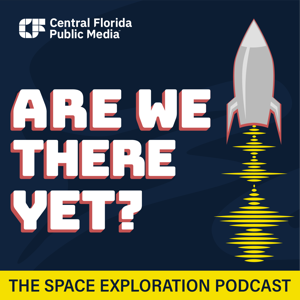
Are We There Yet?

Are We There Yet?

By Central Florida Public MediaScience
Download on the App Store
  • Favorites

    121

    Followers

  • Typical duration

    28 min

    per episode

Based on Podcast App listening data

Are We There Yet? episodes

  • Just A Hop, Skip And A Parsec Away
    You’ve probably already heard by now, but scientists just discovered an exoplanet that might be like Earth. It’s pretty close, too — only about a parsec, or 4 light years away. Observers discovered it by noticing a wobble in the star Proxima Centari. That wobble was from the tug of this exoplanet.
    Now, it’s time to verify the results. Joseph Harrington is a planetary scientist in the Department of Physics at the University of Central Florida. He’s going to try and spot evidence of the planet using telescopes in space. He talks to host Brendan Byrne about the work  and what a discovery of this magnitude means for astronomy.
    18 min
  • The Case Of The Missing T-Cells
    We talk a lot about the hardware that’s going to get us to Mars, but the most important things about human spaceflight is, well, humans! There’s a lot of research going into the impact space travel has on the body. Just think back to Scott Kelly’s year in space.
    We’re going to have to jump over quite a bit of physiological hurdles when traveling to deep space. There’s living in reduced gravity environment, dealing with radiation, nutrient deficiencies, all sorts of challenges.
    There’s also the immune system. My next guest found something rather interesting about astronauts. When they came back from space after spending multiple months in space, they were getting sick. Not like a cold or anything, but viruses that should have been kept in check by their T-cells.
    Dr. Krishna Komanduri, is a researcher at the Sylvester Comprehensive Cancer Center at the University of Miami and he looking into what was causing the flare ups of dormant viruses in astronauts…

    23 min
  • Fly Me To The Moon
    Moon Express is a startup company competing for Google’s Lunar XPRIZE. That’s a prize of at least $15 million to the first private company to make it to the moon.
    But Moon Express doesn’t have their eyes set on just the prize — they want to mine valuable resources on the lunar surface and establish a fuel stop for deep space craft exploration the solar system.
    My next guest is Bob Richards. He’s the CEO of Moon Express. He says that establishing a way to refuel vehicles on the moon is imperative to exploring other spots in deep space. And he’s making great progress.
    One of the challenges he’s run into is not how to get to the moon, or even working on the moon. The challenge was getting permission to go to the moon. Recently, he received approval from the FAA to leave earth’s orbit,  a first for a commercial company.
    27 min
  • The First Martians
    On this podcast we’ve been focusing a lot on the technology of space exploration. We talked to rocket engineers, scientists, designers. But the ultimate goal of Martian exploration is to colonize the planet — and while all this technology is imperative in getting humans to Mars, there’s one aspect of this ambition we haven’t really talked about yet. The first Mars colonists.
    Mars One is a global non-profit with the goal of sending the first group of colonists to the Red Planet in the 2020s. George Hatcher is one of the final 100 candidates being considered for the first corps or astronauts heading to Mars… forever.
    20 min
  • How Did We Get Here?
    You know, most of the time on this podcast we’re looking forward. We’re looking to the future — at all the neat stuff that’s going to get us to Mars.
    While this podcast asks the question “are we there yet?”, Jason Davis thinks it’s an equally important question to ask “how did we get here?”
    Davis is the Digital Editor at the Planetary society. In his reporting series “Horizon Goal”, Jason is looking at the events, starting in 2003, that led NASA to this point in our journey to Mars.
    27 min
  • They See Me Rovin’
    Before we send humans to Mars, we’re exploring the red planet with rovers. We talked a bit about Mars 2020, the next martian rover, in an earlier episode of this podcast. But I want to revisit that…
    And that’s because NASA reached a critical milestone in the development of the rover. They’re moving to the final phase of design, and we’re getting more details on the science equipment on board. And you know what’s really cool? Engineers are slapping a microphone on Mars 2020. We’re going to hear what the surface of Mars sounds like.
    The Mars 2020 rover uses the ‘sky crane’ technique to land on Mars. Take a look at how it works, thanks to the folks at National Geographic.

    And here’s some video from Curiosity’s decent onto the red planet.

    18 min
  • Baby Got Boosters
    NASA wants to head to Mars. To do that, they’re developing a brand new rocket called the Space Launch System, or SLS.
    It’s a rocket, but it’s borrowing some parts for the Space Shuttle. The main engines on SLS, for example, are the RS-25 engines used on the shuttle.
    But just leaving the Earth’s gravity requires a huge amount of thrust. So the hammer that’s going to launch SLS are two Solid Rocket Boosters. The shuttle used these technologies, too. They provide a lot of thrust really fast.
    Engineers at NASA just wrapped up a test firing of the booster’s engineers out in Utah. Bruce Tiller is the Deputy Manager for SLS Boosters at NASA. He was at the test and joins us to talk all things Solid Rocket Boosters.
    22 min
  • Thirsty? Urine Luck.
    If we’re going to go on a long-duration mission like one to Mars we’re going to need a few essentials. Fuel, food and water. All this stuff takes up mass. And mass requires fuel to get it from Earth into space.
    So what if we could recycle some of these things while en route to Mars? Let’s think about water. Water goes in, water comes out, and you drink it? Ew!
    Well, surprisingly NASA astronuats uses a urine recycling system on the International Space Station, but it’s only about 80-percent efficienc. Lauren Kelsey, principal investigator and program manager for the water recovery project with Paragon Space Development Corporation, is working on new technology that makes urine recycling more efficient.
    18 min
  • What ‘Chu Know About Juno?
    It’s been five years since Juno launched from Cape Canaveral heading to Jupiter. Once it enters its polar orbit, we’re going to learn so much about the make-up of our solar system’s largest planet, as well as key scientific findings that will help us better understand how planets and solar systems form.
    The Planetary Society’s Emily Lakdawalla follows the Juno mission. She joins the podcast to bring us up to speed before Juno reaches Jupiter on July 4.
     
    19 min
  • If You Build It…
    If we’re going to work and live on Mars, we need a place to live, right? There are all sorts of plans to bring habitats with us — something like an inflatable habitat.
    That’s great and all, but you need to get it there. And extra mass means extra fuel. What if we could build a habitat when we get there?
    That’s the question NASA asked to some ambition teams of engineers. Design a 3d-printer so to speak that uses the resources already on mars — like martian dust — to build a habitat.
    Keegan Kirkpatrick is the Team Lead at RedWorks 3D  and he’s onto something.
    22 min

About Are We There Yet?

From the publisher's feed

Your weekly podcast journey into the latest news, missions, and stories shaping space exploration.

More shows like Are We There Yet?

Big Picture Science by Big Picture Science

Big Picture Science

940 Listeners

Planetary Radio: Space Exploration, Astronomy and Science by The Planetary Society

Planetary Radio: Space Exploration, Astronomy and Science

1,335 Listeners

SpaceTime with Stuart Gary by Stuart Gary

SpaceTime with Stuart Gary

318 Listeners

Ask a Spaceman! by Paul M. Sutter

Ask a Spaceman!

835 Listeners

Astronomy Cast by Fraser Cain and Dr. Pamela Gay

Astronomy Cast

2,874 Listeners

Universe Today Podcast by Fraser Cain

Universe Today Podcast

564 Listeners

Walkabout the Galaxy by Joshua Colwell, Adrienne Dove, and James Cooney

Walkabout the Galaxy

116 Listeners

Growing Bolder by Central Florida Public Media

Growing Bolder

38 Listeners

The Quanta Podcast by Quanta Magazine

The Quanta Podcast

542 Listeners

Space Nuts: Astronomy Insights & Cosmic Discoveries by Professor Fred Watson and Andrew Dunkley

Space Nuts: Astronomy Insights & Cosmic Discoveries

232 Listeners

Main Engine Cut Off by Anthony Colangelo

Main Engine Cut Off

284 Listeners

Houston We Have a Podcast by National Aeronautics and Space Administration (NASA)

Houston We Have a Podcast

1,251 Listeners

Off-Nominal by Jake Robins, Anthony Colangelo

Off-Nominal

84 Listeners

WMFE Presents StoryCorps Orlando by 90.7 WMFE

WMFE Presents StoryCorps Orlando

1 Listeners

The Supermassive Podcast by The Royal Astronomical Society

The Supermassive Podcast

327 Listeners

Why This Universe? by Dan Hooper, Shalma Wegsman

Why This Universe?

387 Listeners

Astrum Space by Astrum

Astrum Space

149 Listeners