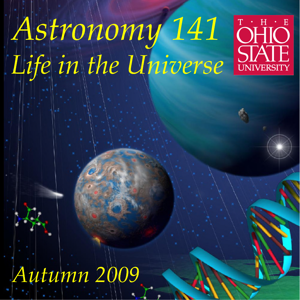
Astronomy 141 - Life in the Universe - Autumn Quarter 2009

Astronomy 141 - Life in the Universe - Autumn Quarter 2009

Download on the App Store
  • Ranking

    26th

    on Astronomy

  • Favorites

    77

    Followers

  • Typical duration

    46 min

    per episode

Based on Podcast App listening data

Astronomy 141 - Life in the Universe - Autumn Quarter 2009 episodes

  • Lecture 16: DNA and Heredity
    DNA and RNA are the key molecules of living cells. DNA plays a vital role
    in storing and transmitting the hereditary information that constitutes
    the "operating instructions" of living cells; how to construct the functional
    and structural proteins that perform vital cell functions, control
    developmental pathways, and basically "build" the organism. RNA is the
    crucial actor in protein synthesis and other cell functions. Mutations,
    changes in the DNA coding, are the molecular basis for evolution,
    providing the genetic variation required by natural selection.
    Understanding the molecular basis of heredity and evolution gives us
    important insights into the functional requirements for life. Recorded
    live on 2009 Oct 15 in Room 1005 Smith Laboratory on the Columbus campus
    of The Ohio State University.
    47 min
  • Lecture 15: The Chemistry of Life
    What is the basic chemistry of living organisms?
    We introduce the requirements for metabolism (raw
    materials and energy), the ATP/ADP energy cycle in cells, auto- and
    heterotrophs, photosynthesis and chemosynthesis, and the role played by
    liquid water. The goal of today's lecture is to seek insights into the
    basic requirements for life from a consideration of the needs of the
    cells' chemistry. Recorded live on 2009 Oct 14 in Room 1005 Smith
    Laboratory on the Columbus campus of The Ohio State University.
    46 min
  • Lecture 14: Cells
    Cells are the basic structural and functional unit of all life on Earth.
    This lecture reviews the basic building blocks of cells, the main
    chemical components, the two basic types of cells (Prokaryotes and
    Eukaryotes), and introduces the Phylogenetic Tree of Life, the way
    biologists order life by their biochemical and genetic relationships.
    Understanding life at the cellular level gives us important insights
    into the nature and history of life on Earth, and clues as to what we
    might look for elsewhere. Recorded live on 2009 Oct 13 in Room 1005
    Smith Laboratory on the Columbus campus of The Ohio State University.
    46 min
  • Lecture 13: What is Life?
    How do we define life? This lecture reviews the six basic criteria
    for living systems described by biologists: order, reproduction, growth and
    development, energy utilization, reaction to environment, and evolution
    that characterize life. The last third of the lecture is an admittedly
    whirlwind review of natural selection (I got off my stride and got a
    little rushed for time at the end). The goal is not a complete survey
    of current biological thought, but to highlight those characteristics of
    "life" that may best inform us as to how to look for signs of life
    elsewhere in the Universe. Recorded live on 2009 Oct 12 in Room 1005
    Smith Laboratory on the Columbus campus of The Ohio State University.
    47 min
  • Lecture 12: Climate Regulation and Climate Change
    What are the main mechanisms of climate regulation and climate
    change that have operated through Earth's history? The Earth's
    climate is regulated by a Carbon Dioxide thermostat that is the
    interaction between the Greenhouse Effect and the CO2 Cycle. I describe
    the CO2 cycle and its role in regulating global temperature. I will
    then discuss other influences on climate, and periods of glaciation (ice
    ages) in the recent and distant past, including the possible Snowball
    Earth events in the early and late Proterozoic Eon. Recorded live on
    2009 Oct 8 in Room 1005 Smith Laboratory on the Columbus campus of The
    Ohio State University.
    46 min
  • Lecture 11: The History of the Earth
    How have we pieced together the geological history of the Earth?
    This lecture reviews the different types of rocks and the cycle
    of transformation between them, with particular emphasis on stratigraphy.
    I will outline the 4 major Eons in Earth's history, and focus on the
    earliest Hadean Eon which proceeded from the formation of the Earth to
    the end of the epoch of Heavy Bombardment. The Hadean Eon saw the formation
    of the primordial atmosphere of the Earth and the formation of the Oceans.
    Recorded live on 2009 Oct 7 in Room 1005 Smith Laboratory on the Columbus
    campus of The Ohio State University.
    43 min
  • Lecture 10: The Earth's Atmosphere Erratum
    This lecture was to be about the Earth's atmosphere, its composition and
    structure, the greenhouse effect, and the primordial atmosphere, but
    about 2 seconds into the lecture, unbeknownst to me, the battery
    compartment on my digital voice recorder came open in my pocket. At the
    end of lecture, I took it out of my pocket to turn it off and the
    battery didn't come with it. Oops! Fail. My apologies, I'll put in
    some work to prevent a recurrence in future lectures. Recorded live on
    2009 Oct 6 in Room 1005 Smith Laboratory on the Columbus campus of The
    Ohio State University.
    2 min
  • Lecture 9: Inside the Earth
    What is the interior structure of the Earth and how does it drive the
    Earth's magnetic and geologic activity? We will review our current
    knowledge of the interior of the Earth, how we measure it using
    Seismology, the origins of the Earth's magnetic field, and discuss the
    workings of plate tectonics. the Earth is a dynamic, geologically
    active world, which has interesting implications later for understanding
    the past and future history of life on Earth. Recorded live on 2009 Oct
    5 in Room 1005 Smith Laboratory on the Columbus campus of The Ohio State
    University.
    43 min
  • Lecture 8: The Cosmological Revolution - The Depths of Space and Time
    Cosmology is the study of the entire Universe as a physical system. The
    past century has witnessed a revolution in cosmological thought that has
    revealed the vastness of space and the depths of cosmic time, a revolution
    that is still playing out in the present day. The lecture will review the
    Earth's place in the Universe, the age of the Universe as reckoned by the time
    since the Big Bang, and the origin of the elements. We will return to
    many of these topics later in the course, but this presents the big
    picture. Recorded live on 2009 Oct 2 in Room 1005 Smith Laboratory on
    the Columbus campus of The Ohio State University.
    47 min
  • Lecture 7: The Biological Revolution - What is Life?
    What is the nature of life? In this lecture I will review the revolution
    in biological thinking that has dramatically changed how we view life.
    I will review such persistent ancient ideas as spontaneous generation
    and why it took so long to disprove this notion, the impact of the
    microscope on biology, and the discovery of the laws and agency of heredity.
    This is obviously a highly-selective view of a vast topic, and my goal is
    to highlight those episodes in the history of biology that inform us about
    the nature of science (its successes and failures), and which we will concern
    ourselves with in the rest of the course. Listeners will note that I do
    not introduce Evolution (more precisely, Natural Selection) since that
    is a huge other topic for another day. Recorded live on 2009 Oct 1 in
    Room 1005 Smith Laboratory on the Columbus campus of The Ohio State
    University.

    45 min

About Astronomy 141 - Life in the Universe - Autumn Quarter 2009

From the publisher's feed

Astronomy 141, Life in the Universe, is a one-quarter introduction to

Best of Astronomy 141 - Life in the Universe - Autumn Quarter 2009

Ranked by our users in the last 21 days

More shows like Astronomy 141 - Life in the Universe - Autumn Quarter 2009

This American Life by This American Life

This American Life

90,968 Listeners

Radiolab by WNYC Studios

Radiolab

43,801 Listeners

StarTalk with Neil deGrasse Tyson by Neil deGrasse Tyson

StarTalk with Neil deGrasse Tyson

14,355 Listeners

In Our Time by BBC Radio 4

In Our Time

5,481 Listeners

The Infinite Monkey Cage by BBC Radio 4

The Infinite Monkey Cage

1,905 Listeners

Big Picture Science by Big Picture Science

Big Picture Science

935 Listeners

Planetary Radio: Space Exploration, Astronomy and Science by The Planetary Society

Planetary Radio: Space Exploration, Astronomy and Science

1,337 Listeners

SpaceTime with Stuart Gary by Stuart Gary

SpaceTime with Stuart Gary

317 Listeners

Ask a Spaceman! by Paul M. Sutter

Ask a Spaceman!

832 Listeners

Astronomy Cast by Fraser Cain and Dr. Pamela Gay

Astronomy Cast

2,878 Listeners

Universe Today Podcast by Fraser Cain

Universe Today Podcast

567 Listeners

Throughline by NPR

Throughline

16,352 Listeners

The Supermassive Podcast by The Royal Astronomical Society

The Supermassive Podcast

324 Listeners

The World, the Universe and Us by New Scientist

The World, the Universe and Us

112 Listeners

Astrum Space by Astrum

Astrum Space

151 Listeners