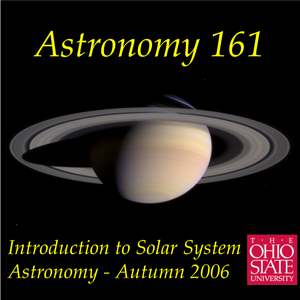
Astronomy 161 - Introduction to Solar System Astronomy

Astronomy 161 - Introduction to Solar System Astronomy

By Richard Pogge

... more

  • 4.6
  • 4.6
  • 4.6
  • 4.6
  • 4.6

4.6

266 ratings


Download on the App Store

Best of Astronomy 161 - Introduction to Solar System Astronomy

The most played episodes among Podcast App listeners.

  1. Number 1: Lecture 46: ExoPlanets - Planets around Other Stars

    Are there planets around other stars? Are there Earth-like planets around other stars? Do any of those harbor life? Intelligent life? We'd like to know the answers to all of these questions, and in recent years we've made great progress towards at least answering the first. To date, more than 200 planets have been found around other stars, most in the interstellar neighborhood of the Sun, but a few at great distance. This lecture reviews the search for ExoPlanets, discussing the successful Doppler Wobble, Transit, and Microlensing techniques. What we have found so far are very suprising systems, especially Jupiter-size or bigger planets orbiting very close (few hundredths of an AU) from their parent stars. The existance of a significant population of so-called "Hot Jupiters" may be telling us that planetary migration can be much more extreme that we saw in our own Solar System, or that these planetary system formed in a very different way than ours. It seems appropriate to end this class with more questions than answers, but that's where the science becomes most exciting. Recorded 2006 Dec 1 in 100 Stillman Hall on the Columbus campus of The Ohio State University.

    0min
    Listen Later
  2. Number 2: Lecture 45: Is Pluto a Planet?

    What is a planet? Is Pluto a planet? This lecture traces the debate on the nature of what it means to be a planet by taking an historical approach, looking at how the question has arisen with the discovery of the asteroids and later Pluto and the Kuiper Belt. Many of the issued raised at the 2006 IAU General Assembly meeting were raised two centuries before after the discovery of Ceres and Pallas. We will end with the new definition of a planet, and why Pluto is better understood as a Dwarf Planet, among the two largest objects of the class of small icy bodies of the outer solar system, than as the smallest of the planets. Recorded 2006 Nov 30 in 100 Stillman Hall on the Columbus campus of The Ohio State University.

    0min
    Listen Later
  3. Number 3: Lecture 44: Comets

    Comets are occasional visitors from the icy reaches of the outer Solar System. This lecture discusses the orbits, structure, and properties of comets, and introduces the "dirty snowball" model of a comet nucleus. The end of class was a demo where I created a model of a comet nucleus from common household and office materials. Imagine a twisted combination of Alton Brown and Emeril Lagasse with a PhD in Astrophysics and you get the idea. We were not able to arrange for a videographer to come, but we did get some stills before the batteries died on the digital camera. The pictures are on the lecture webpage. The lecture is slightly abbreviated because we did the student evaluation of instruction surveys before class started. Recorded 2006 Nov 29 in 100 Stillman Hall on the Columbus campus of The Ohio State University.
    0min
    Listen Later
  4. Number 4: Lecture 43: Icy Worlds of the Outer Solar System

    Beyond the orbit of Neptune is the realm of the icy worlds, ranging in size from Triton, the giant moon of Neptune, and the dwarf planets Pluto and Eris, all the way down to the nuclei of comets. This lecture discussed the icy bodies of the Trans-Neptunian regions of the Solar System, discussing the basic properties of Triton (the best studied such object), Pluto, Eris, and the Kuiper Belt, introducing the dynamical families of Trans-Neptunian Objects that record in their orbits the slow migration of Neptune outwards during the early history of the Solar System. The Kuiper Belt is the icy analog of the main Asteroid Belt of the inner Solar System: both are shaped by their gravitational interaction with giant gas planets (Jupiter for the asteroids, Neptune for the KBOs), and are composed of leftover raw materials from the formation of their respective regions of the Solar System. Recorded 2006 Nov 28 in 100 Stillman Hall on the Columbus campus of The Ohio State University.

    0min
    Listen Later
  5. Number 5: Lecture 42: Asteroids and Meteoroids

    Asteroids are the leftover rocky materials from the formation of the Solar System that reside mainly in a broad belt between the orbits of Mars and Jupiter. Meteoroids are fragments of asteroids or bits of debris from passing comets that occasionally pass through our atmosphere as meteors, and even more rarely survive the fiery passage to reach the ground as a meteorite. This lecture reviews the physical and dynamical (orbital) properties of Asteroids and Meteoroids, and discusses the role of Jupiter and orbital resonances in dynamically sculpting the Main Belt. Recorded 2006 Nov 27 in 100 Stillman Hall on the Columbus campus of The Ohio State University.

    0min
    Listen Later

Astronomy 161 - Introduction to Solar System Astronomy episodes:

FAQs about Astronomy 161 - Introduction to Solar System Astronomy:

How many episodes does Astronomy 161 - Introduction to Solar System Astronomy have?

The podcast currently has 47 episodes available.

More shows like Astronomy 161 - Introduction to Solar System Astronomy

Planetary Radio: Space Exploration, Astronomy and Science by The Planetary Society

Planetary Radio: Space Exploration, Astronomy and Science

1,345 Listeners

Astronomy 141 - Life in the Universe - Autumn Quarter 2009 by Richard Pogge

Astronomy 141 - Life in the Universe - Autumn Quarter 2009

189 Listeners

Astronomy Cast by Fraser Cain and Dr. Pamela Gay

Astronomy Cast

2,859 Listeners

Universe Today Podcast by Fraser Cain

Universe Today Podcast

565 Listeners

Sky Tour Astronomy Podcast by American Astronomical Society

Sky Tour Astronomy Podcast

272 Listeners

Dan Snow's History Hit by History Hit

Dan Snow's History Hit

4,765 Listeners

Space Nuts: Astronomy Insights & Cosmic Discoveries by Professor Fred Watson and Andrew Dunkley

Space Nuts: Astronomy Insights & Cosmic Discoveries

231 Listeners

Casefile True Crime by Casefile Presents

Casefile True Crime

37,622 Listeners

Stay Tuned with Preet by Preet Bharara

Stay Tuned with Preet

32,301 Listeners

The Bulwark Daily by The Bulwark

The Bulwark Daily

12,596 Listeners

The Supermassive Podcast by The Royal Astronomical Society

The Supermassive Podcast

331 Listeners

NASA's Curious Universe by National Aeronautics and Space Administration (NASA)

NASA's Curious Universe

890 Listeners

The Astrophysics Podcast by Paul Duffell

The Astrophysics Podcast

67 Listeners

Bedtime Astronomy by Synthetic Universe

Bedtime Astronomy

47 Listeners

Sherlock Holmes Short Stories by NOISER

Sherlock Holmes Short Stories

951 Listeners