
Sign up to save your podcasts
Or

By Richard Pogge


4.7
206206 ratings


The podcast currently has 43 episodes available.
The most played episodes among Podcast App listeners.
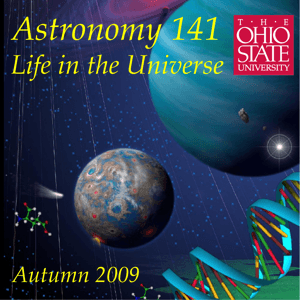
How do stars form? The Sun is old and in Hydrostatic and Thermal equilibrium. How did it get that way? This lecture presents the basic steps of star formation as a progress from cold interstellar Giant Molecular Clouds to Protostars in Hydrostatic Equilibrium, and then Pre-Main Sequence evolution which ends in ignition of core Hydrogen fusion and establishing Thermal Equilibrium on the Zero-Age Main Sequence. Recorded 2006 January 24 in 1008 Evans Laboratory on the Columbus campus of The Ohio State University.

What are the physical laws that determine the internal structure of stars? We first introduce the Mass-Luminosity Relation for Main Sequence stars, as well as seeing how the mean density of stars differs for stars on different parts of the H-R diagram. We then introduce the Ideal Gas Law, which relates pressure, density, and temperature, and show how the internal structure of a star is determined by a continuous tug-of-war between internal pressure trying to blow the star apart, and self-gravity trying to make it collapse. The balance between the two is the state of Hydrostatic Equilibrium. How the balance is maintained, and what happens when it is tipped in favor of either will determine the appearance and subsequent evolution of the star. Recorded 2006 January 18 in 1008 Evans Laboratory on the Columbus campus of The Ohio State University.
How will the Sun evolve? The Sun is now a middle-aged, low-mass, Main Sequence star in a state of hydrostatic and thermal equilibrium that has consumed about half of the Hydrogen available for fusion in its core. What will its subsequent evolution be as its core runs out of Hydrogen? This lecture describes our current state of understanding of the expected evolution of the Sun, informed by a combination of state-of-the-art solar models and stellar evolution codes, and data gathered from observations of nearby stars in our Galaxy. We will trace the future history of the Sun from the present until it begins its final phase as a fading White Dwarf some 8 Billion years in the future. Along the way, we'll also ask what will become of Earth. Recorded 2006 March 6 in 1008 Evans Laboratory on the Columbus campus of The Ohio State University.
What was the Universe like from the earliest phases immediately after the Big Bang to the present day? This lecture reviews the physics of matter, and follows the evolution of the expanding Universe from the first instants after the Big Bang, when all 4 forces of nature were unified in a single grand-unified superforce until the emergence of the visible Universe we see around us today. Recorded 2006 March 1 in 1008 Evans Laboratory on the Columbus campus of The Ohio State University.
The Universe today is old, cold, low-density, and expanding. If we run the expansion backwards, we will eventually find a Universe where all the matter was in one place where the density and temperature are nearly infinite. We call this hot, dense initial state of the Universe the Big Bang. This lecture introduces the Big Bang model of the expanding universe, and how the history of the Universe depends on two numbers: the curretn expansion rate (H0), and the relative density of matter and energy (Omega0). Combined with observations, these give us an estimate of the age of the Universe of 14.0 +/- 1.4 Gyr. Recorded 2006 February 27 in 1008 Evans Laboratory on the Columbus campus of The Ohio State University.
The podcast currently has 43 episodes available.
724 Listeners
1,337 Listeners
319 Listeners

833 Listeners
188 Listeners

2,873 Listeners

567 Listeners

233 Listeners
2,360 Listeners
331 Listeners
3,373 Listeners
380 Listeners

522 Listeners
68 Listeners
573 Listeners