
Sign up to save your podcasts
Or

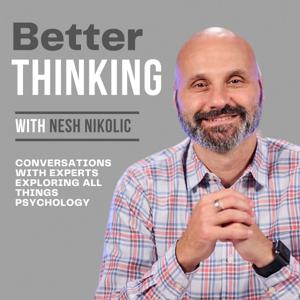


In this episode of Better Thinking, Nesh Nikolic speaks with Damien Stewart about the impact of intergenerational trauma, how traumatic experiences can influence subsequent generations, and what this means for mental health and wellbeing.
As well as an elite level athlete, Damien resigned from a 20-year career as a police Officer in 2012 to pursue a career in psychology. Damien completed two master’s degrees at the University of Queensland: A Master of Philosophy researching the effect of Social Identity Theory on alcohol use within male team sport athletes, and a Master of Applied Psychology in Sport & Exercise Psychology.
After graduating in 2014, Damien entered private practice in which he is highly focused on assisting current and previous serving Police and Military personnel suffering from mental health issues as a result of their career (e.g., depression, anxiety, and trauma). Damien also has a special interest in working with clients suffering from chronic pain and injury as well as athletes seeking to enhance performance and gain assistance for mental health and other issues.
Damien is a previous National Chair of the Australian Psychological Society (APS) College of Sport & Exercise Psychologists and a previous National Convenor of the APS Military and Emergency Services Interest Group. Damien has lectured in Psychology at the Institute for Social Neuroscience in Melbourne, Australia, as well as at the University of Warsaw. Damien completed a PhD in November 2025 through La Trobe University, in conjunction with the University of Warsaw, on Intergenerational Trauma in Poland following WWII.
Damien will soon continue with post-doctoral research at the Centre for Research on Prejudice under Associate Professor Michal Bilewicz at the University of Warsaw, focusing on the effect of trauma on conspiracy thinking. Damien combines his research on intergenerational trauma in Poland following WWII with being the Director of a Polish registered business, Poland at War Tours, a collection of tours designed to educate people on the occupation of Poland, The Holocaust, and Polish resistance during WWII. Damien was also recently appointed Head of Poland for the Polish Australian Chamber of Commerce.
In this episode of Better Thinking, Nesh Nikolic speaks with Niklas Törneke about understanding human behaviour through Acceptance and Commitment Therapy, Relational Frame Theory, and the practical use of language and metaphor in psychological change.
Niklas Törneke is a Swedish psychiatrist, psychotherapist and a peer-reviewed ACT trainer. He has written a series of books on how to apply behavioral principles to psychotherapy, such as Learning RFT (2010) and Using Functional Analysis in Psychotherapy (2025). He has wide experience training clinical workers all over the world.
In this episode of Better Thinking, Nesh Nikolic speaks with Dr Ella Moeck about how emotions shape the way people remember the past, think about the future, and respond to uncertainty.
Dr Ella Moeck is a Lecturer in Psychology at Adelaide University who researches the intersection between cognitive and social psychology. Ella completed her PhD in 2019 at Flinders University before spending a few years working as a postdoctoral researcher at the University of Melbourne. In 2024, Ella started a balanced teaching and research role at Adelaide University, where she directs the Emotion, Memory and Uncertainty lab.
Ella’s research centres around the interactions between cognition and emotion. Broadly, she aims to understand how everyday stressful events shape people's emotions, and ability to manage their emotions. Recently, Ella has been focusing on emotional functioning during uncertain events, like waiting for medical test results, exam grades, or the outcomes of court proceedings. She has also been investigating the association between emotions and social media, with a focus on the occurrence and consequences of seeing negative content online. Ella’s research combines experimental and experience sampling methods, where people complete multiple smartphone surveys each day. This type of method means she researches people in the moments when they experience stressors in their day-to-day
In this episode of Better Thinking, Nesh Nikolic speaks with Stacey Parker about how jobs and careers can be designed to maximise wellbeing, motivation, and performance, and what psychological principles can help create healthier and more fulfilling working lives.
Associate Professor Stacey Parker is an organisational psychologist and academic for the School of Psychology, University of Queensland, Australia. Her research aims to help organisations and their employees devise strategies for realising the dual concerns of feeling well and performing well. To this end, she examines how employees manage their energy during work, how employees recover from work stress in off-the-job time, and how jobs and careers can be designed to maximise well-being, motivation, and performance. She also explores the hidden costs of performance management systems.
She studies these phenomena using controlled work simulations and field research in a range of high-performance settings (e.g., small business owners, professional musicians, elite athletes, and safety critical work in healthcare and transport industries). Her consulting and advisory work has included tackling issues with selection and recruitment, training and development, career management, work design, change management, and operational safety.
She serves on the Editorial Boards for the Journal of Occupational and Organizational Psychology, Journal of Occupational Health Psychology, and European Journal of Work and Organisational Psychology. Her achievements have been recognised by the Australian Psychological Society, with a Doctoral Thesis Award in Occupational Health Psychology (2013) and Early Career Award in Organisational Psychology (2022).
In this episode of Better Thinking, Nesh Nikolic speaks with Professor Jennifer Hudson about the factors that shape children’s emotional health and how we can improve support and services for children experiencing anxiety and other emotional disorders.
Professor Jennifer Hudson has made distinguished contributions to the scientific understanding and clinical treatment of anxiety disorders in children and adolescents as a fellow of the Australian Academy of Social Sciences (2018) and an NHMRC Investigator Fellow (Level 2, 2022-2027). She has delivered sustained and influential insights into the complex aetiology of anxiety, as well as developed and validated innovative, accessible interventions.
She was awarded an ARC Future Fellowship (2013-2016), and a Visiting Fellowship, University of Oxford (2015-20), and is recognised as a world leader for her work on parent-child interactions and the development and treatment of anxiety. Professor Hudson also brings her expertise to government advisory panels, such as the Medical Research Future Fund’s Childhood Mental Health Research Plan Expert Advisory Panel, for which she was appointed Chair by the Federal Minister for Health and Aged Care.
She plays an influential role in Australian policy as a trusted expert in child mental health, and currently leads the Child Mental Health research program at the Black Dog Institute.
In this episode of Better Thinking, Nesh Nikolic speaks with Dr Eden Robertson about the psychosocial needs of families affected by rare disease and how lived experience can drive better, more compassionate healthcare.
Dr Eden Robertson is a Sydney‑based behavioural scientist specialising in understanding and addressing the psychosocial needs of children and families navigating complex, rare disease. For more than a decade, she has worked alongside families, clinicians and advocacy organisations to identify unmet needs and co‑design interventions that are both evidence‑based and genuinely usable in real‑world care. Her academic training spans a Bachelor of Psychology (Honours), a Graduate Certificate in Adolescent and Young Adult Health and Wellbeing, and a PhD in Medicine.
Eden has made significant contributions to her field, including developing the world’s first family decision‑making resource for childhood cancer clinical trials, designing and evaluating a new model of care for caregivers of children with genetic epilepsy, and more recently supporting people affected by inherited retinal diseases to better understand and engage with advanced therapeutics. Highlighting her leadership in the field, she was awarded a prestigious Fulbright Scholarship in 2020.
Drawing on experience across academia, health services and the non‑profit sector, Eden brings a unique cross‑system perspective that strengthens her ability to translate evidence into meaningful, practical solutions for children, families and the teams who support them.
In this episode of Better Thinking, Nesh Nikolic speaks with Professor Simon Rosenbaum about the intersection of physical activity and mental health, and how movement can play a powerful role in improving psychological wellbeing.
Simon is an academic exercise physiologist with a focus on populations exposed to trauma and social disadvantage. Simon has published over 300 peer-reviewed publications and co- edited a textbook on exercise and mental illness. He is a past President of the Australasian Society for Traumatic Stress Studies (ASTSS) and was the inaugural co-chair of the Olympic Refuge Foundation’s Think Tank on sport and humanitarian settings. Simon is a Clarivate Highly Cited Researcher for Mental Health and has delivered workshops in over 25 countries.
He previously worked with the United Nations International Organisation for Migration as a community-based mental health and psychosocial support officer in the Rohingya refugee camps in Bangladesh. Simon is currently supported by an NHMRC Emerging Leadership Fellowship. In Australia, Simon is the founder of ‘Addi Moves’, a free, trauma-informed, exercise facility for people experiencing trauma and social exclusion at the Addison Road Community Organisation in Marrickville, Sydney.
Listen on Apple Podcasts and Spotify
In this episode of Better Thinking, Nesh Nikolic speaks with Dr James Morandini about advancing research across gender identity, gender dysphoria, sexual orientation, and the mental health challenges connected to these areas.
James Morandini is a clinical psychologist and researcher whose clinical and research work focuses on matters of gender dysphoria/identity and sexuality. James has published widely on sexuality/gender in academic journals, including more than 20 empirical articles on these topics, and maintains active involvement in clinically relevant research in sex and gender. James completed a Ph.D in Psychology at The University of Sydney under A/Prof Ilan Dar-Nimrod and Professor Alex Blaszczynski between 2011 and 2016, examining ontological beliefs about sexual orientation held by LGBTQ+ individuals and their implications for self-acceptance and mental health.
He subsequently completed a Postdoctoral Fellowship with A/Prof Ilan Dar-Nimrod between 2016 and2020 funded by Australian Research Council and Templeton Grants. Dar-Nimrod and Morandini have created a hub for sexuality and gender research in the School of Psychology, at The University of Sydney, that is both socially minded and affirming while being scientifically rigorous and at the very cutting edge of sex research. James has pursued an “alternative” academic career since 2020 founding King Street Psychology Clinic.
James lectures on gender/sexuality diversity in undergraduate and postgraduate clinical programs (including UTS, UWS, ACU, ACAP, USYD), is an Honorary Research Associate at The University of Western Sydney and University of Technology Sydney, as well as a Ph.D. and higher degree supervisor at The University of Sydney School of Psychology. He provides clinical supervision on these issues to clinical psychologists and other health professionals in Australia and abroad, including in his capacity as National Convenor of the Psychology of Diverse Bodies, Genders, Sexualities Interest Group of the Australian Psychological Society (APS).
In this episode of Better Thinking, Nesh Nikolic speaks with Lou Lasprugato about ACT within the therapeutic relationship, including process-based functional assessment and shaping psychological flexibility.
Lou Lasprugato is a psychotherapist and internationally recognized trainer in the field of psychology. He is a Peer-Reviewed Trainer in Acceptance and Commitment Therapy (ACT) with the Association for Contextual Behavioral Science (ACBS), for which he also served as Chair of the Training Committee from 2022-2025. In 2025, Lou was elected into the ACBS Fellowship for his contributions in ACT dissemination.
Lou is a licensed Marriage and Family Therapist, with private practices in both California and Virginia (United States), working with both individuals, including college students, and couples. He also has extensive experience in facilitating skill-building and process-based groups. Lou specializes in therapy for intimate partners and the treatment of anxiety disorders, and is a member of the International OCD Foundation.
He has worked as a psychotherapist in a variety of settings, including county-operated crisis intervention services with underserved populations; a mental health and substance abuse intensive outpatient program at Kaiser Permanente that he subsequently managed; and an integrative medicine program at Sutter Health. Lou has taught mindfulness meditation to health care practitioners and facilitated over one hundred training events on ACT, including InterACT for couples and clinically-applied relational frame theory (RFT), as well as co-created courses on nutritional psychology and integrative mental health treatment.
Lou has also provided supervision to other behavioral/mental health professionals and students and continues to provide individual and group consultation on ACT and other contextual behavioral approaches. He earned his Master of Arts in Counseling Psychology, with a specialization in Holistic Studies from Lesley University, Cambridge, MA, following a career as a professional musician.
In this episode of Better Thinking, Nesh Nikolic speaks with Professor Philip Batterham about advancing more efficient and precise methods for assessing suicidality and mental disorders.
Philip Batterham is a Professor and Co-Head at the Centre for Mental Health Research, The Australian National University in Canberra, Australia. Phil is a research leader in improving access to evidence-based support for mental ill health and suicidal thoughts. He has specific interests in the etiology of suicidal behaviour, assessment of suicidality and mental disorders, implementation of online prevention programs, and reducing barriers to help seeking.
Phil has published 320 journal articles and received >$50M in research funding as a Chief Investigator. He has received national and international awards for his research, including the Commonwealth Health Minister’s Award for Excellence in Health and Medical Research, the Professor Vera Morgan Medal for Mental Health Epidemiology, and the inaugural NHMRC Peer Review Excellence Award. He currently leads a major longitudinal cohort study to better understand transitions into suicidal behaviour.
From the publisher's feed

2,512 Listeners

1,381 Listeners

124 Listeners

558 Listeners

325 Listeners

8,307 Listeners

1,347 Listeners

11,949 Listeners

4,064 Listeners

27,962 Listeners

386 Listeners

29,171 Listeners

11 Listeners

859 Listeners

117 Listeners