
Sign up to save your podcasts
Or



What happens when technology stops serving humanity and begins redefining it?
In this episode of Brave New Us, Samantha Stephenson sits down with Dr. John Grabowski, professor of moral theology and ethics at The Catholic University of America and author of A Catholic Guide to Being Human.
Their conversation explores Christian anthropology in an age of artificial intelligence, transhumanism, reproductive technology, and gender ideology. Together they discuss why science is not the same as scientism, why technology is never entirely neutral, and how the Church's understanding of the human person provides a compelling alternative to today's culture of self-creation.
They also examine the ethics of life extension, CRISPR, designer children, contraception, and the relationship between the body, identity, and personhood—drawing on Scripture, Theology of the Body, C.S. Lewis, and Pope St. John Paul II.
In This Episode
Why Dr. Grabowski wrote A Catholic Guide to Being Human
Science versus scientism
The technological imperative
AI and whether tools are ever morally neutral
The promises and pitfalls of transhumanism
Therapy versus enhancement in medicine
CRISPR, longevity, and life-extension ethics
Why children are meant to be begotten, not made
Contraception and the transhumanist impulse
Gender ideology and "the body as screen"
Modern Gnosticism and today's cultural debates
Pope St. John Paul II as an example of authentic humanity
Resources Mentioned
A Catholic Guide to Being Human
Marriage4Life
Angela Franks, Body and Identity
Mary Eberstadt, Primal Screams
Pope St. John Paul II, Redemptor Hominis
Pope Leo XIV, Magnifica Humanitas
Subscribe to Samantha's Choosing Human newsletter
Follow Samantha
Newsletter: https://www.choosinghuman.org
Website: https:www.snstephenson.com
YouTube: https://www.youtube.com/@samanthanstephenson
Chapters
00:00 Science as Truth Judge
00:24 Meet Dr. John Grabowski
01:20 Why This Book Works
05:18 Chapter Eight Focus
06:11 Science Versus Scientism
10:25 Technological Imperative
12:50 AI Not Just Neutral
15:12 Transhumanism Explained
18:24 Life Extension Ethics
23:47 Therapy Versus Enhancement
26:47 Making Versus Begetting
31:25 Designer Children Ethics
32:38 Defining Personhood
34:06 Contraception as Technology
35:47 From Contraception to Identity
39:31 Body as Screen
43:31 Transitioning Realities
46:56 DSM Terms and Treatment
50:58 Gnosticism and Gender
55:17 John Paul II Example
58:58 Resources and Wrap Up
Connect with Samantha
🌿 Newsletter: Choosing Human
🎙️ Podcast: Brave New Us
📚 Books:
Reclaiming Motherhood from a Culture Gone Mad
The Bellbind Letters
Grow Where You're Planted
Thank you for listening.
This is a FREE preview of a subscriber only podcast. To listen to the rest of the episode, become a paid subscriber and support the podcast at https://www.choosinghuman.org
Connect with Samantha
🌿 Newsletter: Choosing Human
🎙️ Podcast: Brave New Us
📚 Books:
Reclaiming Motherhood from a Culture Gone Mad
The Bellbind Letters
Grow Where You're Planted
Thank you for listening.
What happens when technology designed to save premature babies begins to make pregnancy itself seem optional? In this episode, Samantha Stephenson revisits her 2024 essay Artificial Wombs, Artificial Love and explores what has changed in artificial-womb technology—and what we risk losing if machines begin to replace the maternal womb. From maternal touch and fetal development to surrogacy, genetic selection, and the virtue of parental sacrifice, she asks whether technological progress can ever fully substitute for the embodied reality of pregnancy.
In This Episode
What artificial-womb technology can actually do—and where the research is headed
Why the maternal womb cannot simply be reduced to a mechanical environment
Maternal touch, fetal development, and the ethics of experimentation
Artificial wombs, surrogacy, and the growing desire to eliminate pregnancy
What we lose when we replace the sacrifices of parenthood with technological convenience
Connect with Samantha
🌿 Newsletter: Choosing Human
🎙️ Podcast: Brave New Us
📚 Books:
Reclaiming Motherhood from a Culture Gone Mad
The Bellbind Letters
Grow Where You're Planted
Thank you for listening.
It can hardly be a coincidence, I think, that on the day I have selected to launch a new(ish) cadence and project for Choosing Human, Netflix is releasing its new adaptation of Steinbeck’s East of Eden. When I heard they were making an updated version starring Florence Pugh, I was cautiously optimistic. When I realized the release date was today, the day I planned to share with you the origin story for the title of this newsletter, I was downright tickled.
Connect with Samantha
🌿 Newsletter: Choosing Human
🎙️ Podcast: Brave New Us
📚 Books:
Reclaiming Motherhood from a Culture Gone Mad
The Bellbind Letters
Grow Where You're Planted
Thank you for listening.
Recorded live at the Rocky Mountain Catholic Home Educators Conference (June 20, 2026)
Our homes are not just places where we live—they are places where souls are formed.
In this keynote from the 2026 Rocky Mountain Catholic Home Educators Conference, Samantha Stephenson invites parents to see their vocation with fresh eyes. In a culture saturated with anxiety, distraction, algorithms, and competing voices, mothers and fathers are called to become guardians of their homes—carefully discerning what enters their family's imagination, habits, and hearts.
Drawing from Scripture, Catholic tradition, and practical wisdom for everyday family life, Samantha explores how we can cultivate homes rooted in truth, beauty, goodness, and peace. Rather than reacting to every cultural trend or technological advance, Christian families are called to become intentional communities that form children capable of recognizing the voice of the Good Shepherd.
Whether you're homeschooling, raising young children, or simply longing for a more peaceful home, this talk offers encouragement and practical tools for reclaiming your family's attention, imagination, and mission.
In this episode:
Why parents are the primary formators of their children's hearts and minds
How modern media and technology compete for our attention
Learning to recognize the difference between God's voice and the voices of fear, consumerism, and distraction
Building a home centered on truth, beauty, and goodness
Creating habits that foster peace instead of anxiety
Practical ways to cultivate silence, prayer, and wonder in family life
Why the culture of your home matters more than the culture around you
If this episode encouraged you, please consider subscribing, leaving a review, and sharing it with another parent who could use a little encouragement.
Connect with Samantha
🌿 Newsletter: Choosing Human
🎙️ Podcast: Brave New Us
📚 Books:
Reclaiming Motherhood from a Culture Gone Mad
The Bellbind Letters
Grow Where You're Planted
Thank you for listening.
Artificial intelligence is changing how we search for information, write, create, learn, and even pray. But what happens when AI enters the life of the Church?
In this episode of Brave New Us, Samantha Stephenson sits down with Tim, creator of Chatechism, one of the most ambitious Catholic AI projects to date. Together they explore not only what AI can do for Catholics, but also where it should—and shouldn't—go.
Rather than offering easy answers, this conversation wrestles honestly with some of the biggest questions facing the Church in the age of artificial intelligence: Can an AI ever be trusted with spiritual guidance? What responsibilities do Catholic developers have toward truth, ecology, and the common good? Should AI help write homilies or daily reflections? And what might faithful innovation actually look like?
Whether you're excited about AI, deeply skeptical, or somewhere in between, this episode offers a thoughtful Catholic framework for engaging one of the defining technologies of our time.
In this episode:
Why Catholics shouldn't simply fear artificial intelligence—or embrace it uncritically.
How large language models actually work, and why hallucinations remain one of their biggest limitations.
Why Chatechism was created and the vision behind building a distinctly Catholic AI.
What makes a trustworthy Catholic AI different from a generic chatbot trained on religious content.
The ethical responsibilities of Catholic AI developers, including concerns about bias, reliability, environmental costs, and cooperation with morally problematic technology companies.
How one Catholic family is navigating AI with children of every age—from toddlers to adults.
The risks AI poses to education, creativity, and authentic human formation.
Whether AI-generated spiritual reflections and homilies enrich the Church—or risk displacing the unique work of the Holy Spirit through human authors, pastors, and communities.
Why Catholics need to help shape the future of artificial intelligence instead of watching from the sidelines.
Tim's answer to the Brave New Us closing question: Who best embodies what it means to be truly human?
Resources Mentioned
Chatechism
Download the app
Use promo code BRAVENEWUS for a month of full features for FREE
For more, check out Samantha’s article “Can AI Be Redeemed?”
Connect with Samantha
If you enjoy thoughtful conversations about biotechnology, artificial intelligence, faith, and what it means to remain deeply human in an age of rapid technological change, subscribe to Brave New Us wherever you listen to podcasts.
You can also find Samantha's writing at Choosing Human, where she explores bioethics, motherhood, technology, and Christian anthropology.
What if the answer isn’t escaping modern life, but learning to inhabit it differently?
In this season finale, Samantha reflects on her own attraction to the homestead ideal — and why she ultimately reconsidered what it means to live sustainably, faithfully, and attentively in the place God has already given her.
This episode marks the beginning of a summer pause for Brave New Us and an invitation to continue the conversation through gardening, stewardship, and cultivation on YouTube.
In this episode:
The appeal and limits of the homestead dream
Stewardship versus escape
Gardening as an embodied spiritual practice
An invitation to grow where you’re planted
Summer Update:
Brave New Us will return after a seasonal break. In the meantime, join Samantha on YouTube for garden stories, practical growing, and reflections on embodiment, limits, and care for creation.
Buy the book:
Grow Where You’re Planted: Reclaming Eden in Your Own Backyard
YouTube
Medical breakthroughs often arrive faster than our moral vocabulary can keep up.
Samantha speaks with Andrew Kubick of the National Catholic Bioethics Center about uterine transplantation — from its therapeutic promise for women experiencing infertility to the profound ethical questions raised as reproductive technology expands toward increasingly experimental possibilities.
When medicine gains the power not only to heal but to redesign reproduction, how should we think about human dignity, motherhood, and the meaning of the body itself?
In this episode:
The science and ethics of uterine transplants
Therapeutic medicine vs. technological expansion
Bioethics and Catholic moral reasoning
The cultural implications of redefining reproduction
Buy the book:
Transplanting the Womb
Subscribe to the newsletter!
What if health begins not with control, but with trust?
Samantha speaks with a Catholic nutritionist about holistic health, women’s metabolism, and the growing desire to step out of cycles of restriction and anxiety surrounding food and wellness.
Together they explore how Christian anthropology offers a different starting point for health: the body as created good, meaningful, and worthy of care rather than suspicion.
In this episode:
Holistic health and the limits of modern wellness culture
Women’s health, metabolism, and stress
Faith and nutrition
Learning to cooperate with the body instead of fighting it
Buy the Book:
Made Good
Subscribe to the newsletter!
Modern culture is often described as disembodied — detached from physical reality and increasingly virtual. But is that diagnosis accurate?
In this episode, Samantha responds to arguments about “disembodiment,” proposing instead that modern life has produced a cluster of bodily effects: heightened anxiety about health, constant self-monitoring, and confusion about what the body means or how it should be understood.
Rather than abandoning the body, we may be struggling to interpret it.
In this episode:
A response to Helen Roy’s argument on disembodiment
Why modern people are hyper-focused on their bodies rather than detached from them
Technology, medicine, and the loss of bodily intelligibility
How diagnosing the problem shapes the path toward healing
Subscribe to the newsletter!
From the publisher's feed
From gene editing and artificial wombs to brain implants and digital immortality—what does it mean to be human in a world trying to remake us?
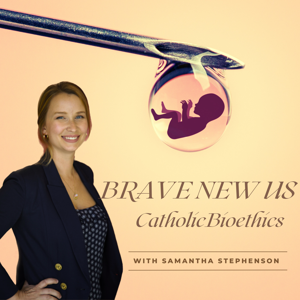
Brave New Us explores how emerging technologies are reshaping what it means to be human. Hosted by Catholic bioethicist and author Samantha Stephenson, the podcast sits at the crossroads of faith, science, and ethics, featuring expert interviews and incisive commentary on biotechnology, AI, transhumanism, reproductive technologies, human enhancement, and the moral questions they raise.
Whether you're questioning the ethics of cutting-edge science, navigating a rapidly changing technological world, or simply seeking clarity in an age of unprecedented innovation, Brave New Us will help you think critically, live intentionally, and choose what is deeply human.
Samantha Stephenson holds master's degrees in theology and bioethics, served as a Paul Ramsey Fellow at the Center for Bioethics and Culture, and taught for the McGrath Institute at the University of Notre Dame. She is the author of several books helping readers grow in faith and navigate the spiritual and ethical questions shaping our rapidly changing world. In addition to hosting the Brave New Us podcast, Samantha writes the Choosing Human newsletter on Substack where she explores faith, family, and the future of being human. Learn more at www.snstephenson.com.
Subscribe now—and stay human in an age that’s forgetting how.

6,753 Listeners
402 Listeners

2,149 Listeners

2,616 Listeners

842 Listeners

1,261 Listeners

2,645 Listeners

1,273 Listeners
951 Listeners
2,915 Listeners

439 Listeners

751 Listeners
283 Listeners

853 Listeners

152 Listeners