
Sign up to save your podcasts
Or

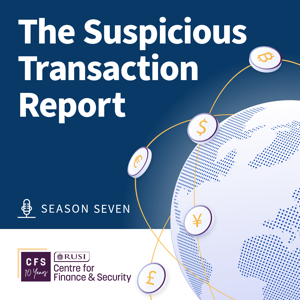

Why disruption, intelligence and genuine public–private partnership matter more than promises to eliminate every terrorist dollar.
Terrorism may have slipped down the political agenda, but its financing remains a critical national security challenge. Attacks can be inexpensive, but terrorist organisations still require money and resources to recruit, communicate, travel, operate and sustain their wider networks.
In this latest episode of the Suspicious Transaction Report, host Tom Keatinge is joined by Jason Blazakis, formerly Director of Counterterrorism Finance and Designations in the US State Department's Counterterrorism Bureau, currently a Professor at the Middlebury Institute in Monterey, California, and author of Terror Disrupted: Countering the Financing of Terrorism.
They examine how terrorist financing has evolved since 9/11, what governments learned from confronting Islamic State, and the essential role of financial intelligence and private-sector partnership.
The discussion also explores the extraordinary bureaucracy behind US terrorist designations, the challenge posed by the transnational radical right, the limitations of state-sponsor listings and the declining effectiveness of multilateral counterterrorist-financing mechanisms.
At the heart of the conversation is a simple conclusion: success should not be measured by whether every terrorist dollar is eliminated, but by whether financial networks are disrupted, resources restricted and intelligence converted into effective action.
Further reading from the Centre for Finance and Security at RUSI:
· A Sharper Image: Advancing a Risk-Based Response to Terrorist Financing | Royal United Services Institute
· Terrorist Financing in the Age of Large Language Models
· Virtual Threats: Terrorist Financing via Online Gaming
Further reading from Project CRAFT:
· Project CRAFT (Collaboration, Research and Analysis Against the Financing of Terrorism) is an academic research and community building initiative designed to improve counter terrorist financing (CTF) capacity around the globe. In 2025, CFS held a roundtable discussion to assess recent developments in CTF and produced a report entitled, Reassessing the Financing of Terrorism in 2025.
 View all episodes
 By Royal United Services Institute

4.5
88 ratings
Why disruption, intelligence and genuine public–private partnership matter more than promises to eliminate every terrorist dollar.
Terrorism may have slipped down the political agenda, but its financing remains a critical national security challenge. Attacks can be inexpensive, but terrorist organisations still require money and resources to recruit, communicate, travel, operate and sustain their wider networks.
In this latest episode of the Suspicious Transaction Report, host Tom Keatinge is joined by Jason Blazakis, formerly Director of Counterterrorism Finance and Designations in the US State Department's Counterterrorism Bureau, currently a Professor at the Middlebury Institute in Monterey, California, and author of Terror Disrupted: Countering the Financing of Terrorism.
They examine how terrorist financing has evolved since 9/11, what governments learned from confronting Islamic State, and the essential role of financial intelligence and private-sector partnership.
The discussion also explores the extraordinary bureaucracy behind US terrorist designations, the challenge posed by the transnational radical right, the limitations of state-sponsor listings and the declining effectiveness of multilateral counterterrorist-financing mechanisms.
At the heart of the conversation is a simple conclusion: success should not be measured by whether every terrorist dollar is eliminated, but by whether financial networks are disrupted, resources restricted and intelligence converted into effective action.
Further reading from the Centre for Finance and Security at RUSI:
· A Sharper Image: Advancing a Risk-Based Response to Terrorist Financing | Royal United Services Institute
· Terrorist Financing in the Age of Large Language Models
· Virtual Threats: Terrorist Financing via Online Gaming
Further reading from Project CRAFT:
· Project CRAFT (Collaboration, Research and Analysis Against the Financing of Terrorism) is an academic research and community building initiative designed to improve counter terrorist financing (CTF) capacity around the globe. In 2025, CFS held a roundtable discussion to assess recent developments in CTF and produced a report entitled, Reassessing the Financing of Terrorism in 2025.

96 Listeners

684 Listeners

80 Listeners
225 Listeners
33 Listeners
75 Listeners
145 Listeners

373 Listeners
22 Listeners

82 Listeners
469 Listeners

174 Listeners
187 Listeners

2,300 Listeners

1,092 Listeners