
Sign up to save your podcasts
Or



Based on Podcast App listening data
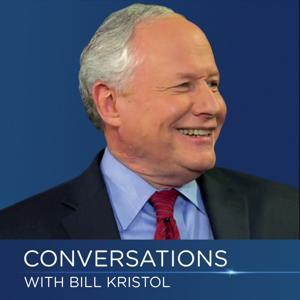
The Biden Administration has announced that all American troops will withdraw from Afghanistan by the end of August. This would, in Biden’s words, bring to end America’s longest war. In this Conversation, Eric Edelman shares his perspective on the decision to withdraw from Afghanistan. While recognizing the challenge of rallying the nation throughout our long involvement in a difficult country, Edelman raises doubts about the wisdom of removing America’s small footprint in Afghanistan. Edelman considers some potentially dangerous possibilities that might follow from the withdrawal—including greater destabilization of Pakistan and the threat of loose nukes getting into the hands of jihadists. Finally, Kristol and Edelman consider constructive things the Biden administration can do to reassure allies in the region that America will remain involved even after troops leave Afghanistan.
Where do the Republican and Democratic parties stand almost six months into the Biden presidency? How could changes in emphasis and legislative priorities for each party influence the direction of our politics? What are possible paths forward for the parties' electoral coalitions as we look toward the 2022 midterms and beyond? In this Conversation, Sean Trende, Senior Elections Analyst for RealClearPolitics and Visiting Fellow at the American Enterprise Institute, shares his perspective on the latest polls and his analysis of the dynamics of the parties in this era of polarization. He presents a fascinating account of the challenges and opportunities facing the parties and candidates, today, and reflects on what we can learn from American political history.
How has America become so polarized? Has negative partisanship opened the floodgates for disinformation and propaganda in our politics? How is cancel culture related to information warfare? How can those who believe in free government fight back? In this Conversation, Jonathan Rauch, a senior fellow at the Brookings Institution, shares his perspective. Drawing on his new book, The Constitution of Knowledge, Rauch argues that to understand contemporary polarization, we must focus on deliberate campaigns of disinformation conducted by political actors who benefit from the weakening of institutions through the diffusion of falsehoods and conspiracy theories. Considering the phenomenon of cancel culture, Rauch argues it should be understood as a systematic attempt to weaken the expression of opinions and civil debate upon which American government rests. Though alarmed about the spread of disinformation, Rauch suggests we may be seeing the beginning of mobilization against cancel culture. He calls on those who believe in America’s constitutional government, civil society, and pluralism to stand up on behalf of those institutions.
What is the nature of comedy? How does it differ from tragedy? What can we learn from Shakespeare’s comedies that we might miss if we focus only on tragedies? In this Conversation, Paul Cantor presents a tour-de-force analysis of the nature of comedy—and explains how and why Shakespeare's comedies exemplify it. As Cantor shows, comedy portrays human beings as worse than they are in order to puncture the sometimes unrealistic and destructive aspirations for ourselves and for our desires. Comedy is therefore meant to show us it’s a mistake to take too seriously things that do not necessarily deserve to be taken seriously. Too often our pride or self-importance leads us to make much ado about nothing. Cantor explains how Shakespeare’s comedies are a necessary complement to his tragedies—and as pointing to a workable middle way between the desires and even dreams humans have, and the conventions and accommodations they need to live together and flourish.
What is the role of immigration in the history of the United States—and the idea of America? Why has America been uniquely successful at integrating immigrants while other countries often fail? What is the connection between immigration and American patriotism? Joining us to discuss is Roya Hakakian, the distinguished author and poet, who emigrated from Iran in the 1980s as a teenager. In this Conversation, Hakakian recalls her first impressions of the United States and describes her experiences as an immigrant. She then shares her perspective on why immigration to the United States has been a positive force for both America and the world—as well as her personal reflections on how immigration has contributed to the American story.
How should we analyze the economic policies advanced by the Biden Administration? What are the possible effects of the trillions of dollars in government spending and the various programs proposed by the administration? What is America’s overall economic outlook coming out of the pandemic—and how might things play out under various scenarios? Joining us to consider these questions is American Enterprise Institute scholar Stan Veuger. Analyzing Biden’s economic agenda, Veuger and Kristol address the paradox that it is both extraordinarily large in scale but doesn’t create large structural changes to the economy, as would the institution of single-payer healthcare, for example. Veuger reflects on the degree to which the territory we face in fiscal policy is uncharted: the extent of domestic spending, outside of a crisis, without sufficient tax revenue to pay for it. Veuger also addresses topics ranging from the threat of inflation to where things stand in our politics relative to immigration and trade.
What can reason tell us about rights, freedom, responsibility, and the common good? What obstacles stand in the way of human beings developing clear thoughts about politics and its role within nature? How can attention to our experiences—for example, of freedom and rights—help us understand the nature of these political phenomena? In this Conversation, Claremont McKenna philosopher Mark Blitz presents his approach to the study of politics and human nature. Drawing on his new book, Reason and Politics: The Nature of Political Phenomena, Blitz argues that we should take our bearings in the study of political things not, in the first instance, through recourse to rigid rules or theories then imposed on the world, but through an open-minded encounter with political phenomena as they come to light through our own experience of them. Employing this approach, Blitz makes a series of stark and revealing comments about the nature of rights, liberty, equality, virtue, and human excellence. Finally, Blitz explains how his approach relates to thinkers including Plato and Martin Heidegger. This is a deep, challenging, and rewarding Conversation that has something important to say to anyone interested in liberal democracy, the American regime, and the nature of politics more generally.
How has Joe Biden done in the first months of his presidency? What role might Donald Trump play in the Republican Party as we look ahead to 2022 and 2024? What challenges do the parties face—from the culture wars to economics? We are delighted to be joined for the first time on Conversations by James Carville, the veteran Democratic strategist. Carville expresses cautious optimism about the Biden presidency but highlights the fragility of the Democratic coalition—and the possibility, in 2022 and 2024, of missteps in the culture war overshadowing the successes of a Democratic administration. He warns his party about vulnerability on issues like defund the police and the talk of socialism. As for the Republicans, Carville argues that Trump is in a weaker position than one might have anticipated—and that Republicans have proven surprisingly unable to challenge Biden’s agenda much beyond opposing the Democratic Party and the media on cultural grounds. Finally, Carville shares advice for those aspiring to run for office, and shares fascinating anecdotes from his distinguished career in politics.
What makes a people a people? What forms its communal identity? The second book of the Bible, Exodus, tells of the departure of the children of Israel from Egypt, their journey through the wilderness, the giving of the law at Mount Sinai, the building of the tabernacle, and much else. Exodus and its abiding mysteries have been studied for millennia as a source for wisdom and understanding about theological questions as well as human affairs. Joining us to discuss Exodus is Dr. Leon Kass, emeritus professor at the University of Chicago and emeritus scholar at the American Enterprise Institute. Kass has just published the new book Founding God’s Nation: Reading Exodus, a monumental work in which he considers Exodus in a philosophical spirit, and shares striking insights on its theology, anthropology, and especially its politics. In this Conversation, he reflects on what he has learned through his study of Exodus—and argues that, regardless of our religious affiliation or beliefs, Exodus has much to teach those who read it with an open mind.
What are the latest developments in Russia with the Putin regime? How have recent protests surrounding the arrest of opposition leader Alexei Navalny affected it? What is the nature of Putin’s power and why have his tactics so often been effective? To discuss, Bill Kristol is joined again by former world chess champion and human rights activist Garry Kasparov. According to Kasparov, the recent protests have demonstrated deep dissatisfaction in Russia with the Putin regime and the depth of its corruption. However, Kasparov notes that Putin has proven stubbornly effective at maintaining power and may yet weather this and other challenges he faces. In response to Putin’s authoritarianism, Kasparov calls for America and the leaders of the West to develop a coherent strategy for countering Putin’s aggression and for defending the principles of liberty, democracy, and free markets that have been the source of our strength.
From the publisher's feed
Ranked by our users in the last 21 days

6,276 Listeners

20 Listeners

12,505 Listeners

4,600 Listeners

8,087 Listeners
1,330 Listeners

3,986 Listeners

4,623 Listeners

2,620 Listeners
492 Listeners

2,238 Listeners

3,186 Listeners

3,454 Listeners
1,091 Listeners
774 Listeners