
Sign up to save your podcasts
Or



Based on Podcast App listening data
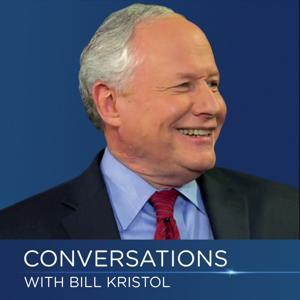
The latest in our ongoing series with Harvard professor Harvey Mansfield is devoted to Jonathan Swift (1667–1745) and particularly his masterwork, Gulliver’s Travels. In this Conversation, Mansfield provides an in-depth interpretation of Swift’s writing, which Mansfield calls “essentially political.” Through his illuminating analysis of Gulliver’s voyages and encounters, Mansfield uncovers Swift’s pointed though subtle critique of modernity. In sum, Mansfield argues that Swift deserves to be studied as an important thinker in the history of political philosophy.
Irwin Stelzer is Director of Economic Policy Studies at Hudson Institute, a Sunday Times (London) columnist, and a thinker who combines wisdom about politics with penetrating insights into economics. In this Conversation, Stelzer shares his perspective on threats to American democratic capitalism, including the “feeling that compensation and performance have become disconnected.” To address these current challenges, Stelzer calls for a more political approach to economics—one which is both mindful of the limitations of economics and considers the political consequences of distributional inequities. In sum, Stelzer offers a spirited defense of democratic capitalism: “not because of the goods and services it produces, but because of the freedom that it has produced.”
Ronald Brownstein is a Senior Editor at The Atlantic, Senior Political Analyst at CNN, and a shrewd observer of American politics. In this Conversation, Brownstein shares his perspective on the 2016 elections and explains why Trump’s path to victory represents the culmination of long-term trends in the ways voters relate to the political system and the two parties. Brownstein also discusses the partisan divisions in the country, today, and outlines the central political and electoral challenges facing each party—including Democrats’ lack of appeal beyond urban and coastal areas and the demographic headwinds faced by Republicans.
Mike Murphy is a Republican political strategist, commentator, and veteran of the campaign trail—having advised John McCain, Arnold Schwarzenegger, Jeb Bush, Mitt Romney, Spencer Abraham, Christie Whitman, among many others. In this Conversation, Murphy shares his perspective on the 2016 elections, the first months of Donald Trump’s presidency, and the challenges both Republicans and Democrats face ahead of the 2018 and 2020 elections. Kristol and Murphy also reflect on Murphy’s experiences in campaigns, including some notable (and comical) experiences with George H.W. Bush and Arnold Schwarzenegger. Finally, Murphy considers how and why American politics has become increasingly “tribal” over the last few decades.
Martin Feldstein is a professor of economics at Harvard University, former president of the National Bureau of Economic Research, and was chairman of the Council of Economic Advisers under President Reagan (1982-1984). In this Conversation, Feldstein discusses the financial crisis of 2008, the policy mistakes that led to it, and the risks we face today from a sustained policy of low interest rates. Feldstein then shares his perspective on other important questions of political economy—including the costs and benefits of trade, the impact of technological innovation, as well as the need for tax and regulatory reform. Finally, Feldstein recalls his experiences as chairman of the Council of Economic Advisers and explains what we can learn from how Reagan managed the serious economic challenges of the early 1980s.
From the publisher's feed
Ranked by our users in the last 21 days

6,276 Listeners

20 Listeners

12,505 Listeners

4,600 Listeners

8,087 Listeners
1,330 Listeners

3,986 Listeners

4,623 Listeners

2,620 Listeners

492 Listeners

2,238 Listeners

3,186 Listeners

3,454 Listeners

1,091 Listeners
774 Listeners