
Sign up to save your podcasts
Or



Based on Podcast App listening data
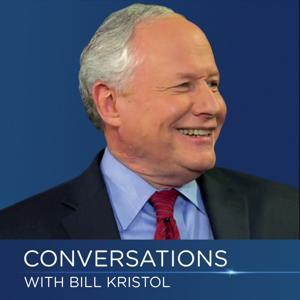
Jonah Goldberg is a senior editor at National Review and a best-selling author and political commentator. In this conversation, Goldberg and Kristol reflect on Trump's candidacy and its meaning for conservatism and the Republican Party. Goldberg also discusses his best-selling book 'Liberal Fascism' (2008) and how subsequent events, including Trump's campaign, have affected his thinking. Finally, Goldberg recommends a few books and essays that played an important role in his political education.
In his second conversation with Bill, General Petraeus makes the case for continued American leadership in the world. Drawing on his experiences in command in Iraq and Afghanistan, Gen. Petraeus explains how the American military can best harness its strategic and technological assets to achieve goals in difficult environments. Finally, Gen. Petraeus and Kristol discuss the general’s academic and battlefield education and how it prepared him for military command.
Garry Kasparov’s third conversation with Bill Kristol focuses on American politics and the 2016 Presidential race. Kasparov argues that the Donald Trump and Bernie Sanders candidacies offer interesting and worrisome lessons about the current state of our politics. Kristol and Kasparov also discuss whether America can change course and consider some distinctive features of the American political character.
University of Virginia politics professor James Ceaser discusses the intellectual roots of contemporary progressivism and the role of progressivism in our politics today. Ceaser compares the new progressivism with the ideas of the early twentieth-century progressives, and highlights the influence of “postmodernism” on the contemporary left. Kristol and Ceaser also discuss the effects of progressivism and its relationship to political correctness on and off campus.
In this wide-ranging conversation, his second on "Conversations with Bill Kristol," business founder and investor Peter Thiel discusses the global economy, the state of technology, and the future of computing and artificial intelligence. Thiel argues that we have had less technological innovation over the last few decades and explains one reason is an increasing aversion to risk. Finally, Kristol and Thiel discuss artificial intelligence and the extent to which it might transform our lives.
From the publisher's feed
Ranked by our users in the last 21 days

6,276 Listeners

20 Listeners

12,505 Listeners

4,600 Listeners

8,087 Listeners
1,330 Listeners

3,986 Listeners
4,623 Listeners

2,620 Listeners
492 Listeners
2,238 Listeners
3,186 Listeners

3,454 Listeners
1,091 Listeners
774 Listeners