
Sign up to save your podcasts
Or



Based on Podcast App listening data
Where do things stand a month after Trump's “Liberation Day” tariffs and the announcements that have followed?
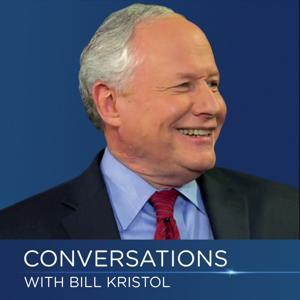
In a thoughtful and wide-ranging Conversation, former Treasury Secretary Lawrence H. Summers shares his perspective on the economic and political consequences of the tariffs—and the threats to financial markets.
According to Summers, our difficulties now go beyond any individual economic policy pronouncement by the Trump administration: “The issue is becoming, in a meta sense, confidence in the United States. When people go in and out of being confident in you, that is alarming. It’s the kind of thing that in a developing country, you’d ask yourself whether they’re going to have to have an IMF program within a few months. We’re too big for an IMF program, but we're at risk of a major kind of a financial incident.” Warning that the administration already has “done a substantial amount of damage,” Summers argues that “we may work our way through this, but only if there’s very substantial alarm and very substantial reversal.”
What are the likely effects of Trump’s tariffs, and what do they mean for the US economy?
To discuss, we are joined again by Harvard economist Jason Furman, who was Chairman of the Council of Economic Advisers in President Obama’s second term. According to Furman, Trump’s tariffs represent an enormous "shock to the system” likely to produce both short- and long-term economic pain. Furman considers both the direct and indirect effects of Trump’s policies, including the effects of uncertainty on the economy. Finally, Kristol and Furman discuss whether Congress could push back against an economic agenda likely, in Furman’s words, to produce “many more losers than winners.”
Where do things stand five months after Election Day?
According to veteran reporter and commentator A.B. Stoddard, Trump’s second term has been far more radical than many anticipated. As she puts it: “The more power you give [Trump], the more he’ll take. And the less pushback that he gets, the freer he is. So I think what we’ve seen in the last couple of months is that he’s been given permission and he will take it. That’s the way Trump is…. So people need to not underestimate the fact that things could be much, much worse in three months or a year.” In a wide-ranging assessment of the state of our politics, Stoddard shares her perspective on the Trump agenda, the Republican Party’s acquiescence, and the situation of the Democratic Party opposing Trump. Stoddard and Kristol also consider how opponents of Trump might chart alternative paths forward in the months and years ahead.
Where do things stand fifty days into Trump’s second term?
According to Georgetown Law professor Steve Vladeck: “We’ve never seen such a wholesale attempt on the part of a president [to] hollow out the executive branch [and] install loyalists in all of the relevant positions of government.” Amid a blizzard of lawsuits in response to Trump’s executive actions, Vladeck analyzes whether and to what extent the courts, Congress, and other institutions might contain the Trump administration by asserting their own Constitutional prerogatives to defend the rule of law. While he notes that courts may push back on certain executive actions on First Amendment and other grounds, Vladeck argues that the courts simply were not set up to handle the kind of large-scale litigation that might follow from mass terminations in the civil service, for instance. This is a must-watch Conversation for anyone interested in understanding how the separation of powers, a bedrock of our constitutional government, is playing out in our institutions in real time.
Where do things stand on the third anniversary of the war in Ukraine? What is the situation in European politics after the German elections? How should we think about the continued challenge of countering autocracy at home and abroad?
To discuss these questions we are joined again by Pulitzer Prize-winning historian Anne Applebaum. As Applebaum explains, despite difficulties on the battlefield, Ukraine is holding up: “The [Russians] cannot win… without Trump." And she argues that the outcome of the German elections present reasons for optimism that a European "coalition of the willing" may be emerging to seriously counter the Russian threat and support Ukraine. Applebaum also shares her perspective on the first month of the Trump administration. As she puts it: “The idea that you have to take control of state institutions and you have to make them work for you personally rather than for the people…. This is something that every illiberal leader elected and unelected sooner or later thinks they need to do. [But] this is more radical than anything any [contemporary] European far-right party has ever done.”
What is the role of social media in our politics today?
To discuss, we are joined by Renée DiResta, a leading analyst of the internet and its effects on politics and society.
As DiResta explains, social media platforms today are significant sources of political power that are fundamentally different from traditional media like newspapers, radio, and television. Social media makes users active participants in the consumption of information and algorithms have reinforced the polarization in our politics: “Algorithms key off of things that you like, things that people who are like you like. And then when that happens, you are put into these buckets, where you’re going to see more of a certain type of thing, so those identities are reinforced.” DiResta considers the ways in which Elon Musk has changed X (formerly Twitter), the power of controlling a social media platform, and the importance of this new phenomenon in politics at home and abroad. DiResta also shares her perspective on positive and negative effects of social media, from the highlighting of new perspectives to the proliferation of conspiracy theories.
What have we learned from the first two weeks of the Trump administration’s approach to executive actions?
Ryan Goodman is a professor of law at New York University, former special counsel in the Department of Defense, and co-editor of NYU Law’s Just Security blog. According to Goodman, behind the Trump administration’s Executive Orders and actions is a claim of executive authority “different in character than anything that’s preceded it.” On issues such as birthright citizenship, TikTok, and immigration, the Trump administration has claimed the right to override Congressional statutes, while Congress, so far at least, has been hesitant to assert its own constitutional powers. Goodman shares his perspective on what has transpired at the FBI, the Department of Justice, and the military, and explains what to look for in the weeks and months ahead in regard to tests of resilience of these institutions and, more broadly, the separation of powers in our constitutional government.
What will immigration policy look like in the second Trump administration? How will it affect the country? To discuss, we are joined by Aaron Reichlin-Melnick, a leading expert on immigration and Senior Fellow at the American Immigration Council. In a wide-ranging analysis that covers the complex situation at the border—as well as the political and policy choices facing Trump and Congress—Reichlin-Melnick considers possible paths forward on immigration for the Trump administration and for the country. Reichlin-Melnick notes that while the president has wide authority to change immigration policies through executive action (particularly on legal immigration), some of Trump’s promises like mass deportations face significant political and legal constraints. This is a must-watch and nuanced Conversation alive to the complexities and real-world consequences of a pressing subject that has become so central to our politics.
Donald Trump will face major geopolitical challenges when he takes office.
In this Conversation, Eric Edelman, former ambassador to Turkey and Finland and Under Secretary of Defense, shares his perspective. As he explains, Trump will face major decisions on all areas of the geopolitical landscape early in his term. Edelman argues that Israel’s military successes have weakened Iran’s “axis of resistance” and opened up new opportunities—but also raise the threat of Iranian nuclear breakout. Meanwhile, the war in Ukraine rages, the situation in Europe remains uncertain, and China’s military buildup increases. To meet the threats around the globe, we need to build up the military and defense industrial base, embrace American leadership, and strengthen our alliances. Will the Trump Administration do so?
How well might the political and legal norms of constitutional government fare in the second Trump administration?
To discuss, we are joined by Jack Goldsmith, distinguished law professor at Harvard and former Assistant Attorney General in the Office of Legal Counsel. As Goldsmith explains, Trump has expressed ambitions to exercise unprecedented control over the federal government, with plans to change the Civil Service and administrative agencies, and wield the pardon power aggressively, among other methods. While emphasizing the broad powers the president has to shape policy and personnel, Goldsmith discusses the future of checks and balances that protect the rule of law. To preserve the guardrails of government, Goldsmith emphasizes the role and responsibility of Congress, political appointees, and bureaucrats maintaining fidelity to constitutional duties.
From the publisher's feed
Ranked by our users in the last 21 days

6,276 Listeners

20 Listeners

12,505 Listeners

4,600 Listeners

8,087 Listeners
1,330 Listeners

3,986 Listeners

4,623 Listeners

2,620 Listeners
492 Listeners
2,238 Listeners
3,186 Listeners

3,454 Listeners
1,091 Listeners
774 Listeners