
Sign up to save your podcasts
Or

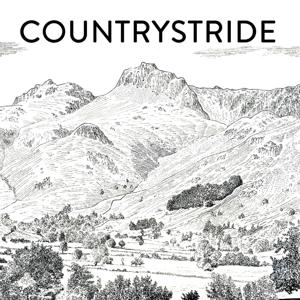
By Countrystride

5
1010 ratings


The podcast currently has 168 episodes available.
The most played episodes among Podcast App listeners.
...in which we head east to one of Lakeland’s loneliest dales, and tell the story of a once-thriving valley lost beneath the dammed waters of Haweswater. In the company of local historian and dialect champion Jean Scott-Smith, we set the historic scene on Mardale, cradled in the Far Eastern Fells and overlooked by a British fort, a Roman Road and Scandinavian shielings. Proceeding into the 18th century, Jean paints a picture of a bustling farmed valley, with rich dairy pastures and a steady flow of traders and packmen making their way over the passes of Nan Bield and Gatesgarth and down past High and Low Water. Recounting tales of the Kendal Archers, boisterous nights at the Old Dun Bull (where buckets of ale were passed around) and the legendary week-long Mardale Shepherds Meet (originally held on High Street, latterly at the Dunnie), we introduce a range of local characters, from the Kings of Mardale to eccentric ‘Old Barham’ the vicar, who bled parishioners using a tortoise-shell lancet. With the waters of Thirlmere insufficient to meet the growing thirst of Manchester, we learn about Manchester Corporation’s acquisition of the valley – with barely a whisper of protest – and, following the Haweswater Act of 1919, the subsequent abandonment of the hamlets of Measand, Mardale Green and Whelter before the grammar school was relocated, the church taken down and Royal Engineers arrived with explosives to raze the remaining farms and homesteads. Heading up-dale to rain-drenched Mardale Head, Jean points out landmarks uncovered by the summer’s drought – including foundations of the Dun Bull, and the old valley road (its walls as they were 90 years after the terminal flood) – before noting nearabouts landmarks – the corpse road to Shap, the grandstand-view peatcutters’ huts, the former navvie settlement of Burnbanks. Closing the pod in Shap’s upper graveyard – where many of Mardale’s dead were reinterred – we reflect on the passing of a community; on the media circus that unfolds in dry years; and on the surprise discovery of Mardale’s long lost church organ. Shap Local History Society holds an extensive archive, including artefacts and images relating to Mardale, at their Heritage Centre, Market Cross, Shap. The archive is open by arrangement – please contact either 01931 716671 or 01931 716386.

...in which we climb Walla Crag in the company of academic and Back o’ Skidda’ resident Dr Liz Woodham for a deep dive into the history of guidebooks dedicated to fell-walking in Lakeland. Striding out from Surprise View, we set the historic context for the emergence of the walking guidebook – the earliest travellers seeking low-level views from Thomas West’s formative Guide to the Lakes (1778), and the use of paid mountain guides, often shepherds, taking well-heeled visitors on mountain adventures. ‘Roving Laker’ Harriet Martineau’s Complete Guide to the English Lakes(1855) was among the first to speak to fell-walkers, Liz tells us, with an ascent description of Fairfield that was – like the woman herself – quietly revolutionary. On the long climb of Cat Gill we discuss the forgotten Victorian colossus of Keswick, Henry Irwin Jenkinson, who compiled the most authoritative guide of its era, his Practical Guide to the English Lake District (1872), in just seven winter months (he would go on to consult on mountain rescues, and organise the Latrigg Fell Mass Trespass of 1887). Entering the age of M. J. B. Baddeley, we turn to his evergreen (tiny type) Thorough Guide to The English Lake District – first published in 1880 and still selling nearly a century later. We consider the democratisation of travel, and walking, in the age of rail, and the changing nature of the guidebook, as fells received dedicated chapters and publishers augmented directions with maps. Atop breezy Walla Crag we talk about the contribution of The Rev. H. H. Symonds – committed to “rescuing scraps of natural beauty” – who published a kind of ‘campaigning guidebook’ in his classic highbrow Walking in the Lake District (1933), and the very different books of his contemporary, outdoors advocate W. T. Palmer, who urged readers to get off the beaten track and take walking tours between youth hostels in his Penguin Guide, The Lake District (1939). Finally, on Falcon Crag, after a discussion of Walter Poucher’s photographic guides, we arrive at the master himself, Alfred Wainwright, whose uniquely artisanal take on the format turned the guidebook into companionable pocket art. Back at Ashness Bridge, we reflect on the factors that make for the perfect guidebook – portable, easy to use, with an intuitive blend of text and imagery – and ask Liz to name her favourite guidebook; to consider where guidebooks go in the post-AW digital age; and to tell us why Steeple remains aloof in her 214 completer’s list.
...in which we return to the golden age of speed records in the company of Dr Keith Mitchell, who was a teen when Bluebird K7 made its tragic final record attempt on Coniston in January 1967, and who has researched all things Campbell ever since. Setting out from the heart of Coniston, we introduce risk-taking Sir Malcolm Campbell – the 'national hero' record-breaker of the inter-war years – and the frenetic home life into which son Donald was born. Approaching Coniston Water, we consider young Donald's emergence from his capricious father's shadow, and his lifelong desire to seek paternal approval – even after Malcolm's death. Arriving on the lakeshore, we learn about the historic context of post-War speed records and the meeting of man and jet-powered machine that allowed Donald to set seven world water speed records between 1955 and 1964, inching him ever closer to the holy grail 300mph. As waves lap the Water's gravelly shore, Keith describes the jet-powered hydroplane's final voyage, the somersault that ended Donald's life, and the speed king's final words, which offer insights into what went wrong as the craft surpassed 320mph. Closing the pod at Donald's grave, we hear the postscript tale of the craft's recovery and rebuild, and reflect on a remarkable man piloting a remarkable craft in a remarkable place. Bluebird K7 The Festival is taking place 11–17 May, 2026: https://bluebirdk7thefestival.co.uk Keith is speaking as part of the Festival on the 11 May: https://m.facebook.com/story.php?story_fbid=pfbid05tuxwjaVVncdp7HQBtJJhPQDscvzP1kc8kPKQS7hYn41wtq5cRqe9CQPBXfJUF2yl&id=100064908631980 Keith and Neil Sheppard's book 'Donald Campbell Bluebird and the Final Record Attempt' can be bought from the Ruskin Museum. To support Countrystride, you can buy our Lake District walking guidebooks at countrystride.co.uk/our-books or gift us as little as £3 a month via Patron at patreon.com/c/countrystride
...in which we congregate at the Armitt, Ambleside for a night of readings, historic press reports, dialect poems and music that celebrate a distinctly Cumbrian Christmas. In the company of Alan Cleaver, Lesley Park, Sue Allan and – on harp and guitar – the Cumbrian Duo, we take a nostalgic trip down memory lane (and beyond) as we learn about seasonal customs from the historic counties of Westmorland and Cumberland: of the 'Waits' who performed dance tunes in isolated valleys; of the 'Merryneets', where dalesfolk would gather for nights of feasting and frivolity; and of the carol-singers of Wasdale, fighting a losing battle against the winter snows. Turning to dialect, Sue regales us with a miscellany of snow terms from the old tongue and champions works of the tragically underrated Cumbrian Bard, Robert Anderson of Carlisle, while Lesley reads one of the all-time classic Lakeland Christmas poems: 'Down t'Lonning'. As we move around the county – from the Ambleside postman's path via Buttermere (and its many pies) to a west coast nativity scene – we're accompanied by winter-time tunes from Ed Haslam and Jean Altshuler, including 'Cold and Raw' and the infamous 'Bleckell Murry Neet'. Alan's book, A Lake District Christmas, is available from Inspired by Lakeland. Sue's book on The Cumberland Bard is available from Books Cumbria. The latest CD from the Cumbrian Duo is sold through Willowhayne Music at naxosdirect.co.uk/search/bleckell Some of their music can be heard at youtube.com/watch?v=xB9CcJLIxKA and youtube.com/watch?v=jbNzqBBTCHk This podcast was recorded at one of our Countrystride Live events. To be first in line for tickets, sign up to our newsletter at countrystride.co.uk/
...in which Dave takes a midwinter stroll with author Polly Atkin to discuss The Company of Owls, Polly's new book about her tawny owl neighbours in Grasmere. Climbing from Town End onto White Moss Common, we consider the recent history of the surrounding landscape – from grazed pasture through makeshift 'hutment' settlement to the rich woodland of today that is home to deer, badger, fox and numerous birds. Arriving at a mossy oak, we learn about Polly's passion for owls, and the personal connection she formed with three new-born owlets. The little-known habits of owls are discussed – the long walks they take to explore territory; the on-and-off cohabitation arrangements of mate-for-life parents; and the pragmatic preservation of energy in death. Arriving at a nature-reclaimed pool, our conversation skips from owls to the Romantic poets, night-time walking, mythology and bluebells. Finally, arriving at Grasmere's Wishing Gate, we turn to Polly's award-winning Some of Us Just Fall, and talk about why the nature-healing narrative is a fallacy; and why the owls in this enchanted patch of woodland embody hope, sadness, anxiety, joy – but, most of all, continuity. The Company of Owls is available to buy (signed) from samreadbooks.co.uk/product/polly-atkin-the-company-of-owls-signed-/13814 and (not signed) eandtbooks.com/books/the-company-of-owls/ Polly is on Twitter/X at x.com/pollyrowena Polly's Linktree: https://t.co/ehfHhLe116
The podcast currently has 168 episodes available.
2,034 Listeners

245 Listeners
152 Listeners
108 Listeners

365 Listeners

89 Listeners
69 Listeners

291 Listeners

60 Listeners
18 Listeners

24 Listeners

3,048 Listeners

802 Listeners

725 Listeners

698 Listeners