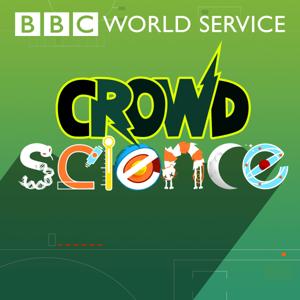
CrowdScience

CrowdScience

By BBC World ServiceScienceTechnology
Download on the App Store
  • Typical duration

    31 min

    per episode

  • If it hooks

    15%

    finish an episode

Based on Podcast App listening data

CrowdScience episodes

  • Why do men rule the world?
    Listener Paula from Kenya is a computer scientist, she can’t help but notice the inequality in her workplace.
    With only 1 in 10 countries having female heads of state, there is no doubt that men are in charge.
    Paula wants to know if there is any scientific underpinning to this inequality? Perhaps it can be explained by our brains and bodies? Or does evolution weigh in?
    Or maybe it is all down to society and the way we raise our boys and girls. The toys and ideals we give our children must surely have an impact.
    And most importantly, if we want a world run by men and women equally, how can we get there? We hear how Iceland became the most gender equal country in the world.
    Presented by Marnie Chesterton. Produced by Caroline Steel for the BBC World Service
    [Image: Men in board room. Credit: Getty Images]
    38 min
  • Can we build houses from living trees?
    It’s the stuff of fairy tales – a beautiful cottage, with windows, chimney and floorboards … and supported by a living growing tree. CrowdScience listener Jack wants to know why living houses aren’t a common sight when they could contribute to leafier cities with cleaner air. The UK has an impressive collection of treehouses, but they remain in the realm of novelty, for good reasons. Architects are used to materials like concrete and steel changing over time, but a house built around a living tree needs another level of flexibility in its design. That doesn’t mean it’s impossible and CrowdScience hears about a project in the Ethiopian capital Addis Ababa, where architect Ahadu Abaineh made a three-storey, supported by 4 living Eucalyptus trees as a natural foundation.
    Host Marnie Chesterton meets some of the global treehouse building fraternity, including builder of over 200 structures, Takashi Kobayashi, who adapts his houses to the Japanese weather. In Oregon, USA, Michael Garnier has built an entire village of treehouses for his “Treesort”. He’s developed better ways of building , including the Tree Attachment Bolt, which holds the weight of the house while minimising damage to the tree.
    Professor Mitchell Joachim from Terreform One explains the wild potential of living architecture, a movement which looks at organic ways of building. He’s currently building a prototype living house, by shaping willow saplings onto a scaffold that will become a home, built of live trees.
    Photo Credit: Ahadu Abaineh
    33 min
  • Can I improve my sense of direction?
    Do you find your bearings quickly or are you easily disorientated? Do your friends trust you with the directions in a new city?
    Finding our way in the physical world – whether that’s around a building or a city - is an important everyday capability, one that has been integral to human survival. This week CrowdScience listeners want to know whether some people are ‘naturally’ better at navigating, so presenter Marnie Chesterton sets her compass and journeys into the human brain.
    Accompanied by psychologists and neuroscientists Marnie learns how humans perceive their environment, recall routes and orientate themselves in unfamiliar spaces. We ask are some navigational strategies better than others?
    Marnie also hears that the country you live in might be a good predictor of your navigation skills and how growing up in the countryside may give you an wayfaring advantage. But is our navigational ability down to biology or experience, and can we improve it?
    With much of our modern map use being delegated to smartphones, Marnie explores what implications an over-reliance on GPS technology might have for our brain health.
    Presenter: Marnie Chesterton
    Producer: Melanie Brown
    (Photo:Lost man with map. Credit: Getty Images)
    40 min
  • Can being happy help me fight infection?
    Could being happier help us fight infectious disease?
    As the world embarks on a mass vaccination programme to protect populations from Covid-19, Crowdscience asks whether our mood has any impact on our immune systems. In other words, could being happier help us fight infectious diseases? Marnie Chesterton explores how our mental wellbeing can impact our physical health and hears that stress and anxiety make it harder for our natural defence systems to kick in – a field known as psychoneuroimmunology. Professor Kavita Vedhara from the University of Nottingham explains flu jabs are less successful in patients with chronic stress.
    So scientists are coming up with non-pharmacological ways to improve vaccine efficiency. We investigate the idea that watching a short feel-good video before receiving the inoculation could lead to increased production of antibodies to a virus. And talk to Professor Richard Davidson who says mindfulness reduces stress and makes vaccines more effective.
    [Image: Happy couple wearing masks. Credit: Getty Images]
    40 min
  • Will giving up alcohol improve my sperm count?
    When planning to have a baby, women are expected to give up everything from smoking to alcohol, even soft cheese. But the other half of fertility comes from the sperm, usually provided by a man. So should men also give up their vices to improve the quality of their sperm, and their chances of conception?
    That’s what Listener Stuart in Australia wants to know. He emailed CrowdScience after he and his wife had been trying to have a second child for two years. He gave up alcohol, and coffee, but wants to know if there is any hard science to back up the idea that this would improve his fertility.
    To find out, presenter Anand Jagatia speaks with Professor Allan Pacey, a scientist who specialises in the study of male fertility and sperm. He discovers that male subfertility accounts for 50% the problems with getting pregnant. And we’re far from alone. Sperm is a remarkably diverse, but also fragile cell. Across the animal kingdom, different species have problems with male fertility, but have adapted novel ways to improve their chances of reaching the egg.
    Men often struggle to speak about their fertility, and reporter Chhavi Sachdev tells Anand the impact this has on couples in India who struggle to conceive, or don’t want to. She speaks with fertility specialist Professor Nirmal Kumar Lohiya about how this reticence to speak about fertility is changing.
    Viruses from Mumps to HIV have long been known to target the delicate sperm production cells in the testicles. Dr Krutika Kuppalli tells Anand why, and what we know about the possible impact of SARS CoV-2 on male fertility.
    Professor Allan Pacey gives Anand and Stuart some advice for what to do while trying to conceive - don’t wear tight underwear - and get used to talking about your swimmers or even getting them checked out.
    Contributors:
    Professor Allan Pacey - Andrologist at the University of Sheffield in the UK.
    Dr Nicolla Hemmings, expert on bird sperm, Royal Society Dorothy Hodgkin Research Fellow at the University of Sheffield, UK.
    Professor Nirmal Kumar Lohiya, Fertility specialist and co-developer of RISUG male contraceptive, University of Rajasthan, India
    Dr Krutika Kuppalli, Assistant Professor at the Medical University of South Carolina, USA
    Chhavi Sachdev, Reporter and presenter for CrowdScience
    Presented by Anand Jagatia,
    Produced by Rory Galloway
    (Image: Sperm cells Credit: Getty images)

    36 min
  • Are there downsides to deep cleaning?
    Covid-19 has prompted a cleaning frenzy. CrowdScience listener William works as a personal trainer in a gym, and while cleaning’s always been part of his job, it’s now taken over much of his working day. He’s constantly wiping down equipment and doing regular deep cleans, and he reckons he can sanitize his hands 40 times in one shift.
    This kind of routine might strike a chord with many of us, and it’s certainly vital to take hygiene seriously during times of pandemic.
    But could there be any downsides to all this extra cleaning? There’s a whole world of microbes out there: some, like SARS-CoV-2, make us sick, but others are essential for our health. A rich microbiome is linked to a healthy immune system, while ‘good’ microbes help keep ‘bad’ ones at bay. And what about the chemicals in cleaning products – do they have any unintended consequences for our health?
    CrowdScience turns to the experts to ask whether our supercharged hygiene routines could damage our immune systems, or promote the spread of superbugs. And we hear why, as long as we have a good diet, plenty of fresh air, and ideally a furry pet, we don’t need to worry too much about being too clean.
    Presented by Marnie Chesterton
    Produced by Cathy Edwards for the BBC World Service
    (Photo credit: Getty Images)
    34 min
  • What are the limits of human endurance?
    When it comes to speed, humans have got nothing on cheetahs - or greyhounds, kangaroos or zebras for that matter. It’s over long distances we really come into our own: when running for hours or even days, our body structure and excellent sweating skills make us able to outpace much faster mammals.
    But what are the limits of human endurance? Can we run ever further and faster, and what’s the best diet to fuel such ambitions?
    This week’s questions come from two CrowdScience listeners in Japan who already know a fair bit about stamina, having run several marathons and long-distance triathlons between them. We head to Greece, legendary birthplace of the marathon, to witness an even more arduous challenge: hundreds of athletes following in the footsteps of the ancient Greek messenger Pheidippides, to run an astonishing 246km across the country. The ever-so-slightly less fit CrowdScience team do our best to keep up, and try to discover the secrets of these runners’ incredible endurance.
    Presenter: Marnie Chesterton
    Producer: Cathy Edwards
    (Photo: a runner in the Spartathlon ultramarathon, with kind permission from the International Spartathlon Association)
    34 min
  • Do green spaces make us healthier?
    One of the more surprising consequences of the pandemic has been the trend for people wanting to move out of cities and back to the countryside. Not everyone has that privilege of course, but undoubtedly for some living in urban areas during lockdown, the lack of access to green spaces took its toll on their mental health and physical well-being. Now, with renewed hope of a global vaccine roll-out, ensuring more people have better access to nature is more important than ever, especially in cities of glass, steel and concrete.
    Italian CrowdScience listener Enrica loves nothing better than walking along the verdant riverbank near her home after a hard week at work. But is this activity doing more than making her feel good? Is it having an actual effect on her health? Presenter Anand Jagatia meets Enrica and visits a radical scheme in the city of Milan, where officials have been working hard to increase urban green features and have committed to planting 3 million trees and building twenty new parks by 2030.
    One such idea is the innovative Bosco Verticale - or vertical forest, planted up the side of two high rises apartment blocks. Amongst other benefits It’s hoped it could provide cooling microclimates to reduce the dangers of summer heat, and improve resident’s mental health.
    Produced by Jennifer Whyntie. First broadcast October 2019.
    (Photo: Tree lined "tunnel" in the English countryside of West Sussex. Credit: Getty Images)
    34 min
  • Is a fungus intelligent?
    As regular listeners may recall, CrowdScience has delved into the strange world of fungi before, as we dug down into the forest floor to reveal how plants and trees are connected to the vast mycelial network known as the “wood wide web”. But what makes this network possible and how might it have evolved? Fungi are incredibly clever, or at least , it appears that they’re capable of displaying complex behaviour that gives them the appearance of intelligence. In this episode, we speak to fungal ecologist and author of a new book, Merlin Sheldrake, about fungal “brains”, the evolution of magic mushrooms and zombie insects – the astonishing way certain fungi can take over the bodies of ants and wasps in order to sow their spores above ground.
    Presented by Anand Jagatia
    Produced by Rami Tzabar for the BBC World Service.
    Image: Getty Images
    30 min
  • Do animals exercise?
    At Christmas, is there a better gift than knowledge? CrowdScience has cooked up its own version of 'secret Santa', with members of the team setting one another the challenge of answering surprising questions from all over the world.
    Are humans the only animals to exercise? Can you get colder than absolute zero? Why are sounds louder at night? When it comes to food dropped on the floor, is there such thing as the "three second rule"? And, does honey really have healing properties?
    Producers and presenters from the CrowdScience team speak to all manner of experts, from zoologists through to material scientists, to find the answers.
    Presenter: Marnie Chesterton
    Producer: Caroline Steel
    38 min

About CrowdScience

From the publisher's feed

We take your questions about life, Earth and the universe to researchers hunting for answers at the frontiers of knowledge.

Best of CrowdScience

Ranked by our users in the last 21 days

More shows like CrowdScience

TED Talks Daily by TED

TED Talks Daily

10,900 Listeners

Global News Podcast by BBC World Service

Global News Podcast

7,608 Listeners

More or Less by BBC Radio 4

More or Less

875 Listeners

The Documentary Podcast by BBC World Service

The Documentary Podcast

1,794 Listeners

The Infinite Monkey Cage by BBC Radio 4

The Infinite Monkey Cage

1,906 Listeners

Future Tense by ABC Australia

Future Tense

62 Listeners

The Science Show by ABC Australia

The Science Show

119 Listeners

The Forum by BBC World Service

The Forum

267 Listeners

BBC Inside Science by BBC Radio 4

BBC Inside Science

391 Listeners

Science Weekly by The Guardian

Science Weekly

420 Listeners

All In The Mind by ABC Australia

All In The Mind

755 Listeners

The Inquiry by BBC World Service

The Inquiry

726 Listeners

CrowdScience by BBC World Service

CrowdScience

474 Listeners

ABC News Daily by ABC Australia

ABC News Daily

149 Listeners

The Intelligence from The Economist by The Economist

The Intelligence from The Economist

2,540 Listeners