
Sign up to save your podcasts
Or



Based on Podcast App listening data
Thayendenagay was a Mohawk war chief, British soldier, tireless advocate and an accomplished diplomat who straddled two very different worlds that were colliding in the latter half of the 18th century. He witnessed the rapid expansion of imperial Britain and then the violent birth of the United States of America all the while attempting to lead his people through the geo-political complexities of that time. He would become one of the most famous Indigenous persons in the British empire and his name was both respected and feared from North America to Europe.
Book recommendation: Joseph Brant: A Man of Two Worlds by Isabel Thompson Kelsay, published in 1984 by Syracuse University Press.
https://press.syr.edu/supressbooks/1843/joseph-brant-1743-1807/
Twitter – https://twitter.com/DocBorys
Patreon – https://www.patreon.com/curiouscanadianhistory
Hosted on Acast. See acast.com/privacy for more information.
Many Canadians know of the incredible bravery and courage that Canadian soldiers showed on 6 June 1944 when the men of 3rd Canadian Infantry Division seized Juno Beach as part of the largest combined-arms operation in the history of warfare: Operation Overlord, the invasion of northwest Europe. And while there are many incredible books and several podcast episodes talking about this invasion today’s episode is actually the product of a special request from a listener. This long-time listener was recently in Normandy and when searching for a podcast on D-Day felt that there was no episode that specifically talked in any detail about the actions of the first day itself, specifically related to the Canadian infantry assault on Juno Beach. Thus with the 6th of June only one week away here is an episode giving an overview of the actions on that 6th of June back in 1944 when the fate of the world changed forever.
Book recommendation: Juno: Canadians at D-Day, 6 June 1944 by Ted Barris, Thomas Allen and Sons, 2009
https://www.amazon.ca/Juno-Canadians-D-Day-June-1944/dp/0887624138
Twitter – https://twitter.com/DocBorys
Patreon – https://www.patreon.com/curiouscanadianhistory
Hosted on Acast. See acast.com/privacy for more information.
The recent passing of Gordon Lightfoot is the loss of one of the most important Canadian singer-songwriters in the history of North American popular music. Not only has he released dozens of albums, including over 200 songs, but his music has been recorded by a nearly endless list of artists from a wide variety of genres. His lyrics and melodies have been sung in honky-tonk saloons, dive bars, on legendary stages, in movie soundtracks, and reverberated in sound systems in some of the most elite clubs on the planet. He was an artist who was in many ways quintessentially Canadian, he loved living in Canada, he loved being outdoors, he loved hockey, he was a passionate advocate for the environment, he was a selfless friend and while he certainly had his demons, he was generous to a fault to those he loved. He was a musical leader in a generation of singer songwriters (and especially Canadian ones) who fundamentally influenced the direction of popular music.
Book recommendation: Lightfoot by Nicholas Jennings, Viking Press, 2017
https://www.penguinrandomhouse.ca/books/541324/lightfoot-by-nicholas-jennings/9780143199212
Twitter – https://twitter.com/DocBorys
Patreon – https://www.patreon.com/curiouscanadianhistory
Hosted on Acast. See acast.com/privacy for more information.
The words mutiny and cowardice are some of the most vile recriminations one could make against a ship and its crew. For years, these words were veiled behind the story of HMCS Uganda, Canada’s only naval vessel to fight against the Japanese. Yet, the story of HMCS Uganda is one of the most unique tales told in the history of Canada’s military and speaks to a strange time at the end of the Second World War, when a Canadian government prioritised domestic political interests over those of the ongoing military conflict and in turn put the sailors of Uganda in a damned-if-you-do, damned-if-you-don’t situation.The sailors aboard Uganda were given an unheard of choice in June 1945, one that would cast a controversial shadow over the ship, its crew and its role in the Second World War.
https://www.amazon.com/Mutiny-odyssey-Uganda-James-Essex/dp/0889544174/ref=cm_cr_arp_d_product_top?ie=UTF8
Twitter – https://twitter.com/DocBorys
Patreon - https://www.patreon.com/curiouscanadianhistory
Hosted on Acast. See acast.com/privacy for more information.
Hosted on Acast. See acast.com/privacy for more information.
The legendary sagas of the Vikings have always spoken of perilous, seaborne adventures to lands so far to the west as to literally drop off the edge of the known European universe. While some of these lands eventually became known as Iceland and Greenland, other parts would later be dubbed the “New World.” Yet, the discovery of the “New World” was attributed to Christopher Columbus. For centuries, legends persisted that Norse explorers came to the new world long before Columbus. In fact, rumours had it that the Norse made it well into the interior of the North American continent. For a long time, it was difficult for most archeologists and historians to prove if this was ever true. That was until 1968. That year two archeologists discovered a small cloak pin of Norse design in a location on the northern tip of the island of Newfoundland in the province of Newfoundland-Labrador. This discovery triggered a massive archeological dig that would eventually come to prove that over one thousand years ago, and nearly 500 years before Christopher Columbus’ infamous arrival in the West Indies, Vikings indeed arrived in what would become known as the “New World.”
Book recommendation: In Search of First Contact: the Vikings of Vinland, the Peoples of the Dawnland, and the Anglo-American Anxiety of Discovery by Annette Kolodny, Duke University Press, 2012.
https://www.dukeupress.edu/in-search-of-first-contact
Twitter – https://twitter.com/DocBorys
Patreon - https://www.patreon.com/curiouscanadianhistory
Hosted on Acast. See acast.com/privacy for more information.
Every city, town and village in this country has its own unique history. For this episode, CCH takes a deep dive into some strange tales from the great city of Toronto. From a brawl between clowns and firefighters, to a bizarre post-mortem request from one of Canada's most important political figures and finally to a strange contest that saw the birth rate of the city spike. Guiding us through these tales is historian Adam Bunch. Adam is the author of the Toronto Book of the Dead and The Toronto Book of Love, host of the Canadiana documentary series on YouTube, and the creator of the Toronto History Weekly newsletter.
He is also one of the organisers of the Festival of Bizarre Toronto History, a festival dedicated
to exploring strange stories from the city's past. This festival is a busy week
filled with online lectures, panels, interviews, and walking tours featuring
some of Toronto's greatest storytellers. The festival runs from April 3 to 9
and tickets are now on sale and can be purchased via the website bizarretoronto.com.
Twitter – https://twitter.com/DocBorys
Patreon - https://www.patreon.com/curiouscanadianhistory
Hosted on Acast. See acast.com/privacy for more information.
Prince Edward Island is one of the most beautiful provinces in Canada. It’s wind-swept beaches are stunning, it’s people are some of the friendliest in the country. It has beautiful golf courses, scenic terrain, a provincial proclivity for incredible music, inspired by both Celtic and French roots. It is the setting for Anne of Green Gables. It has a deep, almost magical connection to the waters that surround it, and if you can catch the perfect day, at the perfect hour, it feels like a small piece of heaven. Today we are talking about one of the most interesting stories regarding Prince Edward Island…the story of how it came to join Canada. Despite the first of the confederation conferences occurring in Charlottetown, the island was not originally part of the Dominion of Canada when first formed in 1867. Why did it not join in then? What happened to make it join in 1873? These questions and more are answered today by Christopher Dummitt. Christopher is a Canadian historian at Trent University, author of Unbuttoned: A History of Mackenzie King’s Secret Life, and host of the podcast 1867 and All That.
Book recommendations:
Unbuttoned: A History of Mackenzie King’s Secret Life
https://www.mqup.ca/unbuttoned-products-9780773548763.php
Twitter – https://twitter.com/DocBorys
Patreon - https://www.patreon.com/curiouscanadianhistory
Hosted on Acast. See acast.com/privacy for more information.
The history of Montreal’s Black community goes as far back as the very first French explorers to settle along the St. Larry River valley. The community has dealt with slavery, oppression, injustice, and both informal and formal racism. Yet, it is a community that has not only endured, it has thrived, despite significant challenges. It is also a community that was very much connected to the emerging civil rights movement in the US, and it is a community that embraced its own struggle, though a struggle that was very much unique to the geopolitical situation of Quebec in the post-Second World War period. While the community was certainly active in fighting for equality no affair highlighted galvanized it more than the Sir George Williams Affair in January 1969, an event that some argue, set off one Montreal’s Black renaissance.
Book recommendation:
Unsettling the Great White North: Black Canadian History by Funke Aladejebi and Michele Johnson. Univ. of Toronto Press, 2022
https://utorontopress.com/9781487529178/unsettling-the-great-white-north/
Twitter – https://twitter.com/DocBorys
Patreon - https://www.patreon.com/curiouscanadianhistory
Hosted on Acast. See acast.com/privacy for more information.
In the autumnal darkness of October 6, 1894, an unseen figure slipped through the streets of Parkdale, rang the doorbell at the home of a well-to-do Toronto family, and shot Frank Westwood in his doorway, murdering him in cold blood. Six weeks later, the spotlight shone on the enigmatic Clara Ford, a Black tailor and single mother known for her impeccable work ethic and resolute personality – and for wearing men’s attire. A former neighbour of the Westwoods, Clara was arrested and confessed to the murder. But as the details of her arrest and her complex connection to the Westwood family emerged, she recanted, testifying that she was coerced by police into a false confession. Clara was the first woman – and only the second person – to testify on her own behalf in a Canadian trial.
On this episode I chat with Dr. Carolyn Whitzman whose recent book Clara at the Door with a Revolver explores the incredible story of Clara Ford
Book recommendation:
Clara at the Door with a Revolver: The Scandalous Black Suspect, the Exemplary White Son and the Murder That Shocked Toronto (UBC Press, 2023)https://www.ubcpress.ca/clara-at-the-door-with-a-revolver
Twitter – https://twitter.com/DocBorys
Patreon - https://www.patreon.com/curiouscanadianhistory
Hosted on Acast. See acast.com/privacy for more information.
From the publisher's feed
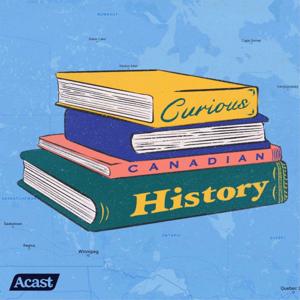
Historian David Borys dives deep into the fascinating world of Canadian history in this bi-weekly podcast exploring everything from the wonderful to the weird to the downright…
Hosted on Acast. See acast.com/privacy for more information.
Ranked by our users in the last 21 days

403 Listeners
155 Listeners

207 Listeners

362 Listeners
741 Listeners
75 Listeners
573 Listeners

99 Listeners

199 Listeners
242 Listeners

78 Listeners

437 Listeners

158 Listeners

112 Listeners

283 Listeners