
Sign up to save your podcasts
Or


To learn about The Freedom Project - Click here
Two thinkers “arrive” right away: Ludwig Wittgenstein (Austria, philosopher of language) and Epictetus (Greek Stoic, formerly enslaved). Their combined theme becomes the episode’s core message: abundance and freedom don’t respond to self-improvement—they respond to present-moment participation, and the language we use either keeps us in “now” or pushes us into fear-based “later.”
Wittgenstein’s thread focuses on how our sentences shape our reality. He points out that many spiritual and abundance struggles are reinforced by everyday grammar: “I’m not ready,” “I’m not healed,” “I must become something else.” These are described as grammatical habits that turn life into a test to pass. Abundance (money, time, health, love) doesn’t show up when we “deserve it” or “fix ourselves”—it shows up when we stop managing it with fear and engage with what’s here.
Epictetus brings a steady, immovable energy and reframes freedom as the absence of inner argument with life. He shares the Stoic insight that suffering isn’t primarily caused by circumstances, but by the internal insistence: “This shouldn’t be happening.” Freedom, he says, is not growth but subtraction—not becoming more powerful, but noticing where we’ve been giving power away (waiting for conditions to improve, needing certainty, money, approval) and simply stopping.
The conversation then turns practical around money. The guides suggest money feels uniquely “heavy” because we use it to answer a future-based question: “Will I be okay later?” Unlike health, relationships, or time (experienced in the present), money is often used as emotional insurance—asked to provide safety, which “isn’t its job.” The episode offers a language-based reframe: shift from future-security sentences to present-usefulness. A key line: stop asking money to protect you from time.
They also address the belief in “sources of money” (job, investments, rentals) as a limiter: the true source is you, via inspiration and participation. Scarcity is framed less as “not enough money” and more as fear of letting it move—guarding rather than participating.
Finally, they connect abundance and freedom as essentially parallel states: both are results of alignment and present-moment engagement. Freedom is “living as cause, not effect,” and abundance is “having what you need when you need it to do what needs doing”—both emerge when we stop requiring conditions to be different before we allow peace.
 View all episodes
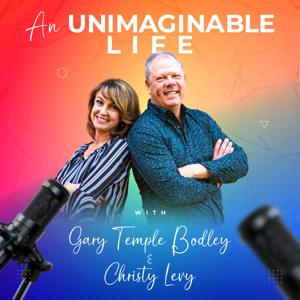
 By Christy Levy, Spiritual Medium with Gary Temple Bodley

4.7
3030 ratings
To learn about The Freedom Project - Click here
Two thinkers “arrive” right away: Ludwig Wittgenstein (Austria, philosopher of language) and Epictetus (Greek Stoic, formerly enslaved). Their combined theme becomes the episode’s core message: abundance and freedom don’t respond to self-improvement—they respond to present-moment participation, and the language we use either keeps us in “now” or pushes us into fear-based “later.”
Wittgenstein’s thread focuses on how our sentences shape our reality. He points out that many spiritual and abundance struggles are reinforced by everyday grammar: “I’m not ready,” “I’m not healed,” “I must become something else.” These are described as grammatical habits that turn life into a test to pass. Abundance (money, time, health, love) doesn’t show up when we “deserve it” or “fix ourselves”—it shows up when we stop managing it with fear and engage with what’s here.
Epictetus brings a steady, immovable energy and reframes freedom as the absence of inner argument with life. He shares the Stoic insight that suffering isn’t primarily caused by circumstances, but by the internal insistence: “This shouldn’t be happening.” Freedom, he says, is not growth but subtraction—not becoming more powerful, but noticing where we’ve been giving power away (waiting for conditions to improve, needing certainty, money, approval) and simply stopping.
The conversation then turns practical around money. The guides suggest money feels uniquely “heavy” because we use it to answer a future-based question: “Will I be okay later?” Unlike health, relationships, or time (experienced in the present), money is often used as emotional insurance—asked to provide safety, which “isn’t its job.” The episode offers a language-based reframe: shift from future-security sentences to present-usefulness. A key line: stop asking money to protect you from time.
They also address the belief in “sources of money” (job, investments, rentals) as a limiter: the true source is you, via inspiration and participation. Scarcity is framed less as “not enough money” and more as fear of letting it move—guarding rather than participating.
Finally, they connect abundance and freedom as essentially parallel states: both are results of alignment and present-moment engagement. Freedom is “living as cause, not effect,” and abundance is “having what you need when you need it to do what needs doing”—both emerge when we stop requiring conditions to be different before we allow peace.

7,027 Listeners
221 Listeners
121 Listeners
1,025 Listeners
102 Listeners

1,393 Listeners
729 Listeners
103 Listeners

83 Listeners
882 Listeners
303 Listeners
179 Listeners
30 Listeners

8,854 Listeners