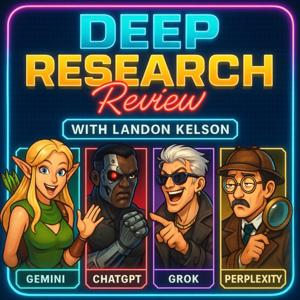
Deep Research Review

Deep Research Review

By Landon KelsonEducation
Download on the App Store

Deep Research Review episodes

  • Palestine - ancient & modern history, conflicts, government, economy, challenges, international law, regional dynamics, complexity

    Today's episode answers the following questions, among others:

    1. What was the British Mandate in Palestine and what was the Balfour Declaration?
    2. What is the Nakba and what happened during the 1948 Arab-Israeli War?
    3. What was the significance of the 1967 Six-Day War for Palestine and Israel?
    4. Who governs the Palestinians, and what are the roles of the Palestinian Authority (PA) and Hamas?
    5. Why are Fatah and Hamas divided, and what are the consequences of this division?
    6. What is daily life like for Palestinians living under Israeli occupation in the West Bank and Gaza?
    7. How has the Israeli occupation affected the Palestinian economy, education, and healthcare systems?
    8. What is the international legal status of Israeli settlements in the West Bank?
    9. What are the competing claims to Jerusalem and its current international status?
    10. What is the "right of return" for Palestinian refugees, and why is it a controversial issue?
    11. What is the two-state solution, and is it still considered a viable path to peace?
    12. What role has the United States played in the Israeli-Palestinian conflict and peace process?
    13. What do international bodies like the UN, International Court of Justice (ICJ), and International Criminal Court (ICC) say about the legality of the Israeli occupation and actions within the conflict?
    14. How has Palestinian identity and culture been shaped by the conflict and expressed as forms of resistance?
    15. What are the main demographic trends in Palestine and the significance of the Palestinian diaspora?


    Request a topic:

    • https://linktr.ee/deepresearchreview


    About Deep Research Review:

    In this ad-free educational podcast, Deep Research reports from Gemini, ChatGPT, Grok, and Perplexity are synthesized to find the objective truth about any topic. Join researcher and entrepreneur Landon Kelson as he pushes the boundaries of research and access to information. Topics include family, technology, pharmacology, astronomy, geography, philosophy, psychology, medicine, history, sports, music, religion, politics, and more. New episodes every morning.


    Disclaimer: 

    Some content on this podcast is AI-generated and may contain biased, offensive, misleading, or outright false information. Nothing is intended as medical, financial, or legal advice. I do my best to encourage unbiased and factual reporting throughout the entire process, but I don't vet or modify AI-generated content in any way; therefore, a healthy dose of critical thinking should always be applied, and listeners would do well to supplement this material with their own research.

    41 min
  • Israel - ancient & modern history, conflicts, government, legal framework, judicial reform debate, population demographic & composition, economy, security, military, controversies

    Today's episode answers the following questions, among others:

    1. What are the ancient historical roots of Israel, and when was "Israel" first mentioned in historical records?
    2. What was the Balfour Declaration, and what role did the British Mandate play in the lead-up to Israel's establishment?
    3. What were the key events and outcomes of the 1948 Arab-Israeli War (War of Independence/Nakba)?
    4. What territories did Israel capture in the 1967 Six-Day War, and what is the significance of UN Resolution 242?
    5. How is Israel's government structured, and what is the role of the Knesset and the Prime Minister?
    6. What are Israel's "Basic Laws," and how do they function as a constitution?
    7. What was the 2023 judicial reform controversy in Israel about?
    8. What is the religious and ethnic composition of Israeli society, including the main Jewish and Arab subgroups?
    9. Why is Israel known as the "Start-Up Nation," and what are its key high-technology industries?
    10. What are the primary security threats Israel faces, and what is the role of the IDF and its intelligence agencies?
    11. What is the nature of the U.S.-Israel relationship, and why is it considered "special"?
    12. What are the Abraham Accords, and how have they affected Israel's relations with Arab countries?
    13. How has Israel addressed its historical water scarcity challenges?
    14. What are the core issues and differing narratives in the Israeli-Palestinian conflict, including the status of settlements and Jerusalem?
    15. What are the "apartheid" allegations made against Israel, and what is the Israeli government's response?


    Request a topic:

    • https://linktr.ee/deepresearchreview


    About Deep Research Review:

    In this ad-free educational podcast, Deep Research reports from Gemini, ChatGPT, Grok, and Perplexity are synthesized to find the objective truth about any topic. Join researcher and entrepreneur Landon Kelson as he pushes the boundaries of research and access to information. Topics include family, technology, pharmacology, astronomy, geography, philosophy, psychology, medicine, history, sports, music, religion, politics, and more. New episodes every morning.


    Disclaimer: 

    Some content on this podcast is AI-generated and may contain biased, offensive, misleading, or outright false information. Nothing is intended as medical, financial, or legal advice. I do my best to encourage unbiased and factual reporting throughout the entire process, but I don't vet or modify AI-generated content in any way; therefore, a healthy dose of critical thinking should always be applied, and listeners would do well to supplement this material with their own research.

    1 hr 6 min
  • Cancer - biology, cellular mechanics, prevalence, impact, diagnosis, treatments, human experiences

    Today's episode answers the following questions, among others:

    1. What is cancer and how does it fundamentally start in the body?
    2. What are the "Hallmarks of Cancer" and why are they important for understanding the disease?
    3. What are the main genetic (e.g., oncogenes, tumor suppressor genes) and epigenetic causes of cancer?
    4. How common is cancer worldwide, and are there differences in cancer rates and deaths between richer and poorer countries?
    5. What are the major lifestyle risk factors (like smoking, diet, alcohol) and environmental factors (like pollution, infections) that can cause cancer?
    6. Can cancer be inherited, and what are some examples of inherited cancer syndromes?
    7. What are the main methods used to diagnose cancer, including imaging and biopsies?
    8. What are "liquid biopsies" and how can they help in detecting and monitoring cancer?
    9. What are the primary types of cancer treatments available today, such as chemotherapy, radiation, targeted therapy, and immunotherapy?
    10. Why do cancer treatments, including targeted therapies, sometimes stop working or lead to resistance?
    11. How does immunotherapy (e.g., checkpoint inhibitors, CAR T-cell therapy) work to fight cancer, and what are its main side effects?
    12. What are some of the newest or emerging approaches to cancer treatment, like gene editing (CRISPR) or nanomedicine?
    13. What is the psychological, social, and emotional impact of a cancer diagnosis on patients and their families?
    14. What does "financial toxicity" mean in the context of cancer care, and why are cancer treatments so expensive?
    15. What are some of the main controversies or debates surrounding cancer screening, such as overdiagnosis or the PSA test for prostate cancer?


    Request a topic:

    • https://linktr.ee/deepresearchreview


    About Deep Research Review:

    In this ad-free educational podcast, Deep Research reports from Gemini, ChatGPT, Grok, and Perplexity are synthesized to find the objective truth about any topic. Join researcher and entrepreneur Landon Kelson as he pushes the boundaries of research and access to information. Topics include family, technology, pharmacology, astronomy, geography, philosophy, psychology, medicine, history, sports, music, religion, politics, and more. New episodes every morning.


    Disclaimer: 

    Some content on this podcast is AI-generated and may contain biased, offensive, misleading, or outright false information. Nothing is intended as medical, financial, or legal advice. I do my best to encourage unbiased and factual reporting throughout the entire process, but I don't vet or modify AI-generated content in any way; therefore, a healthy dose of critical thinking should always be applied, and listeners would do well to supplement this material with their own research.

    1 hr 1 min
  • Microplastics - definition, nanoplastics, environmental contamination, origin, type, spread, persistence, ecological impacts, human exposure, health risks, solutions, policy responses

    Today's episode answers the following questions, among others:

    1. What are microplastics and nanoplastics, and how are they defined by size?
    2. What's the difference between primary and secondary microplastics, and what are some examples of each?
    3. What are the main sources of microplastic pollution in the environment (e.g., from textiles, tires, cosmetics)?
    4. How do microplastics travel through the environment, like in oceans, rivers, and the air?
    5. How are humans exposed to microplastics, and have they been found in the human body (e.g., blood, lungs, placenta)?
    6. What are the potential health effects of microplastics on humans, such as on our respiratory, digestive, or reproductive systems?
    7. How do microplastics affect marine life and other animals in ecosystems?
    8. Do microplastics break down or degrade in the environment, and what factors affect this process?
    9. What policies or regulations exist to address microplastic pollution, such as microbead bans or EU rules?
    10. What technologies are being developed to prevent or remove microplastics from the environment (e.g., filters, cleanup methods)?
    11. What are the economic impacts of microplastic pollution on industries like fishing and tourism?
    12. Is it true that people consume a credit card's worth of plastic each week?
    13. What is the "plastisphere" and why is it a concern for ecosystems?
    14. When did microplastics become recognized as an environmental problem?
    15. How do scientists detect and identify microplastics in samples like water or soil?


    Request a topic:

    • https://linktr.ee/deepresearchreview


    About Deep Research Review:

    In this ad-free educational podcast, Deep Research reports from Gemini, ChatGPT, Grok, and Perplexity are synthesized to find the objective truth about any topic. Join researcher and entrepreneur Landon Kelson as he pushes the boundaries of research and access to information. Topics include family, technology, pharmacology, astronomy, geography, philosophy, psychology, medicine, history, sports, music, religion, politics, and more. New episodes every morning.


    Disclaimer: 

    Some content on this podcast is AI-generated and may contain biased, offensive, misleading, or outright false information. Nothing is intended as medical, financial, or legal advice. I do my best to encourage unbiased and factual reporting throughout the entire process, but I don't vet or modify AI-generated content in any way; therefore, a healthy dose of critical thinking should always be applied, and listeners would do well to supplement this material with their own research.

    1 hr 58 min
  • Insulin Resistance - foundations, history, molecular & cellular mechanisms, development, consequences, diabetes, heart disease, weight gain, nutritional & pharmacological interventions

    Today's episode answers the following questions, among others:

    1. What is insulin resistance?
    2. What does insulin normally do in the body?
    3. What are the main symptoms or signs of insulin resistance?
    4. How is insulin resistance diagnosed by doctors?
    5. What are the major health problems linked to insulin resistance (e.g., diabetes, heart disease)?
    6. What is metabolic syndrome and how does it relate to insulin resistance?
    7. What are the main causes or risk factors for developing insulin resistance?
    8. How does diet (e.g., sugar, fats, carbs) affect insulin resistance?
    9. Can exercise help improve insulin resistance, and how?
    10. Are there medications to treat insulin resistance? What is metformin?
    11. Can insulin resistance be prevented or reversed?
    12. Is insulin resistance genetic, or is it mainly caused by lifestyle?
    13. How does insulin resistance affect different organs like the liver, muscle, and fat tissue?
    14. What is the difference between insulin resistance and Type 2 Diabetes?
    15. Are there any controversies or ongoing debates about what causes or best treats insulin resistance?


    Request a topic:

    • https://linktr.ee/deepresearchreview


    About Deep Research Review:

    In this ad-free educational podcast, Deep Research reports from Gemini, ChatGPT, Grok, and Perplexity are synthesized to find the objective truth about any topic. Join researcher and entrepreneur Landon Kelson as he pushes the boundaries of research and access to information. Topics include family, technology, pharmacology, astronomy, geography, philosophy, psychology, medicine, history, sports, music, religion, politics, and more. New episodes every morning.


    Disclaimer: 

    Some content on this podcast is AI-generated and may contain biased, offensive, misleading, or outright false information. Nothing is intended as medical, financial, or legal advice. I do my best to encourage unbiased and factual reporting throughout the entire process, but I don't vet or modify AI-generated content in any way; therefore, a healthy dose of critical thinking should always be applied, and listeners would do well to supplement this material with their own research.

    1 hr 33 min
  • Peptides - fundamentals, amino acids, synthesis, structure, therapeutics, biotechnology, materials science, agriculture, cosmetics, evolutionary history

    Today's episode answers the following questions, among others:

    1. What exactly are peptides, and how are they different from proteins?
    2. What are some important roles peptides play in the human body (e.g., as hormones or neurotransmitters)?
    3. How are peptides made, both naturally in the body and synthetically in labs?
    4. Can peptides be used as medicines, and what are some examples of peptide drugs?
    5. What are the main challenges in developing and using peptides as drugs (e.g., why are many injected)?
    6. Are peptides used in areas other than medicine, like in cosmetics, food, or agriculture?
    7. What's the science behind collagen peptides and other peptide supplements for skin and health? Do they work?
    8. Are peptides safe to use, and what are the risks associated with unregulated peptide products?
    9. Why are some peptide-based medications, like insulin or new weight-loss drugs, so expensive?
    10. How is artificial intelligence (AI) being used in peptide research and drug development?
    11. What are macrocyclic peptides, and why are they important in drug discovery?
    12. What are antimicrobial peptides (AMPs) and what is their role in fighting infections?
    13. What are GLP-1 agonists (like Ozempic or Wegovy), and how do they work for diabetes and weight loss?
    14. Are peptides used in sports for performance enhancement, and what are the ethical concerns?
    15. What does the future hold for peptide science and its applications in medicine and technology?


    Request a topic:

    • https://linktr.ee/deepresearchreview


    About Deep Research Review:

    In this ad-free educational podcast, Deep Research reports from Gemini, ChatGPT, Grok, and Perplexity are synthesized to find the objective truth about any topic. Join researcher and entrepreneur Landon Kelson as he pushes the boundaries of research and access to information. Topics include family, technology, pharmacology, astronomy, geography, philosophy, psychology, medicine, history, sports, music, religion, politics, and more. New episodes every morning.


    Disclaimer: 

    Some content on this podcast is AI-generated and may contain biased, offensive, misleading, or outright false information. Nothing is intended as medical, financial, or legal advice. I do my best to encourage unbiased and factual reporting throughout the entire process, but I don't vet or modify AI-generated content in any way; therefore, a healthy dose of critical thinking should always be applied, and listeners would do well to supplement this material with their own research.

    1 hr 33 min
  • Hinduism - origins, history, philosophy, texts, traditions, sects, rituals, worship, caste, gender, politics, contemporary challenges

    Today's episode answers the following questions, among others:

    1. What is Hinduism and who is its founder?
    2. What are the core beliefs of Hinduism, like karma, dharma, and moksha?
    3. What are the most important sacred texts in Hinduism (e.g., Vedas, Upanishads, Bhagavad Gita)?
    4. How did Hinduism evolve historically, from ancient times to the modern era?
    5. What are the main schools of Hindu philosophy, such as Vedanta (Advaita, Vishishtadvaita, Dvaita)?
    6. Who are some of the major deities worshipped in Hinduism (e.g., Vishnu, Shiva, Devi)?
    7. What are common Hindu rituals, practices, and life-cycle ceremonies (samskaras)?
    8. What is the caste system, and what is its relationship with Hindu society and scriptures?
    9. What are traditional Hindu perspectives on gender roles, and how are they being debated today (e.g., women priests, Sabarimala)?
    10. What is Hindutva or Hindu nationalism, and how does it relate to secularism in India?
    11. How does Hinduism view other religions, and what are the current debates around religious conversion in India?
    12. How is Hinduism practiced by communities outside of India (the diaspora)?
    13. What is the Hindu perspective on environmental issues or "Green Dharma"?
    14. How has technology and the internet affected Hindu religious practices and communities?
    15. Is Hinduism compatible with science, including concepts like evolution?


    Request a topic:

    • https://linktr.ee/deepresearchreview


    About Deep Research Review:

    In this ad-free educational podcast, Deep Research reports from Gemini, ChatGPT, Grok, and Perplexity are synthesized to find the objective truth about any topic. Join researcher and entrepreneur Landon Kelson as he pushes the boundaries of research and access to information. Topics include family, technology, pharmacology, astronomy, geography, philosophy, psychology, medicine, history, sports, music, religion, politics, and more. New episodes every morning.


    Disclaimer: 

    Some content on this podcast is AI-generated and may contain biased, offensive, misleading, or outright false information. Nothing is intended as medical, financial, or legal advice. I do my best to encourage unbiased and factual reporting throughout the entire process, but I don't vet or modify AI-generated content in any way; therefore, a healthy dose of critical thinking should always be applied, and listeners would do well to supplement this material with their own research.

    1 hr 56 min
  • Proteins - composition, structure, folding, synthesis, enzymes, transporters, signaling, degradation, dysfunction, Alzheimer's, dietary proteins

    Today's episode answers the following questions, among others:

    1. What are proteins and what are their basic building blocks?
    2. What are the different levels of protein structure (primary, secondary, tertiary, quaternary)?
    3. How do proteins fold into their specific shapes, and what helps them do it?
    4. What are the main ways scientists determine the 3D structure of proteins, including new AI methods like AlphaFold?
    5. How are proteins made in our cells, starting from DNA?
    6. What are post-translational modifications (PTMs) and why are they important for proteins?
    7. What are the main functions of proteins in the body (e.g., enzymes, structural support, transport)?
    8. How do enzymes, which are often proteins, speed up chemical reactions?
    9. How do cells get rid of old or damaged proteins?
    10. How can changes or problems with proteins lead to diseases like sickle cell anemia or Alzheimer's?
    11. Can proteins be used as medicines, and what are some examples (like insulin or antibodies)?
    12. How are proteins used in biotechnology and industry, for example, in detergents or making biofuels?
    13. How much protein do people generally need to eat, and does it vary for different individuals (like athletes or older adults)?
    14. What is the difference between animal and plant proteins in terms of nutrition (e.g., complete vs. incomplete proteins)?
    15. What are some of the societal or ethical debates surrounding proteins, such as GMOs, patenting, or lab-grown meat?


    Request a topic:

    • https://linktr.ee/deepresearchreview


    About Deep Research Review:

    In this ad-free educational podcast, Deep Research reports from Gemini, ChatGPT, Grok, and Perplexity are synthesized to find the objective truth about any topic. Join researcher and entrepreneur Landon Kelson as he pushes the boundaries of research and access to information. Topics include family, technology, pharmacology, astronomy, geography, philosophy, psychology, medicine, history, sports, music, religion, politics, and more. New episodes every morning.


    Disclaimer: 

    Some content on this podcast is AI-generated and may contain biased, offensive, misleading, or outright false information. Nothing is intended as medical, financial, or legal advice. I do my best to encourage unbiased and factual reporting throughout the entire process, but I don't vet or modify AI-generated content in any way; therefore, a healthy dose of critical thinking should always be applied, and listeners would do well to supplement this material with their own research.

    53 min
  • COVID-19 - origin, biology, spread, treatments, vaccines, long COVID, social impacts, economic impacts, ethics, legal, psychology, lessons, future preparedness

    Today's episode answers the following questions, among others:

    1. When did the COVID-19 pandemic officially start and end as a public health emergency?
    2. What is SARS-CoV-2, and how does it infect human cells?
    3. What are the main theories about the origin of COVID-19 (e.g., natural spillover vs. lab leak)?
    4. How did key COVID-19 variants like Delta and Omicron differ from the original virus?
    5. How is COVID-19 transmitted, and what does "R0" (R-naught) signify?
    6. What were the main public health interventions (like lockdowns and mask mandates) used during the pandemic, and how effective were they?
    7. What are the common symptoms of acute COVID-19, and what treatments were developed?
    8. What is Long COVID, and what are its common persistent symptoms?
    9. How were COVID-19 vaccines developed so quickly, and what are the different types (e.g., mRNA)?
    10. How effective and safe are COVID-19 vaccines, and why were vaccine mandates controversial?
    11. What were the major economic impacts of the COVID-19 pandemic (e.g., on jobs, global economy, supply chains)?
    12. How did the COVID-19 pandemic affect mental health globally?
    13. What ethical dilemmas (e.g., resource allocation, individual liberties vs. public good) arose during the pandemic?
    14. What was the "infodemic," and how did misinformation about COVID-19 spread?
    15. What are the key lessons learned from the COVID-19 pandemic for future pandemic preparedness?


    Request a topic:

    • https://linktr.ee/deepresearchreview


    About Deep Research Review:

    In this ad-free educational podcast, Deep Research reports from Gemini, ChatGPT, Grok, and Perplexity are synthesized to find the objective truth about any topic. Join researcher and entrepreneur Landon Kelson as he pushes the boundaries of research and access to information. Topics include family, technology, pharmacology, astronomy, geography, philosophy, psychology, medicine, history, sports, music, religion, politics, and more. New episodes every morning.


    Disclaimer: 

    Some content on this podcast is AI-generated and may contain biased, offensive, misleading, or outright false information. Nothing is intended as medical, financial, or legal advice. I do my best to encourage unbiased and factual reporting throughout the entire process, but I don't vet or modify AI-generated content in any way; therefore, a healthy dose of critical thinking should always be applied, and listeners would do well to supplement this material with their own research.

    1 hr 11 min
  • Vaccine Controversies - origins, history, autism, aluminum, mercury, polio accident, brain injury, autoimmune disorders, mRNA, COVID-19, GBS

    Today's episode answers the following questions, among others:

    1. When did vaccine controversies first start, and what were the initial objections?
    2. How do vaccines work to protect us from diseases?
    3. How are vaccines tested for safety before they are given to the public?
    4. Is there a link between the MMR vaccine and autism?
    5. Did thimerosal (mercury) in vaccines cause autism or other health problems?
    6. Can mRNA vaccines like the COVID-19 ones alter my DNA?
    7. What are common ingredients in vaccines, like adjuvants (e.g., aluminum) and preservatives, and are they safe?
    8. Is "natural immunity" from getting sick better than immunity from vaccines?
    9. Can live vaccines (like MMR or chickenpox) cause the vaccinated person to spread the disease to others (viral shedding)?
    10. What was the Cutter Incident with the polio vaccine and what were its consequences?
    11. What are the main psychological reasons people are hesitant about vaccines (e.g., risk perception, trust)?
    12. How does misinformation about vaccines spread, especially on social media?
    13. What is the legal basis for vaccine mandates, and what are the ethical arguments for and against them?
    14. What are the economic factors in vaccine controversies, like pharmaceutical profits and global access?
    15. What are effective ways to communicate about vaccines and address public concerns?


    Request a topic:

    • https://linktr.ee/deepresearchreview


    About Deep Research Review:

    In this ad-free educational podcast, Deep Research reports from Gemini, ChatGPT, Grok, and Perplexity are synthesized to find the objective truth about any topic. Join researcher and entrepreneur Landon Kelson as he pushes the boundaries of research and access to information. Topics include family, technology, pharmacology, astronomy, geography, philosophy, psychology, medicine, history, sports, music, religion, politics, and more. New episodes every morning.


    Disclaimer: 

    Some content on this podcast is AI-generated and may contain biased, offensive, misleading, or outright false information. Nothing is intended as medical, financial, or legal advice. I do my best to encourage unbiased and factual reporting throughout the entire process, but I don't vet or modify AI-generated content in any way; therefore, a healthy dose of critical thinking should always be applied, and listeners would do well to supplement this material with their own research.

    1 hr 56 min

About Deep Research Review

From the publisher's feed

Learn about anything! In this ad-free educational podcast, four Deep Research reports from Gemini, ChatGPT, Grok, and Perplexity are provided to four AI podcast guests, who are then interviewed as a…

More shows like Deep Research Review

The Joe Rogan Experience by Joe Rogan

The Joe Rogan Experience

227,392 Listeners

The Shawn Ryan Show by Shawn Ryan

The Shawn Ryan Show

46,043 Listeners

The Hunter Williams Podcast by Hunter Williams

The Hunter Williams Podcast

125 Listeners

Huberman Lab by Scicomm Media

Huberman Lab

29,124 Listeners

TRT DAD Unscripted by TRT DAD

TRT DAD Unscripted

29 Listeners