
Sign up to save your podcasts
Or


Our guest today is Rachel Tidd, the author of Wild Learning: Practical Ideas for Bringing Teaching Outdoors and the Wild Math® and Reading Curriculums®.
Today’s episode dives into the connections between nature and curriculum. Not only does Rachel provide some great examples on how to incorporate literacy and numeracy into our outdoor learning adventures, but she also talks about the value of different outdoor learning spaces such as the school yard, neighbourhood, and fields. They are all inclusive learning spaces which allow for a range of playful opportunities. In fact, one of the chapters of her book is all about how to use chalk! Around minute 13 of the episode, Rachel talks about how to incorporate arrays and multiplication connections while on a nature walk. Then she digs into some potential barriers of outdoor classrooms, like gear or having a student that is at risk of running out of the boundaries. To end the episode, we talk about how to document student learning outdoors – something that all teachers are eager to learn more about!
Novelty nature note:
I shared about water striders and how their legs are covered in hairs which trap air, making them buoyant. We also learned that they could live up to a year, as long as the temperatures aren’t freezing.
Rachel shared about leaves, both simple and compound, and how leaflets are the structures that make up a compound leaf.
Don’t forget to bookmark: https://teachoutdoors.ca and subscribe to @TeachOutdoors on YouTube (you can find the episode of this podcast here: https://youtu.be/11f9i2ZoTh8 )
Make sure to bookmark Rachel’s website: www.discoverwildlearning.com and follow her on Instagram and Facebook @discoverwildlearning.
 View all episodes
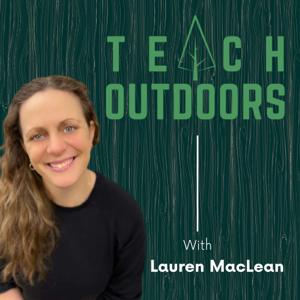
 By Lauren MacLean
5
22 ratings
Our guest today is Rachel Tidd, the author of Wild Learning: Practical Ideas for Bringing Teaching Outdoors and the Wild Math® and Reading Curriculums®.
Today’s episode dives into the connections between nature and curriculum. Not only does Rachel provide some great examples on how to incorporate literacy and numeracy into our outdoor learning adventures, but she also talks about the value of different outdoor learning spaces such as the school yard, neighbourhood, and fields. They are all inclusive learning spaces which allow for a range of playful opportunities. In fact, one of the chapters of her book is all about how to use chalk! Around minute 13 of the episode, Rachel talks about how to incorporate arrays and multiplication connections while on a nature walk. Then she digs into some potential barriers of outdoor classrooms, like gear or having a student that is at risk of running out of the boundaries. To end the episode, we talk about how to document student learning outdoors – something that all teachers are eager to learn more about!
Novelty nature note:
I shared about water striders and how their legs are covered in hairs which trap air, making them buoyant. We also learned that they could live up to a year, as long as the temperatures aren’t freezing.
Rachel shared about leaves, both simple and compound, and how leaflets are the structures that make up a compound leaf.
Don’t forget to bookmark: https://teachoutdoors.ca and subscribe to @TeachOutdoors on YouTube (you can find the episode of this podcast here: https://youtu.be/11f9i2ZoTh8 )
Make sure to bookmark Rachel’s website: www.discoverwildlearning.com and follow her on Instagram and Facebook @discoverwildlearning.

19,848 Listeners

13,648 Listeners
193 Listeners