
Sign up to save your podcasts
Or

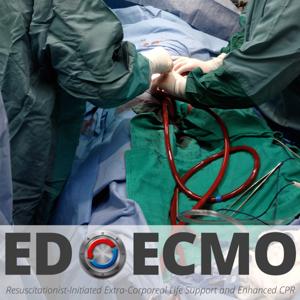

Episode 2 of Evid-ECMO features Dr. David Willms, who is the Director of Critical Care Medicine at Sharp Memorial Hospital. Dr. Willms has over 25 years of experience with VA and VV ECMO and is an amazing resource for us at our hospital. Dr. Willms has been a key player in the development of our highly successful ECMO program at Sharp. Zack and Dave discuss two of the “big” articles in VV-ECMO for ARDS:
PDF: cesar-trial
Identification:
Title: Efficacy and economic assessment of conventional ventilatory support versus extracorporeal membrane oxygenation for severe adult respiratory failure (CESAR): a multicentre randomised controlled trial
Authors: Giles J Peek, Miranda Mugford, Ravindranath Tiruvoipati, Andrew Wilson, Elizabeth Allen, Mariamma M Thalanany, Clare L Hibbert, Ann Truesdale, Felicity Clemens, Nicola Cooper, Richard K Firmin, Diana Elbourne, for the CESAR trial collaboration
Location: UK-based multi-center trial
Source: Lancet. 2009 Oct 17;374(9698):1330
PMID: 19762075
Introduction:
Problem: Does ECMO provide improved safety, efficacy and cost-effectiveness, when compared to traditional therapy, in patients with severe ARDS?
Significance: This is the first positive RCT that shows a statistically significant benefit of VV-ECMO for severe ARDS.
Methods:
Study Type: Randomized Controlled Trial
Subjects: 180 adults with severe ARDS were randomized to receive conventional management or referral to ECMO center.
Primary End-Point: Death or severe disability at 6 months.
Analysis: Intention to treat
Results/Conclusions:
****THE BOTTOM LINE: EDECMO Critical Assessment: If you need a paper to support your use of VV ECMO for severe ARDS, this is your ammunition.
PDF: ANZ ECMO
Identification:
Title: Extracorporeal membrane oxygenation (ECMO) in patients with H1N1 influenza infection: a systematic review and meta-analysis including 8 studies and 266 patients receiving ECMO
Authors: The Australia and New Zealand Extracorporeal Membrane Oxygenation (ANZ ECMO) Influenza Investigators*
Location: Australia and New Zealand
Context: The novel influenza A(H1N1) pandemic affected Australia and New Zealand during the 2009 southern hemisphere winter. It caused an epidemic of critical illness and some patients developed severe acute respiratory distress syndrome (ARDS) and were treated with extracorporeal membrane oxygenation (ECMO).
Source: JAMA, November 4, 2009—Vol 302, No. 17
Introduction:
Purpose: To describe the characteristics of all patients with 2009 influenza A(H1N1)– associated ARDS treated with ECMO and to report incidence, resource utilization, and patient outcomes.
Significance:
Methods:
Study Type: Retrospective Observational Study
****THE BOTTOM LINE: EDECMO Critical Assessment: In 2009, VV ECMO was used with success to combat severe ARDS caused by Influenza A (H1N1).
If you have a question for Dr. Willms you may post it in the comments section below or email him directly at [email protected]
 View all episodes
 By Zack Shinar, MD

4.6
8787 ratings
Episode 2 of Evid-ECMO features Dr. David Willms, who is the Director of Critical Care Medicine at Sharp Memorial Hospital. Dr. Willms has over 25 years of experience with VA and VV ECMO and is an amazing resource for us at our hospital. Dr. Willms has been a key player in the development of our highly successful ECMO program at Sharp. Zack and Dave discuss two of the “big” articles in VV-ECMO for ARDS:
PDF: cesar-trial
Identification:
Title: Efficacy and economic assessment of conventional ventilatory support versus extracorporeal membrane oxygenation for severe adult respiratory failure (CESAR): a multicentre randomised controlled trial
Authors: Giles J Peek, Miranda Mugford, Ravindranath Tiruvoipati, Andrew Wilson, Elizabeth Allen, Mariamma M Thalanany, Clare L Hibbert, Ann Truesdale, Felicity Clemens, Nicola Cooper, Richard K Firmin, Diana Elbourne, for the CESAR trial collaboration
Location: UK-based multi-center trial
Source: Lancet. 2009 Oct 17;374(9698):1330
PMID: 19762075
Introduction:
Problem: Does ECMO provide improved safety, efficacy and cost-effectiveness, when compared to traditional therapy, in patients with severe ARDS?
Significance: This is the first positive RCT that shows a statistically significant benefit of VV-ECMO for severe ARDS.
Methods:
Study Type: Randomized Controlled Trial
Subjects: 180 adults with severe ARDS were randomized to receive conventional management or referral to ECMO center.
Primary End-Point: Death or severe disability at 6 months.
Analysis: Intention to treat
Results/Conclusions:
****THE BOTTOM LINE: EDECMO Critical Assessment: If you need a paper to support your use of VV ECMO for severe ARDS, this is your ammunition.
PDF: ANZ ECMO
Identification:
Title: Extracorporeal membrane oxygenation (ECMO) in patients with H1N1 influenza infection: a systematic review and meta-analysis including 8 studies and 266 patients receiving ECMO
Authors: The Australia and New Zealand Extracorporeal Membrane Oxygenation (ANZ ECMO) Influenza Investigators*
Location: Australia and New Zealand
Context: The novel influenza A(H1N1) pandemic affected Australia and New Zealand during the 2009 southern hemisphere winter. It caused an epidemic of critical illness and some patients developed severe acute respiratory distress syndrome (ARDS) and were treated with extracorporeal membrane oxygenation (ECMO).
Source: JAMA, November 4, 2009—Vol 302, No. 17
Introduction:
Purpose: To describe the characteristics of all patients with 2009 influenza A(H1N1)– associated ARDS treated with ECMO and to report incidence, resource utilization, and patient outcomes.
Significance:
Methods:
Study Type: Retrospective Observational Study
****THE BOTTOM LINE: EDECMO Critical Assessment: In 2009, VV ECMO was used with success to combat severe ARDS caused by Influenza A (H1N1).
If you have a question for Dr. Willms you may post it in the comments section below or email him directly at [email protected]
78,688 Listeners

30,609 Listeners

43,687 Listeners
27,011 Listeners
1,877 Listeners
549 Listeners
97 Listeners
1,468 Listeners
272 Listeners

56,944 Listeners
24,585 Listeners
1,150 Listeners
260 Listeners
437 Listeners
270 Listeners