
Sign up to save your podcasts
Or

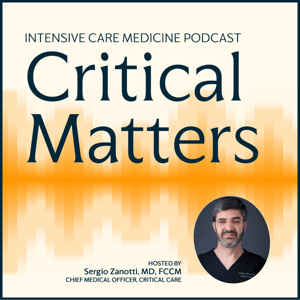


Acute respiratory failure is one of the most common reasons adults require intensive care, and choosing the right respiratory support strategy can have a significant impact on patient outcomes.
In this episode of Critical Matters, Dr. Sergio Zanotti explores the evidence behind noninvasive respiratory support for adults with acute respiratory failure. The discussion examines current clinical guidelines, the role of high-flow nasal cannula and noninvasive ventilation, and key considerations for selecting the most appropriate support strategy in critical care settings.
He is joined by Neha Goel, MD, Assistant Professor in the Division of Pulmonary, Critical Care, and Sleep Medicine at the Icahn School of Medicine at Mount Sinai. A physician-scientist specializing in pulmonary and critical care medicine, Dr. Goel's research focuses on respiratory failure, mechanical ventilation, ARDS, sepsis, and the physiology of breathing during critical illness. She is also the lead author of the recently published American Thoracic Society Clinical Practice Guideline on Noninvasive Respiratory Support for Adult Patients with Acute Respiratory Failure.
Additional resources:
American Thoracic Society Clinical Practice Guidelines on Noninvasive Respiratory Support for Adult Patients with Acute Respiratory Failure
High-flow oxygen through nasal cannula in acute hypoxemic respiratory failure. FLORALI Study. NEJM 2015
Noninvasive Ventilation for Preoxygenation during Emergency Intubation. PREOXI Trial. NEJM 2024
Effect of Postextubation High-Flow Nasal Oxygen With Noninvasive Ventilation vs High-Flow Nasal Oxygen Alone on Reintubation Among Patients at High Risk of Extubation Failure: A Randomized Clinical Trial. HIGH-WEAN Trial. JAMA 2019
Noninvasive ventilation for acute exacerbations of chronic obstructive pulmonary disease. Bouchard et al. NEJM 1995
Books mentioned in this episode:
Breath: The New Science of a Lost Art. By James Nestor
Sepsis remains one of the leading causes of death and disability worldwide, making early recognition and coordinated care essential to improving patient outcomes.
In honor of Sepsis Awareness Month, observed every September, we are revisiting an episode of Critical Matters featuring a conversation about hospital sepsis programs and the CDC Hospital Sepsis Program Core Elements.
Originally debuting in 2023, Dr. Sergio Zanotti’s discussion with guest Hallie Prescott, MD, MSc, Associate Professor of Pulmonary and Critical Care Medicine at the University of Michigan, hits on evidence-based approaches to building effective sepsis initiatives and advancing quality care across healthcare organizations.
Additional resources:
CDC Hospital Program Sepsis Program Core Elements
CDC Additional Sepsis Clinical Resources
SCCM Surviving Sepsis Guidelines 2021
Characterizing an implementation intervention in terms of behaviour change techniques and theory: the ‘Sepsis Six’ clinical care bundle. Steinmo S, et al. Implementation Science 2015
Effect of a Multicomponent Sepsis Transition and Recovery Program on Mortality and Readmissions After Sepsis: The Improving Morbidity During Post-Acute Care Transitions for Sepsis Randomized Clinical Trial. Crit Care Medicine 2022
Recent episodes of Critical Matters related to sepsis:
Sepsis – Beyond the guidelines
Surviving Sepsis Campaign 2026 Guidelines
Capillary Refill Time (CRT)
Books mentioned in this episode:
The Autumn Ghost: How the Battle Against a Polio Epidemic Revolutionized Modern Medical Care. By Hannah Wunsch
For patients receiving mechanical ventilation, losing the ability to speak can be one of the most frightening and frustrating aspects of critical illness.
In this episode of Critical Matters, Dr. Sergio Zanotti discusses the experience of being "voiceless" in the ICU and examines evidence-based strategies to improve communication between patients, families, and care teams.
He is joined by Mary Beth Happ, PhD, RN, Nursing Distinguished Professor of Critical Care Research at The Ohio State University College of Nursing and a nationally recognized researcher whose work has transformed our understanding of communication during mechanical ventilation.
Additional resources:
Giving Voice: Nurse-Patient Communication in the Intensive Care Unit. Happ MB. American Journal of Critical Care 2021.
Effect of a multi-level intervention on nurse-patient communication in the intensive care unit: results of the SPEACS trial. Happ MB, et al. Heart Lung 2014.
The Patient Communication Support Guide (PCSG): Development and Pilot Field Testing of a Digital Clinical Guide for Patient Communication in ICU. Tate, JA, Happ MB, et al. Ann Am Thorac Soc 2026.
Shin JW, Happ, MB., Tate, J. (2021). VidaTalk™ communication application “opened up” communication between nonvocal ICU patients and their family caregivers. Intensive and Critical Care Nursing, 66:103075. doi: 10.1016/j.iccn.2021.103075.
Shin JW, Happ MB., Tate, J., Balas, MC., Dabelko-Schoney, H., Tan, A. (2025). Preliminary efficacy of an electronic VidaTalkTMcommunication application on family-patient communication and family psychological distress in the intensive care unit: A pilot study. Heart Lung, 70: 14-22. PMCID: PMC11846697.
Books mentioned in this episode:
Culpability: A Novel. By Bruce Holsinger
Recovering after a stay in the intensive care unit (ICU) is a long and difficult process, and for some survivors, healing the body may only be a fraction of the journey.
In recent years, attention has increasingly turned to the cognitive impact post-intensive care syndrome, or PICS, has on ICU patients. In this episode of Critical Matters, Dr. Sergio Zanotti explores how to communicate with patients and families about post-intensive care syndrome.
He is joined by Dr. Carla M. Sevin, an Associate Professor of Medicine in the Division of Allergy, Pulmonary, and Critical Care Medicine at Vanderbilt University Medical Center (VUMC). Dr. Sevin also serves as Director of the Pulmonary Patient Care Center and Director of the ICU Recovery Center.
Previous episodes of Critical Matters related to this topic:
Post-Intensive Care Syndrome (PICAS)
The Forgotten Patient
Additional resources:
Communicating to Patients and Families About Post-Intensive Care Syndrome. CHEST, 2025.
Post-Intensive Care Syndrome Awareness and Communication: Surveys of ICU Providers and Patients. CHEST, 2026.
The Heroism of Incremental Care. Atul Gawande. The New Yorker, 2017.
Critical Illness, Brain Dysfunction. And Survivorship (CIBS) Center.
CAIRO- Critical and Acute Illness Recovery Organization.
Books mentioned in this episode:
The Diving Bell and the Butterfly: A Memoir of Life in Death. By Jean Dominique-Bauby
The Correspondent: A Novel. By Virginia Evans.
The Wall. By Marlen Haushofer
Recovering after a stay in the intensive care unit (ICU) is a long and difficult process, and for some survivors, healing the body may only be a fraction of the journey.
In recent years, attention has increasingly turned to the cognitive impact post-intensive care syndrome, or PICS, has on ICU patients. In this episode, Dr. Sergio Zanotti explores how to communicate with patients and families about post-intensive care syndrome.
He is joined by Dr. Carla M. Sevin, an Associate Professor of Medicine in the Division of Allergy, Pulmonary, and Critical Care Medicine at Vanderbilt University Medical Center (VUMC). Dr. Sevin also serves as Director of the Pulmonary Patient Care Center and Director of the ICU Recovery Center.
Previous Critical Matters episodes related to this topic:
Post-Intensive Care Syndrome (PICAS)
The Forgotten Patient
Additional Resources:
Communicating to Patients and Families About Post-Intensive Care Syndrome. CHEST, 2025.
Post-Intensive Care Syndrome Awareness and Communication: Surveys of ICU Providers and Patients. CHEST, 2026.
The Heroism of Incremental Care. Atul Gawande. The New Yorker, 2017.
Critical Illness, Brain Dysfunction. And Survivorship (CIBS) Center.
CAIRO- Critical and Acute Illness Recovery Organization
Books mentioned in this episode:
The Diving Bell and the Butterfly: A Memoir of Life in Death. By Jean Dominique-Bauby
When it comes to critical illness, nutrition isn't just supportive care—it can be a key part of the treatment plan.
In this episode, Dr. Sergio Zanotti sits down with Dr. Jayshil Patel to discuss nutrition therapy for critically ill adults and the growing evidence behind enteral nutrition's role in improving outcomes.
Dr. Patel is a pulmonary and critical care physician in the Division of Pulmonary at the Medical College of Wisconsin whose research focuses on how enteral nutrition influences outcomes in critical care settings.
Additional resources:
Books mentioned in this episode:
In a recent episode, Dr. Sergio Zanotti discussed the 2026 iteration of the Surviving Sepsis Guidelines. In this episode, the discussion continues, focusing on important aspects beyond clinical guidelines. He is joined by Dr. Andre Kalil, a physician specializing in critical care and infectious diseases. Dr. Kalil is a Professor in the Division of Infectious Diseases and Director of Transplant Infectious Diseases at the University of Nebraska Medical Center (UNMC). Dr. Kalil is a prolific author and has participated in several IDSA/SCCM Clinical Guidelines and has written extensively on critical care and infectious disease topics.
Additional resources:
Surviving sepsis campaign 2026 guidelines | Critical Matters
Sepsis. M Singer, et al. The Lancet 2026.
Surviving Sepsis Campaign: International Guidelines for Management of Sepsis and Septic Shock 2026. Crit Care Medicine 2026.
Subphenotypes and phenotypes to resolve sepsis heterogeneity: hype or hope? Andre Kalil, et al. Intensive Care Med 2025.
Early Goal-Directed Therapy for Sepsis: A Novel Solution for Discordant Survival Outcomes in Clinical Trials. Andre Kalil, et al. Crit Care Med 2017.
Books mentioned in this episode:
Curious: The Desire to Know and Why Your Life Depends on It. By Ian Leslie.
This episode was originally posted Feb. 24, 2022.
The last 24 months have pushed ICU teams around the world to their limits. As we move forward, we need to heal and rebuild our critical care teams. Healthcare more than ever will require ICU teams to perform at the highest levels and to continuously innovate to deliver high-value care to the sickest of the sick. In this episode, Dr. Sergio Zanotti discusses the elements of The Fearless ICU. He is joined by Amy Edmondson (@AmyCEdmondson), the Novartis Professor of Leadership and Management at the Harvard Business School. For the last two decades, she has studied the elements of high-performing teams in complex environments.
Additional Resources:
Faculty page for Amy Edmondson. A great jumping point to her vast body of work.
How to turn a group of strangers into a team. TED Talk by Amy Edmondson
The Fearless Organization. By Amy Edmondson.
What Google Learned in its Quest to Build the Perfect Team. New York Times.
Implementing New Practices: An Empirical Study of Organizational Learning in Hospital Intensive Care Units. A. Edmondson et al. Management Science 2007.
Books Mentioned in this Episode:
Get Rid of the Performance Review! By Samuel Culbert.
Mindset. By Carol Dweck.
In this episode, Dr. Sergio Zanotti discusses the care of older adults in the ICU. He is joined by Dr. Lauren Ferrante, a pulmonary critical care physician in the medical intensive care unit at Yale New Haven Hospital. She is an Associate Professor of Medicine at the Yale School of Medicine and serves as Director, Operations Core, at the Yale Claude D. Pepper Older Americans Independence Center. Dr. Ferrante is the lead author of the recently published “Society of Critical Care Medicine Guidelines on Caring for Older Adults in the ICU."
Additional resources:
Society of Critical Care Medicine Guidelines on Care for Older Adults in the ICU. Crit Care Medicine 2026
Society of Critical Care Medicine Guidelines on Care for Older Adults in the ICU. Implementation Toolkit
American Geriatric Society Beers Criteria (Pocket Guide)
Books mentioned in this episode:
The Correspondent. By Virginia Evans
In this episode, Dr. Sergio Zanotti discusses arterial catheters in shock through the lens of the recently published EVERDAC trial. He is joined by Dr. Gregoire Muller, a critical care physician in the Department of Intensive Care Medicine and Resuscitation at the University Hospital Center of Orléans, Orléans, France. Dr. Muller is an accomplished clinician and researcher. He is the principal investigator/lead author of the EVERDAC clinical trial published in the New England Journal of Medicine.
Additional resources:
Deferring Arterial Catheterization in Critically Ill Patients with Shock. EVERDAC Trial. New Engl J Med 2025.
Arterial lines in the ICU: A call for rigorous controlled trials. CHEST 2014.
Hemodynamic monitoring in shock and implications for management. International Consensus Conference, Paris, France 2006. Intensive Care Med 2007.
Noninvasive BP monitoring in the critically ill: time to abandon the arterial catheter? CHEST 2018.
Books mentioned in this episode:
Getting Things Done: The Art of Stress-Free Productivity. By David Allen.
From the publisher's feed

1,866 Listeners

534 Listeners

499 Listeners

254 Listeners

807 Listeners

3,348 Listeners
273 Listeners

1,157 Listeners
694 Listeners
517 Listeners

249 Listeners
257 Listeners

430 Listeners
373 Listeners

267 Listeners