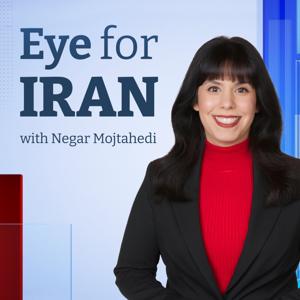
Eye For Iran

Eye For Iran

By Iran International EnglishNews
Download on the App Store

Eye For Iran episodes

  • Iran’s oil revenue could hit ZERO by December —first time in history | Eye for Iran | EP 124 |
    Iran has survived revolution, war and decades of sanctions without losing its oil revenue entirely. That could change in December.

    For the first time in Iran's history, revenue from crude oil and condensate exports could fall to ZERO by mid-December if the US blockade continues, according to new analysis from Kpler. The Islamic Republic stands to lose as much as $6 billion a month. But will unprecedented economic pressure force Tehran to compromise, or is its leadership prepared to fight to the bitter end?

    This week on Eye for Iran, Negar Mojtahedi explores three extraordinary stories that raise troubling questions about the Islamic Republic's future.

    Why is Tehran accelerating its executions? Khosro Esfahani, Research Director at NUFDI, examines the regime's escalating use of the death penalty following January's anti-government protests. He argues that the leadership's apocalyptic worldview helps explain its willingness to embrace endless conflict, even at the cost of devastating consequences for Iran. Just how far is it prepared to go?

    Could Iran's oil money disappear by December? Homayoun Falakshahi, Head of Crude Oil Analysis at Kpler, reveals why Iran could be approaching an unprecedented financial turning point. With oil exports effectively halted, can Tehran find a way around the US blockade? What happens to the economy, the regime's regional allies and its negotiating position with Washington if billions in oil revenue vanish?

    Imprisoned for being poor. Shahin Milani, Executive Director of the Iran Human Rights Documentation Center, exposes the largely forgotten Iranians held behind bars over unpaid debts. Some have spent years in prison without a criminal conviction. As economic conditions worsen, could thousands more face the same fate?

    From the regime's execution campaign to the potential disappearance of its oil lifeline, this episode asks a fundamental question: What happens when an increasingly isolated leadership faces unprecedented pressure but refuses to change course?

    Watch the full episode of Eye for Iran for exclusive interviews and analysis of Iran's executions, the US oil blockade, sanctions evasion, the Islamic Republic's ideology and the country's deepening economic crisis.

    Chapters:

    02:48 Segment 1 | Khosro Esfahani
    Iran's escalating executions: Why the Islamic Republic's leadership is prepared to fight to the bitter end.

    22:07 Segment 2 | Homayoun Falakshahi
    Iran's oil revenue could hit zero by December for the first time in history. What happens next?

    46:31 Segment 3 | Shahin Milani
    Iran's forgotten prisoners: Thousands jailed over unpaid debts, sometimes for years.


    #iran #hormuz #oil #executions #debt #prison #iranian #news #podcast #irannews #youtubeshorts #youtube
    1 hr 13 min
  • Is Iran becoming North Korea — or can society stop it? | Eye for Iran | EP 123 |
    Are we witnessing the “North Koreanization” of the Islamic Republic of Iran?

    From the growing presence of Basij paramilitary forces in elementary schools to the sentencing of musicians and the accelerating use of executions against those detained in connection with January’s uprising, repression inside Iran appears to be intensifying. Just this week, two protesters detained following the January unrest were executed.

    But every society has a red line. Has Iran reached its own?

    This week on Eye for Iran, we look beyond the possibility of another war with the United States or a new diplomatic deal to examine the forces unfolding inside Iran — and what they may tell us about the direction of the Islamic Republic itself.

    Former US diplomat Alberto Fernandez, vice president of the Middle East Media Research Institute, warns of what he calls the “North Koreanization” or “Houthization” of Iran: a system that survives, but as a poorer, harsher and increasingly hollowed-out state. “It doesn’t mean that the regime falls tomorrow,” Fernandez says, but if it survives, Iran could become “a more ramshackle predatory state” in which repression becomes increasingly overt.

    Kamran Bokhari, strategic forecaster and senior resident fellow at the Middle East Policy Council, sees what he calls a “slow meltdown,” arguing that the regime’s fundamental challenge is not simply war but governance and the economy. And there are limits to repression, he says: used on too great a scale, it can “backfire” and eventually raise questions even within the security forces.

    David Patrikarakos, special correspondent for the Daily Mail and author of Nuclear Iran: The Birth of an Atomic State, points to an even more basic indicator: whether ordinary Iranians can afford to live. “You can only terrorize people back into their homes for so many things,” he says. “If they’re starving, they can’t afford food, there’s nothing you can do.”

    Together, the three experts identify the trends they are watching most closely — economic pressure, the cost of basic goods, internal regime infighting, unrest and the limits of the state’s coercive power — and what those indicators could reveal about what comes next for Iran.

    We then turn from repression to resistance.

    Bahiyyih Nakhjavani, editor and co-translator of Open Wide the Doors, the new memoir by acclaimed Iranian poet, writer and Baha’i prisoner of conscience Mahvash Sabet, discusses decades of persecution faced by Iran’s Baha’i community and Sabet’s philosophy of “constructive resilience.”

    Nakhjavani describes it not as passive resistance, nor as aggression, but as a purposeful refusal to allow repression to define the individual. She connects Sabet’s experience in prison to a broader transformation she sees taking place in Iran, particularly since the Woman, Life, Freedom movement: the moment when people establish a red line and say, “thus far and no further.”

    Finally, we examine a viral political exchange in Michigan that struck a nerve among many Iranians.

    University of Michigan student Iman Dashti questioned Democratic US Senate nominee Abdul El-Sayed at a town hall over whether he stood unequivocally against Iran’s Islamic Revolutionary Guard Corps. El-Sayed said he stood with movements for freedom and democracy and opposed US-led regime change, but Dashti says the answer did not address the specific question he had asked about the IRGC.

    “I never asked about regime change,” Dashti told Iran International after the exchange. His question, he says, was fundamentally about whether an American political candidate would explicitly stand with Iranians facing repression.

    Dashti joins Eye for Iran to explain why he asked the question, why the exchange resonated so widely and what happened after the video went viral — including the harassment, threats and alleged doxxing of members of his family that he says followed. Despite that reaction, Dashti says the response has been overwhelmingly supportive.

    From the machinery of repression to the limits of fear, this episode asks a larger question: how long can a state tighten its grip before the very tools it uses to survive begin working against it?

    Chapters:

    02:31 Is Iran Becoming North Korea?

    Experts examine escalating repression, economic pressure and the warning signs that could reveal where the Islamic Republic is heading.

    Guests: Ambassador Alberto Fernandez, Kamran Bokhari and David Patrikarakos

    23:37: Iran’s Red Line: Resistance Under Repression

    What decades of Baha’i persecution — and Mahvash Sabet’s prison memoir — reveal about “constructive resilience” and the limits of fear.

    Guest: Bahiyyih Nakhjavani

    43:46 : The IRGC Question That Went Viral

    The Iranian-American student who challenged Michigan Senate nominee Abdul El-Sayed explains why he asked the question — and what happened afterward.

    Guest: Iman Dashti

    #iran #irgc #Baháʼí #abdulelsayed #michigan #podcast #iranian #news #youtubeshorts #youtube

    59 min
  • Trump has Iran cornered. So what is he waiting for? | Eye for Iran | EP 122 |
    President Donald Trump has subjected Iran to extraordinary military and economic pressure. Its leadership has been battered, its economy squeezed, its oil trade disrupted and its regional network weakened. Yet the Islamic Republic remains in power — and Washington has yet to translate that pressure into a clear political outcome.

    So what is Trump waiting for?

    This week on Eye for Iran, former US diplomat Ludovic Hood examines what would actually have to happen for pressure on Tehran to produce political change — and why he believes the confrontation with Iran still has more chapters to come.

    Ilan Berman of the American Foreign Policy Council argues the war may already have changed who wields power inside Iran, accelerating the Revolutionary Guards’ consolidation of control and altering how Tehran operates across the region.

    And former US Treasury official Max Meizlish asks why Washington isn't using more of its financial leverage over China, Iran’s most important economic lifeline. His conclusion raises an even bigger question: after months of military and economic pressure, what exactly is America’s endgame for Iran?

    Iran is under pressure. The question now is what Washington intends to do with it.

    Chapters:

    02:09 Trump, Iran and the search for an endgame
    Ludovic Hood — Former US Diplomat; Hudson Institute
    US-Iran talks over Hormuz and the blockade are active, while major differences remain over how to wind down the war.

    32:51 Who holds power in Tehran after seven months of war?
    Ilan Berman — Senior Vice President, American Foreign Policy Council
    Iran is simultaneously negotiating over Hormuz while threatening further escalation, including through the Red Sea.

    54:55 Trump, Xi and China’s lifeline to Iran
    Max Meizlish — Research Fellow, Foundation for Defense of Democracies; Former US Treasury Official
    Trump has just hosted Xi in Washington while pressure is mounting over Chinese purchases of Iranian oil and alleged Chinese support involving weapons components and other material.

    #iran #trump #unga #iraneconomy #irgc #iranwar #china #airlines #xijinping
    1 hr 15 min
  • Twins sentenced in Iran: one to death, one to prison | Eye for Iran | EP 121 |
    They were 19 when they took to the streets. They turned 20 behind bars. Now one twin has been sentenced to death — and the other to decades in prison.

    Taraneh and Romina Rahimi joined Iran’s January uprising in Isfahan. Their cousin, Masoud Nourmohammadi, says the sisters were tortured and forced to confess. Taraneh now faces execution, while Romina has been sentenced to decades behind bars. As their family fights to save them, Masoud says he and his children are also receiving death threats for speaking publicly about their case.

    Their story comes four years after the death of Mahsa “Jina” Amini ignited the Woman, Life, Freedom movement and changed the trajectory of protest in Iran. Iran International journalists Shervin Shahrestani and Azadeh Akbari look at what that movement left behind — from women openly defying compulsory hijab to a generation that discovered the power of collective action. Could January’s massive nationwide uprising have happened without it? And what did the Islamic Republic learn from 2022?

    And beyond Iran’s borders, another pressure point is emerging. As the Houthis make their biggest military gains in Yemen in years, Yemeni-American analyst Fatima Abo Alasrar explains why she believes the timing is no coincidence — and why Tehran may see the Red Sea as another source of leverage in its economic confrontation with Washington. How far can Iran push Saudi Arabia before that leverage becomes a liability?

    Chapters:

    02:50 One twin sentenced to death, the other to decades in prison

    Guest: Masoud Nourmohammadi

    25:13 Four years after Mahsa Amini: What did Woman, Life, Freedom change?

    Guests: Shervin Shahrestani & Azadeh Akbari

    49:42 Why are the Houthis escalating now — and what does Iran want?

    Guest: Fatima Abo Alasrar

    #iran #iranprotests #mahsaamini #houthi #humanrights #babalmandab #hormuz #yemen #saudiarabia #iranian #hijab
    1 hr 18 min
  • Iranians turn on the regime as fear wanes: Is the ‘hour of freedom’ near? | Eye for Iran | EP 120 |
    Can the Islamic Republic survive a deepening economic crisis, growing resistance at home and a war with the United States?

    On this week’s episode of Eye for Iran, British-Iranian comedian Omid Djalili and Iran International’s Arash Sohrabi examine the dark humor spreading across Iran as people struggling to afford basic necessities publicly mock the regime and turn its own language of fear against it. Djalili explains why he believes the phenomenon shows that “the fear is gone.”

    The episode also looks at what Washington is prepared to do to help Iranians challenge the Islamic Republic. After President Donald Trump told Iranians that “the hour of your freedom is at hand” and urged them to take over their government once the US is “finished,” Middle East expert Dr. Eric Mandel examines what those words could mean in practice, particularly amid reports that the US-Iran war could continue through the end of Trump’s presidency.

    Finally, Eye for Iran examines the hidden cost of surviving Iran’s crackdowns. Shahin Abdolghaderi, who was shot in the head with hundreds of pellets during the 2022 Woman, Life, Freedom protests, and her son Ardalan Mameh describe the chronic pain, displacement and uncertainty they still live with nearly four years later. Their story offers a chilling warning of what may lie ahead for survivors wounded in Iran’s January 8 and 9 crackdown.

    Guests: Omid Djalili, Arash Sohrabi, Dr. Eric Mandel, Dr. Sara Raza, Shahin Abdolghaderi and Ardalan Mameh.

    Chapters:

    00:00 — Iranians mock Islamic Republic as economic crisis fuels resistance

    Guests: Omid Djalili and Arash Sohrabi
    37:10 — Trump tells Iranians to “take over your government” as war drags on

    Guest: Dr. Eric Mandel
    1:00:07 — The hidden cost of surviving Iran’s crackdowns

    Guests: Shahin Abdolghaderi, Ardalan Mameh and Dr. Sara Raza

    #iran #iraneconomy #iranuswar #trump #iranprotests #iranpodcast #news #youtubeshorts #youtube #podcast

    1 hr 23 min
  • Why Iran is turning to sea mines in the Strait of Hormuz | Eye for Iran | EP 119 |
    Iran is still striking back — but is Tehran choosing smaller attacks, or are its military options narrowing?

    Former CENTCOM commander Gen. Joseph Votel, now a Distinguished Senior Fellow at the Middle East Institute, and Farzin Nadimi, Senior Fellow at the Washington Institute for Near East Policy, examine why Iran is turning to sea mines in the Strait of Hormuz, what it reveals about its remaining military capabilities, and how Tehran may still try to make the conflict painful for the United States and its regional partners.

    Then, inside Iran, the pressure is coming from somewhere else. Inflation and shortages are squeezing families while the state prepares to meet renewed unrest with force. Iranian-American economist Ali Dadpay, based in Texas, and Kamran Bokhari, Strategic Forecaster and Senior Resident Fellow with the Middle East Policy Council in Washington, ask: how long can force contain an economic crisis that keeps getting worse?

    And finally, a very different sign of a regime under pressure. After nearly two decades abroad, musician Mohsen Namjoo is back in Iran despite having crossed some of the Islamic Republic’s most sensitive religious and political red lines. Iranian popular-culture expert Siavash Rokni and historian Shahram Kholdi examine what his return reveals about a system willing to bend its own ideological rules when it needs to.

    Military power. Economic survival. Ideological retreat.

    This week on Eye for Iran.

    Subscribe here and never miss an episode. Eye for Iran is out every Friday — watch on YouTube or listen wherever you get your podcasts.

    Chapters:

    00:00 — Introduction

    02:12 — Iran turns to sea mines in the Strait of Hormuz | Gen. Joseph Votel & Farzin Nadimi

    22:59 — Iran’s economic crisis and the threat of unrest | Ali Dadpay & Kamran Bokhari

    46:51 — Mohsen Namjoo’s return to Iran: What does it reveal? | Siavash Rokni & Shahram Kholdi

    #iran #hormuz #usa #mines #economy #iraneconomy #inflation #iranprotests #namjoon
    1 hr 8 min
  • Oil is flowing through Hormuz again. But not for Iran | Eye for Iran | EP 118 |
    Iran’s oil revenues could effectively fall to zero within months if the US blockade holds, according to Kpler senior oil analyst Homayoun Falakshahi.

    On this episode of Eye for Iran, Falakshahi and former US Treasury OFAC official Max Meizlish examine Washington’s expanding economic pressure campaign, China’s crucial role in buying Iranian oil, the financial networks running through Hong Kong and Dubai, and whether the United States is actually prepared to close the regime’s remaining sanctions-evasion routes.

    But what happens when economic pressure on the Islamic Republic also deepens the suffering of ordinary Iranians? With inflation soaring, food prices climbing and gasoline shortages worsening, the discussion turns to the possibility of renewed unrest — and the danger of another violent crackdown.

    Then, a letter expressing solidarity with Iran’s political prisoners triggers an extraordinary ideological backlash. Human rights advocates Gissou Nia and Roya Boroumand and journalist Jay Solomon examine why condemning the imprisonment and torture of Iranians has become entangled in arguments over American imperialism, Israel and the legacy of the 1979 revolution — and what political prisoners actually endure inside and outside Iran.

    Finally, journalist Mohamed Fahmy who has been in and out of Lebanon this month tells us how Hezbollah can resist disarmament and Tehran’s influence remains deeply entrenched. After speaking with Lebanese people across the country, Fahmy asks whether Iran has really lost its grip on Lebanon — and who ultimately speaks for the Lebanese state.

    Watch this week’s episode of Eye for Iran — and subscribe so you never miss a new episode, out every Friday.

    You can also listen to Eye for Iran on your favorite podcast platform.

    Chapters:

    00:00 Coming Up

    02:02 CHAPTER 1: Iran’s economic endgame: Can Washington choke off Tehran’s lifelines?

    Max Meizlish & Homayoun Falakshahi — Iran’s oil revenues could fall to zero

    32:54 CHAPTER 2 :Why defending Iran’s political prisoners became controversial

    Gissou Nia, Roya Boroumand & Jay Solomon

    53:31 CHAPTER 3: Hezbollah, Iran and the battle over Lebanon’s future

    Mohamed Fahmy

    #Iran #IranNews #IranEconomy #StraitOfHormuz #Oil #OilPrices #Sanctions #Hezbollah #Lebanon #PoliticalPrisoners #HumanRights #EyeForIran
    1 hr 11 min
  • Iran’s crackdown risks creating a generation dependent on opioids | Eye for Iran | EP 117 |
    Could Iran’s crackdown leave behind a generation with permanent disabilities and dependent on opioids for chronic pain? Dr. Sarah Raza, a trauma physician helping wounded protesters inside Iran, has documented hundreds of metal pellets embedded in victims’ bodies, including a six-year-old with pellets lodged in his face and skull. Her warning: “This is making someone’s body a prison.”

    Iran feels the pressure, but will it bend? Raz Zimmt of the Institute for National Security Studies (INSS) says Tehran increasingly recognizes the economic situation is working against it, yet its leadership may still view another war with the United States as preferable to concessions it considers capitulation. We examine what that calculation could mean for what comes next.

    And 31 years for helping children: Afshin Heyratian, a Bahá’í children’s rights activist who devoted his life to helping some of Iran’s most vulnerable children, has received prison sentences totaling 31 years. His brother, Ramin Heyratian, tells us about the man behind the extraordinary punishment and the family fighting for him.

    Watch Eye for Iran, Episode 117, with Negar Mojtahedi.

    Subscribe for a new episode every Friday.

    Or listen on any podcast platform.

    Chapters:

    00:00 Coming Up

    02:26 CHAPTER 1: Dr. Sarah Raza | Iran’s generation at risk of permanent disability and opioid dependence
    A trauma physician documents the lifelong consequences of pellet injuries sustained during Iran’s crackdown.

    20:31 CHAPTER 2 — Raz Zimmt | Why Iran’s regime may risk another war
    Despite mounting economic pressure, Tehran may see another war with the US as preferable to concessions it considers capitulation.

    47:22 CHAPTER 3 - Ramin Heyratian - Afshin's brother | 31 years in prison for helping children
    Afshin Heyratian’s brother - Ramin- tells the story of the Bahá’í children’s rights activist facing decades behind bars.

    #iran #iranprotests #irgc #usa #hormuz #war #bahai
    1 hr 10 min
  • How Iran is preparing for a domestic war against its own people | Eye for Iran | EP 116 |
    The war with Iran was supposed to change the equation.

    But before bombs fall, before presidents decide on war and peace, and before negotiators ever sit across from one another, there is intelligence.

    So what does someone who spent decades trying to understand Iran from inside the CIA see happening next?

    Eye for Iran’s Negar Mojtahedi spoke with Mark Fowler, a decorated former CIA case officer and Farsi speaker who spent 22 years at the agency, rising to the number two position on Iran and Iraq within the CIA and serving overseas as a Chief of Station.

    “We are in a test of wills,” Fowler said. “I just don’t know who will blink first.”

    Then, inside Iran, some very familiar faces are being put back in charge.

    The unseen Supreme Leader Mojtaba Khamenei has appointed six senior commanders across Iran’s armed forces, Revolutionary Guards and Basij, while veteran Guards commander Mohsen Rezaei has been handed one of the most powerful national security positions in the country.

    These aren’t young commanders being elevated to build a new Islamic Republic.

    They are veterans of the old one.

    So is Mojtaba Khamenei rebuilding the command structure for the next phase of war, consolidating his own power or preparing for unrest at home?

    Joining the discussion are Kamran Bokhari, senior resident fellow at the Middle East Policy Council and a strategic forecaster, Jason Brodsky, policy director at United Against Nuclear Iran, and Omid Memarian, senior Iran analyst at DAWN.

    “There’s been an undeclared coup by the Guard,” Bokhari said.

    Brodsky sees signs of an effort to balance competing power centers inside the IRGC.

    “I think we have some hints here that the system is trying to thread the needle among different camps within the IRGC, to try to hand out different positions to basically allow these different factions to have different aspects of the system under their control,” Brodsky said.

    Memarian argues one appointment in particular may reveal what the regime fears most.

    “Putting a veteran intelligence chief in charge of the Basij suggests that Tehran increasingly sees the foreign battlefield and the domestic street as two fronts of the same security challenge,” Memarian said. “The appointment was a sign of anxiety, not confidence.”

    And finally, preparations for unrest may extend beyond who controls the streets to how those streets themselves are designed.

    In some of Tehran’s most historic areas, the municipality is tearing up cobblestones and replacing them with asphalt.

    Iran International journalist Mehdi Sepahvand investigated what is happening and the long history of designing cities with security and social control in mind.

    “They are creating plain sight and direct shooting range for their forces,” Sepahvand said.

    His reporting examines why replacing cobblestones with asphalt could make it harder for protesters to congregate and easier for security forces and their vehicles to move through the streets.

    Taken together, the changes raise a bigger question: Is the Islamic Republic preparing not only for another confrontation abroad, but for the possibility of major unrest at home?

    And when the war ends, what happens at home?

    Watch Eye for Iran every Friday for three segments on the stories shaping Iran and its future.

    Subscribe on YouTube or listen on the podcast platform of your choice.


    Chapters:

    00:00 Coming Up

    02:41 CHAPTER 1: Inside the CIA’s Iran Playbook

    Mark Fowler — decorated former CIA case officer, Iran specialist and former Chief of Station

    Fowler spent 22 years at the CIA, rising to the number two position on Iran and Iraq. He explains how human intelligence on Iran actually works, how intelligence reaches the president and why he believes the US and Iran have entered a “test of wills.”

    34:35 CHAPTER 2 — Who Really Controls Iran Now?

    Kamran Bokhari — Senior Resident Fellow, Middle East Policy Council and Strategic Forecaster
    Jason Brodsky — Policy Director, United Against Nuclear Iran
    Omid Memarian — Senior Iran Analyst, DAWN

    The panel breaks down the return of Iran’s old guard, the unanswered questions surrounding Mojtaba Khamenei and whether the IRGC is consolidating power. Bokhari argues there has been an “undeclared coup by the Guard,” while Memarian says the appointments reveal a regime preparing simultaneously for conflict abroad and unrest at home.

    1:07:41 CHAPTER 3 - Tehran Is Redesigning Its Streets for Protest

    Mehdi Sepahvand — Iran International journalist

    Sepahvand investigates why Tehran is replacing cobblestones with asphalt in historic pedestrian areas. His reporting connects the changes to security control, including making it easier for security vehicles to move through protest areas and creating clearer lines of sight for forces

    #iran #irgc #cia #iranprotests #iranwar #mojtabakhamenei #iranpodcast #irannews #youtubeshorts #youtube #news #podcast
    1 hr 27 min
  • Bombs won't break Iran's regime, but money might | Eye for Iran | EP 115 |
    Can financial pressure succeed where military strikes cannot?

    For months, the debate over Iran has focused on bombs, missiles and airstrikes. But what if the Islamic Republic's greatest vulnerability isn't military at all?

    In this episode of Eye for Iran, I sit down with Roger Macmillan, Counterterrorism and Security Specialist, and Miad Maleki, Senior US Sanctions Strategist, FDD Fellow and former US Treasury official, to explore why Iran's economy—and more specifically the regime's ability to pay the IRGC, Basij and its security apparatus—may be its greatest vulnerability. While the Islamic Republic has shown it can absorb military strikes, can it survive sustained financial pressure?

    Segment 2: Inside Iran’s sanctions-busting military supply networks

    Kerri Bittsoff, former senior official at the US Department of the Treasury's Office of Foreign Assets Control (OFAC), spent years targeting the financial and procurement pipelines behind Iran's drones, missiles and nuclear program, disrupting the regime's ability to develop, indigenize and source critical components. Most recently, she led efforts to expose and disrupt Tehran's military supply chain to Russia for use in the war in Ukraine. She explains how China and Russia have become critical lifelines for Tehran, helping the regime procure advanced weapons, finance its activities and evade sanctions.

    Segment 3: Is the IRGC becoming the state?

    Alex Vatanka, Senior Fellow at the Middle East Institute, Behnam Ben Taleblu, Senior Fellow at the Foundation for Defense of Democracies (FDD), and historian Shahram Kholdi examine how power inside Iran is shifting after the war. Has the IRGC eclipsed the country's civilian institutions? Is parliament becoming irrelevant? And what could the post-war power struggle mean for Iran's political future?

    If you enjoyed this episode, don't forget to like, subscribe and share.

    Please let us know what you think in comments below.

    Chapters:

    00:00 Coming Up

    01:23 Roger Macmillan & Miad Maleki | Can Financial Pressure Break Iran?

    13:44 Iran's Achilles' Heel

    25:03 Kerri Bitsoff | Can the US Cut Off Iran's Lifelines?

    26:43 China's Weapons Pipeline to Iran

    30:03 How Iran Evades Sanctions

    37:51 Russia's Role in Arming Iran

    44:38 Are China and Russia Keeping Iran Alive?

    45:19 Alex Vatanka, Behnam Ben Taleblu & Shahram Kholdi | Is the IRGC Taking Over Iran?

    46:11 Has the IRGC Taken Over Iran?

    53:28 Is the IRGC United?

    1:00:57 Who Really Holds Power in Tehran?

    1:07:20 Who Speaks for Mojtaba Khamenei?

    1:13:22 Thanks for Watching

    #iran #iranuswar #scottbessent #china #russia #majlis #Iranpodcast #podcast #news #youtubeshorts #youtube #israel #ofac #middleeast

    1 hr 15 min

About Eye For Iran

From the publisher's feed

From Iran International comes the 'Eye for Iran' podcast, a weekly show that will take listeners beyond the headlines, deep into the Iran stories that matter most. With compelling interviews, expert…

More shows like Eye For Iran

War on the Rocks by Ryan Evans

War on the Rocks

1,068 Listeners

A Mandatory Listen by The Times of Israel

A Mandatory Listen

36 Listeners

Israel Policy Pod by Israel Policy Forum

Israel Policy Pod

175 Listeners

Haaretz Podcast by Haaretz

Haaretz Podcast

295 Listeners

Quillette Podcast by Quillette

Quillette Podcast

795 Listeners

GoodFellows: Conversations on Economics, History & Geopolitics by Hoover Institution

GoodFellows: Conversations on Economics, History & Geopolitics

696 Listeners

Hold Your Fire! by International Crisis Group

Hold Your Fire!

68 Listeners

Call Me Back - with Dan Senor by Ark Media

Call Me Back - with Dan Senor

3,181 Listeners

The Times of Israel Daily Briefing by The Times of Israel

The Times of Israel Daily Briefing

1,062 Listeners

Global Security Briefing by The Royal United Services Institute

Global Security Briefing

22 Listeners

School of War by The Free Press

School of War

495 Listeners

The Foreign Affairs Interview by Foreign Affairs Magazine

The Foreign Affairs Interview

468 Listeners

Yasmine Mohammed Podcast by Yasmine Mohammed

Yasmine Mohammed Podcast

132 Listeners

FDD Morning Brief by FDD

FDD Morning Brief

87 Listeners

Ask Haviv Anything by Haviv Rettig Gur

Ask Haviv Anything

910 Listeners