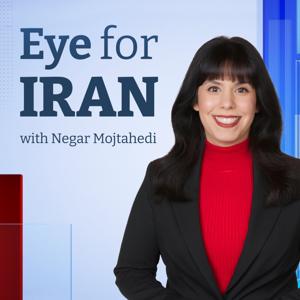
Eye For Iran

Eye For Iran

By Iran International EnglishNews
Download on the App Store

Eye For Iran episodes

  • Is Trump giving Iran's regime a lifeline? Eye for Iran 105
    Is a new US-Iran deal on the horizon—or is Tehran being thrown a lifeline at one of the most vulnerable moments in its history?

    As reports of renewed negotiations intensify, major questions remain. Is the Islamic Republic negotiating from a position of weakness or strength? Has Iran emerged damaged by war and economic pressure, or can its leadership still claim victory?

    Host Negar Mojtahedi is joined by former US Treasury official, FDD research fellow and former CENTCOM official Miad Maleki, alongside former Canadian government official, University of Ottawa professor and Chatham House associate fellow Thomas Juneau, to debate the state of the negotiations, Iran’s vulnerabilities, and what a deal could mean for the future of the Islamic Republic.

    Then, foreign policy commentator Mohamed Amersi joins Eye for Iran with a rare perspective from someone who regularly engages with Iranian officials, as well as Chinese, Russian, Arab and Western policymakers. He shares what he is hearing behind the scenes and why Tehran’s leadership may view the current moment very differently from many analysts in Washington.

    Finally, investigative reporter Jay Solomon of The Free Press and security expert Roger Macmillan examine allegations that Iran-linked proxy networks are expanding beyond the Middle East. From Europe to North America, they discuss growing security concerns, recruitment tactics, and what Western governments are doing to respond.

    In this episode:

    • Is a US-Iran deal getting closer?
    • Has the Islamic Republic been weakened by war and sanctions?
    • What is Tehran’s leadership really thinking behind closed doors?
    • Could a deal help the regime survive?
    • What role are China, Russia and Gulf states playing?
    • Are Iran-linked proxy networks expanding into Europe and North America?
    • What are the implications for Western security and Jewish communities?

    Chapters:

    00:02:04:18 - 00:40:31:14 Is Trump Giving Iran's Regime a Lifeline?

    00:40:34:14 - 01:17:46:17 Inside Tehran: What are Islamic Republic Really Thinking

    01:17:49:10 - 01:42:56:23 Iran's Proxy Network Goes Global

    #iran #trump #israel #irannucleardeal #middleeast #shorts #youtube #podcast #news
    Miyad Maleki and Thomas Juneau debate the potential US-Iran deal, whether Tehran is negotiating from weakness, and what any agreement could mean for the future of the Islamic Republic.
    1 hr 44 min
  • Will a US deal with Tehran save the regime? | Eye for Iran | EP 104 |
    Is Iran heading toward a nuclear deal — or another war?

    As negotiations intensify, Tehran is threatening to expand the conflict beyond the Middle East while Israel remains on high alert. But behind the headlines lies a much bigger story: Iran’s growing attempt to turn the Strait of Hormuz into a geopolitical toll booth.

    In this episode of Eye for Iran, Negar Mojtahedi is joined by former U.S. State Department Senior Advisor Hazem Alghabra, former U.S. Treasury sanctions official Max Meizlish, Middle East analyst Hayvi Bouzo and national security expert Shayan Samii to break down:

    • Is Trump bluffing — or preparing for more war with Iran?
    • Could a new nuclear deal actually help the Islamic Republic survive?
    • Is China enabling Iran’s sanctions evasion and regional influence?
    • Why Tehran’s “Hormuz toll booth” strategy could trigger a global economic confrontation
    • Reports alleging Mahmoud Ahmadinejad was once considered in a post-Khamenei scenario
    • Internal fractures inside the Iranian regime
    • Whether economic pressure — not military strikes — is now the real battlefield

    “The Iranian people do not need rockets, they do not need drones, the Iranian people need to live.”

    WATCH UNTIL THE END for the explosive discussion on Ahmadinejad, Mossad, the New York Times report and the growing debate over what comes after the Islamic Republic.

    00:00 Segment 1 — Deal or No Deal? War or No War?
    Guest: Hazem Alghabra

    00:00 Intro — Is Iran Heading Toward Diplomacy or More War?
    02:19 Trump, Tehran & Israel’s High Alert Status
    03:27 Iran’s Internal Power Struggle Explained
    07:20 Could Economic Pressure Bring Down the Regime?
    08:28 Trump’s Negotiation Strategy & Iran Fatigue
    09:02 Russia, China & Europe’s Role in the Crisis
    11:08 “The Iranian People Need to Live”
    13:25 Segment 2 — China, Hormuz & Iran’s Toll Booth Strategy
    Guest: Max Meizlish

    13:25 Iran’s New “Hormuz Toll Booth” Explained
    14:01 China’s Role in Iran’s Sanctions Evasion
    16:04 Can the U.S. Punish China for Supporting Tehran?
    19:35 Why Washington Isn’t Using Maximum Economic Pressure
    21:50 Could Economic Warfare Weaken Both Iran & China?
    25:06 Is Iran Formalizing Control Over the Strait of Hormuz?
    27:56 Why China Needs Hormuz Open
    29:28 China’s Quiet Negotiations With Tehran
    30:53 Iran’s Alleged $2 Million Transit Fees
    32:59 Segment 3 — Ahmadinejad, Mossad & The NYT Report
    Guests: Hayvi Bouzo & Shayan Samii

    33:08 The New York Times Report Explained
    34:08 Who Is Mahmoud Ahmadinejad?
    37:39 Ahmadinejad’s Record: Holocaust Denial & the Green Movement
    39:17 Was the NYT Report Deliberately Leaked?
    43:05 Is the Regime Turning on Ahmadinejad?
    45:15 Internal IRGC Infighting & Succession Chaos
    49:14 Could Ahmadinejad Ever Return?
    51:54 Was the Leak Meant to Distract Iran’s Leadership?
    53:20 Final Thoughts & Outro

    #iran #trump #israel #china #hormuz #iranwar #nucleardeal #middleeast #irgc #MahmoudAhmadinejad #geopolitics #EyeForIran
    54 min
  • Can Iran’s Economy Survive the Internet Blackout and Economic Fury? | Eye for Iran 103
    In episode 103 of Eye for Iran, Mohamad Machine-Chian is filling in for Negar Mojtahedi. 
    In this episode, Holly Dagres, senior fellow at Washington Institute discusses the continued internet blackout in Iran. 
    Operation Epic Fury may be over but Operation Economic Fury is just getting started. Siamak Javadi, from Texas University explains what's next for Iran’s  economy.#iraninternational #Iraninternational #ایران_اینترنشنال
    46 min
  • The price of oil and the future of Hormuz
    The Strait of Hormuz remains closed and the U.S. blockade of Iranian ports continues. Can Tehran weaponize Hormuz for years to come? Are Iranian oil fields nearing the point of no return? 

    In episode 102 of Eye for Iran, two energy experts assess the potential scenarios ahead.

    #Iraninternational #ایران_اینترنشنال
    55 min
  • Canada let Iran football chief linked to IRGC in — then got caught | Eye for Iran | EP 101|
    An Iran International exclusive has triggered a political firestorm in Ottawa — after Mehdi Taj, Iran’s football chief and a former Islamic Revolutionary Guard Corps (IRGC) intelligence commander, was granted entry into Canada despite being legally inadmissible under the country’s own terrorist designation.

    Taj was issued a Temporary Resident Permit (TRP) — a rare override used to bypass national security inadmissibility — allowing him to travel to Vancouver for a FIFA Congress. But after the story broke and public pressure mounted, he was stopped at the airport and sent back.

    Now, Prime Minister Mark Carney is facing mounting questions:
    Who approved the permit? Why was an IRGC-linked figure allowed in? And did the government only act after being exposed?

    Melissa Lantsman, Deputy Leader of Canada’s Conservative Party, joins Eye for Iran to demand accountability, warning that this case exposes deeper failures in Canada’s immigration system, national security screening and enforcement of its own IRGC terror listing.

    But this story doesn’t stop at Canada.

    At the same time, the UK is facing a surge in violent attacks targeting Jewish communities — including a stabbing in Golders Green, attempted synagogue firebombings and arson attacks on Jewish ambulances.

    British authorities are now investigating whether these attacks are linked to Iran and a shadow network known as HAYI (Harakat al-Shabab al-Yamin al-Islamiyah).

    Alex Winston of The Jerusalem Post explains why intelligence officials fear this reflects a broader Iranian strategy: proxy networks, online radicalization
    and sleeper cells recruited across Europe

    Len Khodorkovsky, former U.S. State Department official, breaks down the war of narratives, Trump’s warning to Iran and how the regime is using internet blackouts and information control to hide unrest and shape global perception.

    This episode connects the dots between immigration policy, terrorism and the Islamic Republic’s global reach — and asks critical questions.

    Guests: Melissa Lantsman, Len Khodorkovsky, Alex Winston
    Host: Negar Mojtahedi
    Program: Eye for Iran

    Eye for Iran is a podcast series brought you by Iran International that takes you beyond the headlines and brings you the Iran stories that matter most.

    Chapters:
    00:00 Opening Highlights | Taj turned away, Trump warning, UK Jewish attacks

    02:15 Melissa Lantsman | How did Mehdi Taj get a permit?
    03:25 Melissa Lantsman | “Somebody issued him a permit”
    05:16 Melissa Lantsman | IRGC concerns in Canada
    07:42 Melissa Lantsman | “They circumvented the rules”
    08:51 Melissa Lantsman | Who approved Taj’s entry?
    10:09 Melissa Lantsman | Canada’s privacy excuse
    11:27 Melissa Lantsman | Parliament demands answers
    12:09 Melissa Lantsman | Did Canada act only after being exposed?
    13:41 Melissa Lantsman | Canada’s wider IRGC problem
    15:44 Melissa Lantsman | Ottawa’s confusing response
    16:47 Melissa Lantsman | What happens next?

    18:47 Alex Winston | UK Jewish attacks and possible Iran links
    19:41 Alex Winston | Golders Green, synagogue firebombings and HAYI
    20:07 Alex Winston | Iran’s external operations playbook
    22:30 Alex Winston | Telegram, IRGC-linked media and proxy networks
    24:03 Alex Winston | Why proving Iran links is difficult
    26:39 Alex Winston | Was HAYI born out of the war?
    27:38 Alex Winston | How Iran takes the war to the West
    29:45 Alex Winston | Is the West waking up?
    30:51 Alex Winston | Is regime change the only solution?
    32:38 Alex Winston | Where the war could go next
    36:01 Alex Winston | Fears of more sleeper-cell attacks

    38:02 Len Khodorkovsky | Iran, messaging and information warfare
    38:27 Len Khodorkovsky | America’s message to Iran’s regime and people
    42:00 Len Khodorkovsky | Iran’s internet blackout and the battle for truth
    46:10 Len Khodorkovsky | Western media narratives and the Iran war
    52:06 Len Khodorkovsky | Trump’s warning and negotiation strategy
    56:00 Len Khodorkovsky | Iran’s people, blackout and Western silence
    59:42 Len Khodorkovsky | Prince Reza Pahlavi, the press and agenda-driven narratives
    01:01:51 Len Khodorkovsky | How journalism standards have changed
    01:05:15 Len Khodorkovsky | How audiences should consume news today

    01:08:05 Closing Remarks | Final thoughts and newsletter details


    #iran #irgc #fifa #iranwar #operationepicfury #canada #usa #trump #carney #immigration #uk #jewish #israel #youtube #shorts #podcast #news #middleeast

    1 hr 9 min
  • Tehran turns on itself as Iran’s regime fractures | Eye for Iran | EP 100 |
    Veteran journalist Eli Lake of The Free Press and host of the Breaking History podcast joins Eye for Iran to discuss real fractures inside Iran’s regime, why Tehran’s leadership may be turning on itself and how internal power struggles could eventually bring down the Islamic Republic from within.

    Lake says Iran’s rulers now need a deal more than Washington does, and argues any negotiations should begin with restoring internet access, freeing political prisoners and ending executions.

    Lake also offers hope for Iran’s future, saying the Iranian people remain the country’s greatest strength: “You cannot keep these people down.”

    Hudson Institute research fellow Zineb Riboua then breaks down China’s growing anxiety over the Strait of Hormuz, Beijing’s weakening leverage over Tehran, Iran-China ties and whether Operation Epic Fury is really about weakening China’s position in the Middle East.

    Finally, Iran International journalist Shervin Shahrestani reveals his major investigation into Iran’s expanding influence network in Kashmir and India, including ideological outreach, funding networks and why some call the region a “Mini Iran.”

    A special 100th episode covering Iran regime fractures, the Strait of Hormuz crisis, China, the IRGC and the fight for Iran’s future.

    Contents for this video:

    00:00 Intro: Tehran Turns on Itself? Fractures in Iran’s Regime
    02:16 Eli Lake Joins Eye for Iran
    02:38 What Is Really Happening Between US and Iran?
    05:25 Why Give Tehran More Time?
    06:03 Eli Lake: Put Iranian People First
    07:56 Any Deal Must Include Internet & Prisoners
    11:51 Xi Jinping Pressures Tehran Over Hormuz
    12:57 Are Iran’s Internal Fractures Real?
    17:35 Can the Islamic Republic Fall From Within?
    24:38 Why Even Ahmadinejad Is Criticizing the Regime
    27:56 How Change Could Happen Inside Iran
    32:54 Biggest Bet: Collapse From Within
    34:43 Are Negotiations Psychological Warfare?
    36:03 Iran’s Nuclear Program & What Comes Next
    40:25 Eli Lake: “You Cannot Keep These People Down”
    46:01 Eli Lake on His Iran Podcast Series
    52:31 Zineb Riboua Joins Eye for Iran
    52:32 Why China Suddenly Spoke on Strait of Hormuz
    56:30 Beijing’s Weakness Exposed?
    58:32 Is China Panicking?
    01:02:16 What China Stands to Lose
    01:05:28 Is Operation Epic Fury Really About Weakening China?
    01:07:45 Are US and Israel Fully Aligned?
    01:09:22 What to Watch Next: Gulf States & China
    01:12:27 Shervin Shahrestani Joins Eye for Iran
    01:13:00 Iran’s Influence Network in Kashmir
    01:15:02 Why Kashmir Is Called “Mini Iran”
    01:19:54 How Tehran Builds Influence in India
    01:22:30 Security Risks: Sleeper Cells & Lone Wolves?
    01:26:21 Why This Story Matters Now
    01:28:19 Is Iran More Dangerous After the War?
    01:30:16 Final Thoughts / Subscribe

    #iran #iranwar #israel #trump #nuclear #podcast #news #usa #youtube #shorts #middleeast
    1 hr 31 min
  • Iran war: ceasefire holds, Strait of Hormuz reopens — what now? | Eye for Iran | EP 99 |
    A fragile ceasefire may be holding between the United States and Iran — but is the war really over, or just paused?

    As the Strait of Strait of Hormuz reopens after weeks of disruption, new questions are emerging about the true impact of the conflict: who’s actually winning, how much pressure the Islamic Republic is under, and whether this moment leads to a deal — or another round of escalation.

    On this episode of Eye for Iran, Charlie Brown, Senior Advisor at United Against Nuclear Iran, and Dr. Iman Nasseri, Managing Director for the Middle East at FGE, break down the maritime and economic battlefield — from Iran’s shadow fleet and sanctions evasion networks to the real timeline for when a blockade actually hits Tehran’s economy.

    We also examine the nuclear file with Dr. David Albright, Founder of the Institute for Science and International Security, who warns that while Iran’s ability to build a bomb may have been set back, its incentive to pursue one could be growing.

    And in a stunning regional development, Lebanon and Israel hold direct talks for the first time in decades. Hussain Abdul-Hussain, Research Fellow at the Foundation for Defense of Democracies, explains what this could mean for Hezbollah, Lebanon’s sovereignty, and whether Iran’s grip on the region is beginning to weaken.

    Is this the beginning of the end — or just the calm before the next phase of conflict?

    Watch Eye for Iran.

    Recorded just before the Strait of Hormuz reopened, offering a real-time snapshot of a rapidly shifting situation.

    Chapters:

    00:00 Is the Iran war really over?
    00:39 Hormuz reopens: what it means now
    02:07 Conflicting narratives: is Iran winning or losing?
    03:22 Can Iran survive the blockade?
    05:15 How long until sanctions actually hit?
    07:54 What’s really happening at sea right now
    11:44 Will the next 10 days change everything?
    15:11 Is Iran still making money from oil?
    17:32 Shadow fleet & sanctions evasion explained
    19:01 Shadow banking crackdown: does it work?
    22:10 U.S. strategy: pressure or regime change?
    26:19 What’s the endgame here?

    Nuclear file segment

    32:16 Can Iran still build a nuclear weapon?
    36:54 Could Iran be hiding enriched uranium?
    43:23 Is Iran now a greater long-term threat?
    49:09 Where do global powers stand?
    53:52 Why regime change isn’t so simple
    57:59 What has this war actually achieved?
    01:03:32 Missiles, drones & future threats
    01:06:12 Are we heading toward another war?

    Lebanon / regional shift segment

    01:06:35 Historic Lebanon-Israel talks explained
    01:08:39 Is Lebanon breaking away from Iran?
    01:10:42 Does Hezbollah still have power?
    01:11:52 What do Lebanese people really think?
    01:15:26 How Lebanese view Iran’s role
    01:17:54 Iran’s internal divisions revealed
    01:19:02 Decoupling Lebanon from Iran
    01:23:32 Is Iran weakening across the region?
    01:27:02 Could Lebanon normalize with Israel?

    01:29:57 Final thoughts & what comes next

    #Iran #IranWar #MiddleEast #StraitOfHormuz #Hormuz #OilMarkets #Geopolitics #USIran #Israel #Lebanon #Hezbollah #NuclearDeal #EnergyCrisis #BreakingNews #EyeForIran
    1 hr 31 min
  • Iran-US ceasefire: pause before escalation or deal? | Eye for Iran | EP 98 |
    A fragile ceasefire appears to be in place between Iran and the United States, but is it really a ceasefire, or simply a brief pause before a new phase of conflict?

    In this episode of Eye for Iran, former CIA analyst and former National Security Council director Ken Pollack explains why he believes both sides may not have agreed to the same terms, and why the current moment could still lead to renewed escalation. He also warns that if this war ends with the regime intact, the Iranian people may once again be left to pay the price.

    Then, writer, activist, and Middle East expert Dalia Ziada breaks down the regional fallout. She explains why many Arab states, especially in the Gulf, feel sidelined despite being directly affected by the conflict, and why frustration is also growing over Pakistan’s role.

    Finally, investigative reporter Jay Solomon joins us to discuss his months-long investigation into Calla Walsh, the 21-year-old American activist who has become a prominent voice amplifying the Iranian regime’s narrative. How did her radicalization happen, and why does it matter?

    Watch the full episode of Eye for Iran, and subscribe for more in-depth interviews and analysis.

    Contents for this video:
    00:00 Fragile ceasefire or pause before escalation?
    01:42 Ken Pollack joins: what this “ceasefire” really means
    03:24 Why Washington and Tehran are talking past each other
    07:05 Will the Iranian people be abandoned again?
    13:27 What a new phase of war could look like
    17:24 Trump’s messaging to the people of Iran
    23:02 Is regime change still possible?
    30:51 Why Gulf states may move closer to Israel
    36:51 Dalia Ziada: regional fallout and Arab frustration
    39:11 Could this accelerate Arab-Israeli alignment?
    44:02 Pakistan’s role and Saudi disappointment
    47:08 Lebanon, Hezbollah, and Iran’s regional reach
    49:37 Qatar rethinking ties to Tehran?
    52:10 Jay Solomon: who is Calla Walsh?
    54:29 Cuba, radicalization, and Tehran’s influence
    01:00:36 How Walsh became part of Iran’s narrative machine
    01:05:14 Why Gen Z radicalization should worry the West
    01:07:37 Is this Iran exporting its revolution?
    01:09:46 Subscribe for more Eye for Iran

    #iran #usa #israel #war #ceasefire #pakistan #youtube #shorts #youtubeshorts #news #podcast #middleeast
    1 hr 11 min
  • UAE hits Iran’s economic lifeline | Decoding Trump’s speech | Special report| Eye for Iran | EP 97 |
    The UAE’s arrest of dozens linked to the IRGC’s sanctions-evasion network could mark one of the biggest blows yet to Tehran’s economic lifeline.

    Former U.S. Treasury sanctions strategist Miad Maleki, United Against Nuclear Iran (UANI) Research Director Daniel Roth, and Iran International senior economic journalist Mohammad Machine-chian break down what this could cost the regime — and whether it could cripple Tehran’s ability to fund repression, proxies and sanctions evasion.

    Then Republican strategist, former Bal Harbour, Florida Mayor and Standpoint podcast host Gabe Groisman unpacks what President Trump’s Iran speech really signaled, who the message was intended for and whether “strategic ambiguity” is part of the plan.

    Plus, Iran International journalist Azadeh Akbari reveals new findings from a special report showing the regime moved weapons and personnel into at least 70 civilian sites, including schools.

    You can watch this week's episode of Eye for Iran or listen on any podcast platform.

    Chapters:

    00:00 Trump’s Iran Speech and What It Really Means
    00:35 UAE Arrests IRGC-Linked Money Changers
    01:31 Special Report: Regime Used 70 Civilian Sites
    02:06 How Important Is Dubai to Tehran’s Survival?
    05:35 Why the UAE Is Cracking Down Now
    07:26 How Much Money Is the Regime Set to Lose?
    12:56 Can This Disrupt Iran’s Global Money Laundering?
    17:48 Iran’s Other Financial Lifelines: Turkey, Erbil, Herat
    19:34 Impact on Proxies, Repression, and the Rial
    22:02 Political Fallout for Iran-UAE Relations
    24:11 Tehran’s Strategic Miscalculation
    28:57 Gabe Groisman on Trump’s Iran Speech
    32:10 Trump’s Tone: Planned, Measured, Strategic
    34:11 Is Trump Using Strategic Ambiguity?
    37:52 Was Trump Also Sending a Message to Tehran?
    39:08 Regime Change: Goal or Byproduct?
    42:26 Strait of Hormuz and Regional Allies
    46:30 October 7 and Iran’s Biggest Miscalculation
    49:13 Why Trump Didn’t Mention Oman
    50:24 Was Trump’s Speech Escalatory?
    52:59 Could Ground Troops Still Be on the Table?
    55:05 Trump vs Netanyahu on Messaging
    58:55 Special Report: Weapons Moved Into Schools and Civilian Sites
    59:13 How Iran International Verified the Investigation
    01:03:46 Are Civilians Being Used as Human Shields?
    01:07:05 Children Put in Harm’s Way
    01:08:15 What This Says About the Regime’s Wartime Doctrine

    #iran #uae #money #sanctions #trump #usa #iranian #HumanShields #israel #war #iranwar #news #podcast #shorts #youtube
    1 hr 10 min
  • Iran just proved its reach — how much further will this war go? | Eye for Iran | EP 96 |
    A war already underway — now entering a more dangerous phase.

    We begin with Iran’s reported strike toward Diego Garcia — a moment that signals something critical: this threat is no longer abstract. It is real.

    Defense experts Farzin Nadimi of The Washington Institute and Janatan Sayeh of the Foundation for Defense of Democracies (FDD) break down what this reveals about Iran’s capabilities — from vast underground missile networks, some “the size of small cities,” to a growing global threat. As Sayeh warns, “Iranian missiles and drones were already being used on European soil through Russia — now the regime itself can launch them directly from Iranian territory.”

    Then — what comes next.

    Former US State Department official Joel Rubin and foreign policy expert Dr. Walid Phares analyze the global response and the role of diplomacy as well as signs the conflict may be moving toward a broader escalation.

    Reacting to a striking op-ed by the UAE ambassador to Washington calling for a “conclusive outcome,” Rubin underscores the stakes, saying “this is how Iran behaves — willing to disrupt the global economy to protect itself.”

    Phares, meanwhile, argues current talks are part of a strategic calculation — “less about peace and more about buying time” — as momentum builds toward a more decisive phase that could include limited ground operations.

    They also point to developments in Lebanon — long seen as firmly within Iran’s sphere of influence — as evidence that Tehran’s regional grip may be weakening in real time.

    And finally — the human reality behind it all.

    Ali Rezaei Majd, the Iranian protester whose video from inside Iran was seen by millions, speaks out after escaping the country:
    “We cannot make a deal with them. Dealing with them means letting this cancer continue.” Watch this week's episode of Eye for Iran or listen on any podcast platform of your choosing.

    YouTube Chapters

    00:00 Opening: “They were shooting people like a video game”
    00:06 The viral witness: Ali Rezaei Majd
    00:43 Iran fires toward Diego Garcia
    01:20 UAE warns ceasefire is not enough
    01:58 Iran’s missile capabilities and what comes next
    02:42 Farzin Nadimi on Iran’s true missile range
    04:55 Could Iran’s missiles reach the UK?
    06:16 Why this is a global wake-up call
    07:30 How much of Iran’s missile arsenal remains?
    11:08 Inside Iran’s underground missile cities
    12:44 Missile sites hidden near civilians
    15:04 Factories, launchers, and urban danger zones
    17:32 Kharg Island and the regime’s economic lifeline
    20:27 What Iran is still capable of militarily
    24:01 Threats to the US homeland?
    25:17 UAE sounds alarm on Iran as a global threat
    27:52 Is the region shifting against Tehran?
    30:35 Are talks stalling?
    33:27 Could boots on the ground be next?
    37:21 Lebanon and Iran’s loosening grip
    42:33 Ali Rezaei Majd on the January massacre
    43:12 The viral video from inside Iran
    45:16 Why he recorded it
    46:43 What he witnessed on the streets
    50:55 How he escaped Iran
    54:33 His message to the world: no negotiations
    58:14 First Nowruz after the massacre
    01:02:04 “It was like a video game”
    01:03:03 Final message from Ali Rezaei Majd

    #iran #diegogarcia #trump #ballisticmissiles #irgc #iranmissiles #uae #lebanon #hezbollah #israel #usa #middleeast #podcast #news #youtube #shorts
    1 hr 6 min

About Eye For Iran

From the publisher's feed

From Iran International comes the 'Eye for Iran' podcast, a weekly show that will take listeners beyond the headlines, deep into the Iran stories that matter most. With compelling interviews, expert…

More shows like Eye For Iran

War on the Rocks by Ryan Evans

War on the Rocks

1,068 Listeners

A Mandatory Listen by The Times of Israel

A Mandatory Listen

36 Listeners

Israel Policy Pod by Israel Policy Forum

Israel Policy Pod

175 Listeners

Haaretz Podcast by Haaretz

Haaretz Podcast

295 Listeners

Quillette Podcast by Quillette

Quillette Podcast

795 Listeners

GoodFellows: Conversations on Economics, History & Geopolitics by Hoover Institution

GoodFellows: Conversations on Economics, History & Geopolitics

696 Listeners

Hold Your Fire! by International Crisis Group

Hold Your Fire!

68 Listeners

Call Me Back - with Dan Senor by Ark Media

Call Me Back - with Dan Senor

3,181 Listeners

The Times of Israel Daily Briefing by The Times of Israel

The Times of Israel Daily Briefing

1,062 Listeners

Global Security Briefing by The Royal United Services Institute

Global Security Briefing

22 Listeners

School of War by The Free Press

School of War

495 Listeners

The Foreign Affairs Interview by Foreign Affairs Magazine

The Foreign Affairs Interview

468 Listeners

Yasmine Mohammed Podcast by Yasmine Mohammed

Yasmine Mohammed Podcast

132 Listeners

FDD Morning Brief by FDD

FDD Morning Brief

87 Listeners

Ask Haviv Anything by Haviv Rettig Gur

Ask Haviv Anything

910 Listeners