
Sign up to save your podcasts
Or



This passage argues that the United States does not have a permanent dynasty of wealth. While some inherited fortunes exist, the majority of the richest Americans earned their wealth independently, and new industries such as microelectronics and emerging energy technologies continuously create fresh fortunes. Economic change ensures that wealth shifts over time, discouraging stagnation. Historically, few families have maintained great wealth across generations, and the most successful societies remain those where opportunity allows individuals to rise regardless of their birth. Overall, the passage emphasizes that America’s economic mobility fosters prosperity, innovation, and a continually improving standard of living.
#EconomicMobility #WealthCreation #AmericanOpportunity #InnovationAndProsperity
In “Moral Paralysis,” Rushdoony argues that modern society is increasingly incapable of decisive moral action because it has abandoned belief in absolute truth and God’s sovereign law, replacing it with relativism and pragmatism. This results in people who may recognize evil but lack the authority, confidence, or will to oppose it, mistaking moral insight for moral strength and denunciation for righteousness. Without an objective foundation, principles become personal preferences that cannot bind anyone else, producing inaction, cynicism, and drift in both liberal and conservative camps alike. Rushdoony contends that moral vitality comes only from acknowledging a transcendent moral order grounded in God, not from human opinion or state decree. Where relativism reigns, society collapses into either anarchy or statism, both expressions of moral paralysis. True moral action, he concludes, requires faith in God’s absolute law, which alone provides a solid foundation for dominion, reconstruction, and a future worth commanding.
This passage emphasizes that the primary caregivers for the poor in the U.S. are not government agencies, but private and voluntary institutions. The family remains the most effective welfare system, providing for sick members, elderly parents, and children’s education from kindergarten through college. Churches, both Protestant and Catholic, supplement this care by aiding the homeless and transient populations, often with limited resources and in spite of bureaucratic resistance. Additionally, private organizations like Strategies to Eliminate Poverty (STEP), led by wealthy evangelical businessmen, actively work to alleviate poverty and empower individuals to succeed. The author underscores that understanding and supporting these “free sector” efforts is crucial for maintaining freedom and effective social care.
#PovertyAlleviation #FamilyCare #ChurchAid #PrivateInitiatives #FreeSectorImpact
In “Moral Disarmament,” Rushdoony argues that before societies are conquered politically or militarily, they are first defeated morally, as distinctions between good and evil, truth and error, Christ and Antichrist are deliberately blurred. Through literature, theology, education, and popular culture, sympathy is shifted from righteousness to rebellion, from law to lawlessness, until betrayal, criminality, and perversion are reinterpreted as tragic or noble while moral discipline and principle are condemned as Pharisaical evil. This process disarms the conscience, teaching coexistence with sin and even reconciliation with Satan, thereby denying the Biblical realities of judgment, hell, and moral separation. Rushdoony insists that such moral confusion inevitably leads to political surrender, tyranny, and social collapse, as seen in the French Revolution and modern totalitarian movements. The antidote is not sentimental pietism but Christian maturity: sound doctrine, Biblical law, and comprehensive Christian thinking applied to every sphere of life, so that believers may stand fully armed in God’s truth rather than defenseless before the advance of evil.
In “Epistemological Self-Consciousness,” Rushdoony argues that every worldview must eventually face the implications of its own foundations, and that atheism, when consistently applied, leads to meaninglessness, lawlessness, and the collapse of authority. He contrasts figures like modern artists and scientists who deny God yet still borrow God’s order in practice, showing that unbelief cannot live consistently without smuggling in divine presuppositions. As history advances, God forces cultures toward greater self-awareness, exposing the impossibility of maintaining order, morality, or meaning apart from Him. The result is rebellion against all authority—family, church, state, and law—and the rise of chaos and mob mentality. Rushdoony insists that Christians must develop Christian epistemological self-consciousness through comprehensive Christian education and systematic obedience to God’s law, rather than fighting humanism on humanistic grounds. Only a coherent, God-centered worldview can rebuild what unbelief can only destroy, and victory belongs not to lawless systems of negation but to faithful submission to the triune God who alone gives knowledge, order, and meaning.
In “Kwan-Yin Versus Christ,” Rushdoony contrasts Biblical Christianity with the relativistic, equalitarian impulse he traces to Eastern religions, arguing that modern socialism and progressive lawlessness flow from a worldview that denies absolute distinctions between good and evil. He presents Kwan-yin’s refusal to enter paradise until all are included as the logical symbol of total inclusivism, a mercy that ultimately abolishes justice by treating righteousness and criminality as morally equivalent. This mindset, he contends, has deeply shaped Western liberalism, weakening Biblical law, elevating the rights of criminals over the protection of the innocent, and producing social breakdown rather than compassion. The issue, therefore, is not political technique or voting strategy but a religious choice between relativism and Biblical absolutes: either Christ, with His unchanging law and real justice, or Kwan-yin’s sentimental democracy of good and evil, which promises heaven but delivers hell.
This passage argues that fears of overpopulation and overpollution are largely myths. Citing Dr. Julian L. Simon’s The Ultimate Resource, it emphasizes that food production, farmland availability, and natural resources are increasing, not diminishing. Pollution has been declining, population density does not inherently create social or biological problems, and immigration contributes positively to society. The author highlights that claims of resource scarcity often serve as a pretext for statist controls and planning, which can threaten individual freedom. Rather than limiting growth, evidence suggests human ingenuity continues to expand resources and improve living standards.
#OverpopulationMyth #ResourceAbundance #Freedom #PopulationGrowth #EnvironmentalRealities
In “Moral Force,” Rushdoony argues that all lasting authority rests not on brute power but on moral force rooted in faith, and that when societies abandon moral absolutes they inevitably replace persuasion, law, and justice with coercion, bribery, violence, and aestheticized destruction. He traces how relativism leads first to cynicism, then to the worship of power—whether through revolutionary violence, statist control, or an aesthetics that glorifies shock, perversity, and negation—until man becomes enslaved to the very state he trusted to save him. Political salvation, artistic rebellion, and force-based ideologies all fail because they cannot give meaning, character, or hope; they only accelerate moral collapse. Against this, Rushdoony insists that only faith in the sovereign God provides true moral force, purpose, and dominion, enabling men to fight evil without despair and to reconstruct society under God’s law, confident that while duties are ours, the ultimate victory belongs to the Lord.
In “The Smiling Face of Evil,” Rushdoony warns that evil rarely appears brutal or grotesque but commonly presents itself as kind, helpful, idealistic, and morally concerned, masking its true nature behind pleasant words, good intentions, and public-relations charm. Drawing on personal anecdotes and biblical examples, he argues that Satan’s most effective strategy is not open hostility but deception—using humanitarian language, visions of peace, and promises of progress to replace God’s law with man-centered hopes, as seen in movements that borrow Christian language while opposing Christian truth. Because people prefer comfort to truth, the smiling face of evil is often embraced while prophetic honesty, like Paul’s, is rejected as harsh or unloving. Rushdoony concludes that when churches and societies prize affirmation over truth, they become complicit in deception, forgetting that sin earns death and that genuine love is found not in smooth words but in faithful obedience to Christ and His law-word.
In “Abominations”, Rushdoony explains that Scripture’s strong language about sin reflects God’s holiness and justice, not vulgarity or excess, and that the biblical term abomination consistently denotes what God finds utterly abhorrent because it is idolatrous, lawless, and spiritually corrupt. Drawing on Hebrew and Greek usage, he shows that abominations are actions and attitudes that despise God’s law while often masquerading as faith—ranging from sexual immorality and idolatry to dishonest worship, lying, and false weights—revealing the unity of moral, spiritual, and physical corruption. What God calls an abomination is not culturally relative or emotionally offensive but objectively repulsive to Him, marked by filth, stench, and rebellion, and barred from His kingdom. Because God does not change, what He abhors must also be abhorrent to His people; therefore, encountering this word in Scripture is a warning that demands clear obedience, moral clarity, and submission to God’s law rather than accommodation to cultural standards.
From the publisher's feed
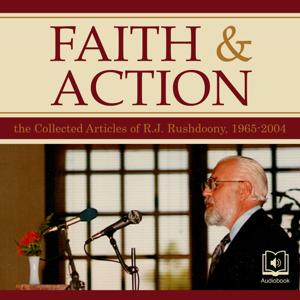
Faith and Action is the complete collection of the essays of R. J. Rushdoony written for the Chalcedon Report between 1965 and 2001 along with several transcripts of his recorded talks. The large…