
Sign up to save your podcasts
Or



History is made by people, not abstract “social forces”; men and women of faith and action shape events, drive progress, and give purpose to civilizations, while the modern notion that vague forces dictate outcomes undermines human responsibility, freedom, and the Biblical understanding of man as God’s active creation. #HistoryMakers #FaithAndAction #HumanResponsibility #BiblicalWorldview #FreedomOfAction
In “Humanism and Christ’s Kingdom,” Rushdoony argues that modern humanistic statism is waging a covert but aggressive war against Christ’s Kingdom by redefining freedom as state permission and justice as mere legality, using regulation, licensure, taxation, and “public policy” to control churches, Christian schools, families, and even parental instruction. Under the guise of civil rights and humanitarian concern, the state asserts sovereignty over education, faith, and morality—claims Rushdoony identifies as a revival of ancient Baalism and modern fascism, where the state becomes god walking on earth. This assault is intensified not only by statist elites but also by cowardly churchmen who justify surrender and reject the Biblical mandate to obey God rather than men. The conflict is irreducibly religious and total: Christ or Caesar, theonomy or autonomy. Neutrality is impossible, retreat is apostasy, and surrender forfeits the crown rights of King Jesus, whose lordship alone defines true liberty, justice, and life.
#ChristTheKing #CrownRightsOfJesus #HumanismVsChristianity #NoNeutrality #StatismExposed #ReligiousLiberty #Theonomy #ChristianResistance #KingdomOfGod #ObeyGodNotMen
Concerns about “book banning” in U.S. schools are often misrepresented; parents may object to certain books for moral or educational reasons, while libraries promote works aligned with humanistic perspectives, but true censorship prohibiting publication altogether does not exist here; freedom means the right to choose, and defending that choice requires respecting others’ freedom to make their own selections. #FreedomOfChoice #Education #ParentalRights #IntellectualFreedom #BookSelection
In “The Cultural War,” Rushdoony argues that history is defined by an irreconcilable conflict between the Kingdom of God and the kingdom of man, a conflict intensified when churches compromise biblical truth in an effort to merge faith with fallen culture. He warns that unbelief increasingly empties the church of its covenantal identity as orthodox doctrines—such as infallibility, creation, and atonement—are diluted or treated as negotiable, often with greater hostility toward orthodoxy than toward outright modernism. Because God is unchanging and His Word is not subject to human revision, attempts to adapt divine law to contemporary tastes only deepen division rather than heal it. The cultural war ultimately turns on anthropology: Scripture affirms man’s depravity and need for redemption, while humanistic culture insists on man’s natural goodness. These opposing premises cannot be reconciled, and any effort to do so results not in unity, but in a more radical cultural fracture.
#CulturalWar #KingdomOfGod #KingdomOfMan #BiblicalOrthodoxy #AgainstModernism #AuthorityOfScripture #NoCompromise #ChristianReconstruction #TruthVsCulture
Those in positions of responsibility deserve fair compensation, but when civil officials use taxpayer money for extravagant personal benefits like $85,000 office remodels they cross from just reward into exploitation, creating a growing gap between leaders and citizens, eroding trust, and undermining freedom; life should be better at the top only in proportion to responsibility and service, not luxury. #PublicService #EthicalLeadership #TaxpayerResponsibility #GoodGovernance #Accountability
In “The Necessary Future,” Rushdoony argues that history is moving inexorably toward the collapse of statism, a faith that has repeatedly sought to replace God with the state as man’s savior—from pagan Rome to Enlightenment humanism and modern politics. Christianity, he insists, is not a reform of statism but its negation: a Kingdom under Christ, governed by Biblical law, where neither church nor state saves man but both serve under God’s authority. Attempts to baptize political parties or statist systems as “Christian” are therefore false and destructive, rooted in a minimal faith that seeks heaven without obedience. As the statist order unravels in the twenty-first century, Rushdoony warns that Christians who tie their hope to non-Christian politics will collapse with it, while the only enduring future lies in placing all of life and society under the lordship of Jesus Christ.
#TheNecessaryFuture #KingdomOfGod #ChristTheKing #BiblicalLaw #AntiStatism #ChristianReconstruction #Lordship #FaithAndCulture #Chalcedon #NoPoliticalSaviors
The passage argues that trade controls and protectionism ultimately harm consumers more than they help producers. While some domestic industries may complain about cheap foreign imports whether Japanese or American the real effect of tariffs and trade restrictions is to raise prices for the majority of consumers, who are paying more for goods that could otherwise be purchased more cheaply.
Free trade, on the other hand, benefits the broader public by providing access to lower-cost products and freeing resources for new and more innovative industries. Attempts to shield specific industries delay necessary adaptation, reduce economic efficiency, and slow technological progress. The passage highlights that America’s long-term advantage comes from innovation, and free trade allows the economy to shift toward emerging industries like those in Silicon Valley, which drive growth and improve living standards.
#TradePolicy #EconomicFreedom #ConsumerBenefits #Innovation #Protectionism
In “Van Til’s Christian Theistic Ethics,” Rushdoony argues that Cornelius Van Til’s 1947 work provides a powerful theological foundation for an eschatology of victory grounded in the absolute antithesis between theonomy and autonomy, insisting that Christian ethics must begin not with abstract moral teachings but with creation, the Fall, and the atoning work of Christ at Calvary. Van Til presents Christ as Creator-Redeemer, places God—not man—at the center of all reality, and defines man’s highest good as the Kingdom of God, realized as believers live out their calling as God’s vicegerents in history. Rejecting humanistic utopianism, environmental determinism, and antinomianism, Van Til teaches that evil must be destroyed, righteousness upheld, and God’s law obeyed in every sphere of life, beginning with the regeneration of the individual and extending to all nations. Rushdoony concludes that this theonomic, kingdom-oriented vision made Van Til objectionable to modern Christianity but foundational to Christian Reconstruction, and he calls for the republication of Van Til’s works to equip future generations.
#VanTil #ChristianTheisticEthics #Theonomy #ChristianReconstruction #KingdomOfGod #BiblicalEthics #Presuppositionalism #PostmillennialHope #Chalcedon
The passage argues that deficit spending is both economically and morally harmful. Economically, running annual deficits accumulates national debt, threatens programs like Social Security, and risks eventual bankruptcy. Deficit spending fuels inflation, which undermines the purchasing power of citizens and destabilizes the economy. Morally, debt living is seen as a symptom of poor discipline and prudence, lowering societal standards, encouraging vice, and weakening family and community cohesion. Politically, deficits erode trust in government, increase social unrest, and historically have preceded major societal collapses or revolutions.
The proposed constitutional amendment would require federal spending to match revenues and prevent expenditures from growing faster than the national economy, protecting citizens from confiscatory taxes and preserving economic stability. It is presented not only as a fiscal necessity but also as a moral and political safeguard.
#DeficitSpending #FiscalResponsibility #EconomicStability #MoralEconomics #GovernmentAccountability
Cornelius Van Til is presented as a watershed figure whose thought confronts every thinker with an unavoidable ultimatum: begin and end with the triune God of Scripture, or inevitably with man, reason, or some created substitute; this clarity—echoing Joshua’s call to choose whom we will serve—made him deeply offensive to those seeking theological or philosophical respectability, yet profoundly liberating to those who grasped its implications. Rushdoony emphasizes that Van Til was not merely a difficult philosopher but a powerful, lucid preacher, whose exposition of 1 Corinthians 1 revealed the gospel as God’s wisdom against human pride. Despite neglect by institutions and hostility from church leaders, Van Til’s influence continued to spread through seminal works like The Defense of the Faith and Christian Theistic Ethics, laying foundations for Christian Reconstruction. His refusal to profit from his books underscored his humility, while the continued demand for his writings—even in photocopied form—testified to their enduring power. The unresolved question remains whether the church will be judged for neglecting Van Til or renewed by finally embracing his God-centered vision.
#CorneliusVanTil #ChristianReconstruction #PresuppositionalApologetics #GodCenteredThinking #Theonomy #FaithAndReason #BiblicalWorldview #Chalcedon #Rushdoony
From the publisher's feed
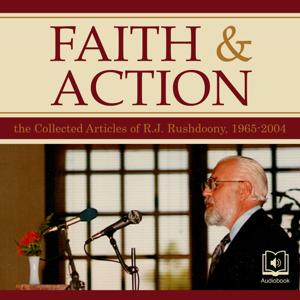
Faith and Action is the complete collection of the essays of R. J. Rushdoony written for the Chalcedon Report between 1965 and 2001 along with several transcripts of his recorded talks. The large…