
Sign up to save your podcasts
Or



In “The Fifth Amendment,” Rushdoony argues that the constitutional protection against self-incrimination is not a loophole or technicality but a deeply Biblical safeguard against tyranny, torture, and terror, rooted in God’s law requiring voluntary confession and conviction by credible witnesses rather than forced testimony. He warns that when Americans are manipulated into resenting or weakening the Fifth Amendment often through its cynical exploitation by Communists or criminals they are being led to dismantle their own defenses and “dig their own graves.” The real danger, he insists, is not the abuse of the amendment but the abandonment of Biblical justice itself, as courts politicize law, tax agencies compel self-incrimination, and immunity bargains erode due process. When law ceases to rest on God’s standards of justice and testimony, the door opens to coercion, terror, and totalitarian control masquerading as order. Rushdoony concludes that only a return to God-centered law not humanistic pragmatism can preserve liberty, justice, and true due process.
#FifthAmendment #BiblicalLaw #DueProcess #AgainstTyranny #ChristianJustice #RuleOfLaw #Rushdoony #LibertyUnderLaw #GodsLaw
In “Two-Cow, No-Cow Justice,” Rushdoony exposes a false concept of justice rooted in envy rather than God’s law, illustrated by a missionary account from China where judgment was rendered not by guilt or restitution but by comparing who had more and who had less. The missionary was forced to surrender a cow simply because he had two and the offended farmer had none, revealing a system where inequality itself was treated as injustice. Rushdoony argues this envy-based logic paved the way for Maoist socialism, where resentment was weaponized to destroy productive people and communities, and he warns that the same mentality now dominates Western courts, media, and even churches. When justice is severed from Biblical law and restitution, it becomes a tool of redistribution, favoritism, and social engineering, rewarding grievance rather than righteousness. Rushdoony concludes that only a return to God’s law-word rather than sentimentalism, relativism, or identity-based judgment can halt societal decay, and that judgment rightly begins with a church that has abandoned true justice for compassion without law.
#TwoCowNoCowJustice #BiblicalJustice #AgainstEnvy #GodsLaw #Restitution #SocialJusticeCritique #Rushdoony #LawAndRighteousness #JudgmentBeginsAtTheHouseOfGod
In “Restitution,” Rushdoony argues that restitution stands at the very heart of Biblical justice, grounding both God’s law and Christ’s atoning work in the principle that wrongs must be made right. Scripture consistently requires offenders to restore what was taken often multiple times over so that crime does not pay, a standard fulfilled perfectly in Christ’s obedience and sacrificial death as restitution before God for His people. Where restitution governs, justice is stable and meaningful; where it is abandoned in favor of sentimental “love,” probation, or imprisonment, crime becomes profitable and law decays into inequality, coercion, and pressure politics. Rushdoony warns that rejecting restitution in civil law inevitably follows the erosion of its theological foundation the denial of Christ’s satisfaction for sin because the cross itself declares restitution to be the essence of righteousness. Men may evade human courts, but God will always exact restitution, for it is inseparable from His law, His justice, and His final judgment.
#Restitution #BiblicalJustice #GodsLaw #Atonement #JusticeAndRighteousness #AgainstCrimePays #ChristOurSatisfaction #LawAndGrace #Rushdoony
In “Injustice in the Name of Justice,” Rushdoony contends that modern society loudly proclaims justice while systematically denying its very foundation by rejecting God as Lawgiver, leaving justice as a hollow façade for humanistic power. When the state identifies its own will with justice, legality replaces morality, and coercion forced abortions, suppression of religious speech, and state control of the church is justified as righteousness. Rushdoony warns that many churches aid this injustice by embracing antinomianism, confining Christ’s lordship to private faith while granting the state sovereign authority over law and public life. Scripture, however, teaches that justice and righteousness are inseparable from God’s law, fulfilled not abolished by Christ, who reigns as King over all things. When men deny God’s law, they enthrone the state, legitimize oppression, and produce misery by law itself; only the recognition of Christ’s total sovereignty restores true justice.
#Injustice #JusticeAndLaw #GodsLaw #ChristTheKing #AgainstStatism #BiblicalJustice #Antinomianism #CivilReligion #Rushdoony
In “Social Justice,” Rushdoony argues that modern social justice is not a Biblical concern but a humanistic doctrine rooted in the self-deification of intellectual elites who replace God’s law with their own autonomous reason, making justice whatever they declare it to be. Whereas Biblical law flows from the nature and authority of the sovereign God repeatedly grounded in the declaration “I am the Lord” social justice arises from man as the ultimate judge, turning law into a weapon of moral absolutism wielded by those who see themselves as virtue incarnate and their opponents as evil or subhuman. Historically embodied in revolutionary movements from Robespierre to Marx, social justice justifies unlimited coercion, purges, and the destruction of church, family, and economic freedom in the name of moral progress. Rushdoony contends that churches have been especially compromised, eagerly baptizing social justice because they too have shifted from God-centered justice to man-centered compassion. The result is not greater humanity but deeper division, dehumanization, and tyranny, for when justice is severed from God’s law, it becomes an instrument of injustice, reducing entire classes of people to expendable enemies rather than sinners in need of regeneration.
#SocialJustice #GodsLaw #BiblicalJustice #AgainstHumanism #Statism #ChristianWorldview #LawAndJustice #IdolatryOfMan #Rushdoony
In “The Modern State, an Ancient Regime,” Rushdoony argues that the modern humanistic state is not a new creation but a revival of ancient pagan sovereignty, claiming to be both the incarnation of man and the ultimate source of law and morality, thereby usurping the role of God and mirroring—by inversion—the Biblical doctrine of Christ as the true Adam and federal head of redeemed humanity. By making itself the lawgiver, the state becomes the arbiter of good and evil, demanding religious allegiance and imposing moral reform through bureaucratic agencies rather than divine law, while steadily encroaching on family, church, education, and vocation. Although once trusted as a substitute for the church and a guarantor of freedom and security, the modern state has become increasingly oppressive, ineffective, and self-serving, an obsolete ancien régime whose power grows even as its usefulness declines. Like pre-revolutionary France, it survives largely by inertia and coercion, not by service. Rushdoony insists that its collapse is inevitable; the real question is whether Christians will be prepared to replace it—not with another statist order, but with a godly reconstruction grounded in Christ’s lordship, Biblical law, Christian education, and renewed scholarship.
#ModernState #AncientRegime #Statism #Sovereignty #ChristTheKing #GodsLaw #ChristianReconstruction #KingdomOfGod #BiblicalWorldview
Our prisons have become breeding grounds for violence and extortion, as illustrated by a young man murdered for refusing to pay $5 a week to a gang in Los Angeles Men’s Central Jail, highlighting that the humanistic assumption that prisoners are “good at heart” blinds us to their evil nature; misjudging criminals as unfortunate or reformable only endangers society, and true safety requires recognizing sinfulness and holding offenders accountable. #PrisonCrisis #CriminalJustice #HumanNature #PrisonViolence #Accountability
In “Necessity Versus Law,” Rushdoony exposes how the ancient pagan maxim “necessity knows no law” steadily replaced God’s law as the governing principle of Western society, allowing rulers, states, and eventually individuals to justify any action—however immoral—by appeals to emergency, public welfare, or reason of state. Once necessity became the “higher law,” God’s law was reduced to a private concern, morality collapsed, and both personal conduct and civil authority were freed from accountability. The state emerged as the chief beneficiary, defining itself as the realm of necessity and therefore beyond law, claiming jurisdiction over every sphere of life while acknowledging no authority above itself. Rushdoony argues that totalitarianism cannot be defeated by fear or resistance alone but only by rejecting its foundational premise and restoring the absolute sovereignty of God and His law. True freedom comes not by bowing to the supposed necessities of the state but by confessing that the only real necessity is obedience to God, whose law alone restrains tyranny and gives life.
#NecessityVersusLaw #GodsLaw #AgainstStatism #BiblicalAuthority #ChristianCulture #LawAndLiberty #SovereigntyOfGod #Theonomy #KingdomOfGod
The world is facing a banking crisis fueled by massive international debt, with trillions owed by “Third World” and communist states, threatening global economies and taxpayers alike; long-term inflation, currency depreciation, and the potential loss of personal savings underscore that debt is a form of slavery, and true economic freedom requires sound banking practices and a return to fiscal responsibility. #BankingCrisis #GlobalDebt #InflationRisk #DebtSlavery #FinancialFreedom
In “The Power of Heresy,” Rushdoony warns that false belief often proves more influential than faithful theology, using Marcion as a historic example of how heresy undermines the unity of Scripture, separating law from grace, creation from redemption, and the Old Testament from the New. Marcion’s rejection of God’s law, his reduction of God to love alone, and his implicit dualism paved the way for antinomianism, dispensationalism, and moral confusion—errors Rushdoony sees echoed in much of modern evangelicalism. When law is treated as evil or irrelevant, grace becomes sentimentalism, justice is denied, and atonement itself is emptied of meaning, leaving no coherent reason for holiness or obedience. Orthodoxy, by contrast, affirms one sovereign God, one unified Bible, and one redemptive purpose in which law and gospel, justice and love, creation and salvation are inseparable. The real question Rushdoony presses is stark and unavoidable: are today’s churches shaped by historic Christianity—or by a baptized form of Marcionism?
#PowerOfHeresy #Marcionism #LawAndGospel #BiblicalUnity #AgainstAntinomianism #ChristianOrthodoxy #GodsLaw #Atonement #CreationalFaith
From the publisher's feed
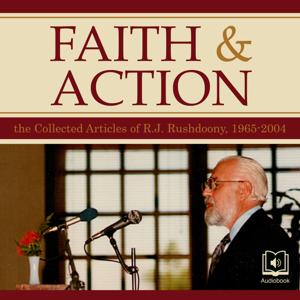
Faith and Action is the complete collection of the essays of R. J. Rushdoony written for the Chalcedon Report between 1965 and 2001 along with several transcripts of his recorded talks. The large…