
Sign up to save your podcasts
Or



In “Blind Faith” (Chalcedon Report No. 419), Rushdoony argues that Darwinism functions not as proven science but as a massive act of blind faith, embraced because it promises liberation from the God of Christianity rather than truth. From its rapid acceptance in 1859 to its dominance in modern education, culture, and even churches, this faith in humanistic evolution has shaped a civilization that rejects Christ’s authority and substitutes man-centered autonomy for God’s order. Rushdoony warns that such civilizations have always ended in death, noting that the twentieth century—deeply shaped by this worldview—became the bloodiest in history, with the twenty-first poised to be worse unless there is repentance. He critiques a truncated gospel that treats being “born again” as the end rather than the beginning of faith, arguing that redemption restores man to Adam’s original calling: exercising godly dominion under Christ. When the church abandons this calling, faith collapses into self-centered spirituality, leaving the world under the dominion of the fall and forcing the church to confront a decisive question about its future direction.
In “Humanism and Education” (Chalcedon Report No. 54), Rushdoony argues that modern vandalism, campus unrest, and the collapse of public education are not random social failures but the visible signs of a dying religion—humanism—which once enthroned man as god and the state school as his church. He traces this faith to Horace Mann’s belief that public education could save society and usher in a utopia, a promise disproven by rising crime, cultural decay, and deep hatred toward schools and educators, now attacked by humanism’s own children. As humanism fails to deliver peace, moral order, or meaning, its institutions—schools, universities, churches, economies, and even paper money—enter crisis and disintegration. In contrast, Rushdoony presents Christian education as evidence of new growth amid destruction: men of living faith build rather than burn. He warns against trying to restore dying orders, as Stilicho and Theoderic did with Rome, and calls Christians instead to reconstruction under Christ’s lordship, declaring that the future belongs not to man-centered systems but to the sovereign and living God, whose authority alone can give meaning, stability, and renewal to history.
This passage argues that the courts, rather than serving justice, have increasingly become instruments of relativism and majority rule, often harming victims more than criminals. It highlights Oliver Wendell Holmes Jr.’s philosophy that the law is a game to be played according to its rules rather than a pursuit of justice, suggesting that justice is no longer viewed as absolute but as subject to human whims. The author warns that when courts treat law as a game, human lives and freedoms are at stake, and both moral and civil order suffer. The broader critique is that divorcing law from objective standards of good and evil leads to a destructive legal system that undermines true justice.
#JusticeVsLaw #CourtCritique #HolmesianLaw #Relativism #FreedomAtRisk
In “The Disastrous War” (Chalcedon Report No. 369), Rushdoony argues that the American Civil War was the greatest tragedy in U.S. history, not only because of its immense human cost but because it entrenched a worldview of irreconcilable conflict that still divides the nation. He contends that the war was driven less by Biblical moral reasoning than by Enlightenment humanism shared by influential leaders on both sides—especially Unitarian, Transcendentalist, and Hegelian ideas that exalted revolutionary conflict as the means to justice and progress. Slavery, though real and evil, could have been abolished peacefully, as it was elsewhere, but extremists North and South demanded confrontation rather than resolution. Rushdoony shows that Southern secessionist leaders were largely non-Christian in outlook, while Northern abolitionist rhetoric was often anti-Christian and revolutionary, united by a belief in the “conflict of interests” rather than the Biblical doctrine of moral reconciliation under God. This philosophical shift transformed a legal dispute into a revolutionary war, inaugurated the doctrine of total war (seen in figures like Sherman and Quantrill), and replaced Christian moral antithesis—resolved by repentance and regeneration—with annihilating conflict. The legacy of this war, he concludes, is the ongoing fragmentation of American life, rooted in a humanistic worldview that seeks peace through destruction rather than justice through God’s law and grace.
This passage critiques the uncritical glorification of science and technological enhancements, using the “bionic man” as a symbol of this trend. The author argues that while medical devices pacemakers, glasses, crutches are helpful, they are no replacement for God’s original design and natural human faculties. Scientific interventions, including test-tube babies, are portrayed as risky, morally complex, and often overhyped, with failures underreported. The core message is that God’s creation is superior, and reliance on technology as a supposed improvement over natural human design can mislead us and potentially jeopardize both life and moral freedom.
#BionicMan #ScienceVsCreation #NaturalDesign #MedicalTechnology #MoralConsiderations
In “Depending on Evil” (Chalcedon Report No. 112), Rushdoony argues that modern states consistently trust and support evil regimes because corruption is predictable, purchasable, and controllable, whereas righteousness and freedom are not. Using the long history of European and later global protection of the corrupt Turkish state as a central example, he shows how powers repeatedly defended tyranny—not out of ignorance, but because evil could be relied upon to serve power politics, commerce, and strategic interests. From the suppression of Christian minorities to the betrayal of Armenians, Greeks, and others, Rushdoony contends that modern diplomacy rests on a Machiavellian faith in evil rather than in God’s law. This pattern, he insists, governs relations with regimes like Marxist Russia and Communist China as well, revealing a humanistic world order built on collectivism, statism, and anti-Christianity. Such an order, he warns, is self-destructive and already under judgment, for no society can endure when it trusts evil rather than God. True rebuilding, he concludes, can come only through regeneration, obedience to God’s law, and faith in Christ, because those who trust in evil ultimately become like the evil they trust.
#DependingOnEvil #PowerPolitics #Statism #Humanism #AntiChristianity #BiblicalWorldview #ChristianReconstruction #TrustInGod
This passage explores the origin and meaning of the word nag, tracing it from its Scandinavian roots meaning “to gnaw, bite, or burrow” to its modern sense of persistent, irritating talk or complaint. The imagery comes from rats gnawing in thatched-roof houses during the Middle Ages, producing an unending, unwelcome noise hence the connection to human nagging. Solomon recognized the difficulty of living with constant complaint, yet the text argues that not all nagging is negative. Constructive nagging, like Samuel Adams’ persistent advocacy for freedom, can lead to important political or social change. The takeaway is that citizens should engage in persistent, courteous political advocacy with state and federal representatives to safeguard and advance freedom reminding us that freedom requires active, continual effort.
#Nagging #PoliticalPersistence #Freedom #CivicEngagement #Etymology
In “History” (Chalcedon Report No. 108), Rushdoony argues that history is not merely a record of past events but the remembered past shaped by faith, memory, and meaning, making it a fundamental obstacle to statist efforts to remake man. Because historical consciousness roots people in inherited loyalties, beliefs, and moral judgments, modern humanism seeks to erase history through statist education and “social sciences,” replacing memory with rootlessness and presenting this alienation as freedom. By denying God’s providential meaning in history and insisting that history has no objective meaning apart from what planners assign to it, the modern state suppresses historical memory to impose a manufactured narrative through education and propaganda. This rejection of history severs justice from memory, enabling technocratic cruelty in the name of rational planning, as seen in modern treaties, revolutions, and state policies. Rushdoony concludes that peoples with enduring faith and memory endure, while societies that abandon God’s meaning in history descend into emptiness, revolt, and death, because man cannot live without a history grounded in God’s purpose.
#History #MeaningAndMemory #Statism #Humanism #HistoricalAmnesia #GodsProvidence #CulturalRoots #FaithAndCivilization
In “Loss of the Past” (Chalcedon Report No. 320), Rushdoony argues that modern society’s deliberate forgetting and moralizing distortion of history has severed us from reality, leaving us ignorant of both the past and present and therefore incapable of shaping a sound future. By erasing figures like Patrick Henry and Stephen Decatur, caricaturing European history, and indulging in shallow denunciations of men like Columbus, modern critics practice Pharisaical self-righteousness rooted in a loss of the Biblical doctrine of sin. Without recognizing human depravity, people demand moral perfection from past societies while excusing or ignoring present evils, turning history into a weapon for self-exaltation rather than understanding. Rushdoony insists that sin is fundamentally an offense against God, not merely against other people or the state, and that only through Christ’s atonement can guilt be resolved and history redeemed. When history is viewed under God’s sovereignty, even its failures become instructive and humbling, restoring perspective, gratitude, and wisdom; without this, modern man becomes a moral pygmy condemning giants, blind to his own corruption and drifting toward cultural collapse.
#LossOfHistory #HistoricalAmnesia #Phariseeism #BiblicalViewOfSin #HumanDepravity #ChristAndHistory #CulturalDecline #Perspective
From the publisher's feed
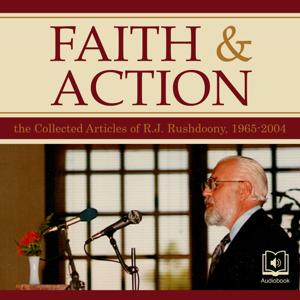
Faith and Action is the complete collection of the essays of R. J. Rushdoony written for the Chalcedon Report between 1965 and 2001 along with several transcripts of his recorded talks. The large…