
Sign up to save your podcasts
Or



Our prisons have become breeding grounds for violence and extortion, as illustrated by a young man murdered for refusing to pay $5 a week to a gang in Los Angeles Men’s Central Jail, highlighting that the humanistic assumption that prisoners are “good at heart” blinds us to their evil nature; misjudging criminals as unfortunate or reformable only endangers society, and true safety requires recognizing sinfulness and holding offenders accountable. #PrisonCrisis #CriminalJustice #HumanNature #PrisonViolence #Accountability
In “Necessity Versus Law,” Rushdoony exposes how the ancient pagan maxim “necessity knows no law” steadily replaced God’s law as the governing principle of Western society, allowing rulers, states, and eventually individuals to justify any action—however immoral—by appeals to emergency, public welfare, or reason of state. Once necessity became the “higher law,” God’s law was reduced to a private concern, morality collapsed, and both personal conduct and civil authority were freed from accountability. The state emerged as the chief beneficiary, defining itself as the realm of necessity and therefore beyond law, claiming jurisdiction over every sphere of life while acknowledging no authority above itself. Rushdoony argues that totalitarianism cannot be defeated by fear or resistance alone but only by rejecting its foundational premise and restoring the absolute sovereignty of God and His law. True freedom comes not by bowing to the supposed necessities of the state but by confessing that the only real necessity is obedience to God, whose law alone restrains tyranny and gives life.
#NecessityVersusLaw #GodsLaw #AgainstStatism #BiblicalAuthority #ChristianCulture #LawAndLiberty #SovereigntyOfGod #Theonomy #KingdomOfGod
The world is facing a banking crisis fueled by massive international debt, with trillions owed by “Third World” and communist states, threatening global economies and taxpayers alike; long-term inflation, currency depreciation, and the potential loss of personal savings underscore that debt is a form of slavery, and true economic freedom requires sound banking practices and a return to fiscal responsibility. #BankingCrisis #GlobalDebt #InflationRisk #DebtSlavery #FinancialFreedom
In “The Power of Heresy,” Rushdoony warns that false belief often proves more influential than faithful theology, using Marcion as a historic example of how heresy undermines the unity of Scripture, separating law from grace, creation from redemption, and the Old Testament from the New. Marcion’s rejection of God’s law, his reduction of God to love alone, and his implicit dualism paved the way for antinomianism, dispensationalism, and moral confusion—errors Rushdoony sees echoed in much of modern evangelicalism. When law is treated as evil or irrelevant, grace becomes sentimentalism, justice is denied, and atonement itself is emptied of meaning, leaving no coherent reason for holiness or obedience. Orthodoxy, by contrast, affirms one sovereign God, one unified Bible, and one redemptive purpose in which law and gospel, justice and love, creation and salvation are inseparable. The real question Rushdoony presses is stark and unavoidable: are today’s churches shaped by historic Christianity—or by a baptized form of Marcionism?
#PowerOfHeresy #Marcionism #LawAndGospel #BiblicalUnity #AgainstAntinomianism #ChristianOrthodoxy #GodsLaw #Atonement #CreationalFaith
Too often, we let fear of words charges of racism or bigotry paralyze us while taxpayers fund groups that fail obligations yet sue the government and receive federal support, highlighting how timidity in confronting abuses undermines both freedom and fiscal responsibility. #FreedomOfSpeech #TaxpayerBurden #StopAbuse #NameCalling #ProtectLiberty
In “Law and Sin,” Rushdoony argues that God’s law addresses real, completed acts of sin rather than attempting to prevent evil through coercive control, thereby strictly limiting the authority of courts and the state to punishing criminal actions after the fact and not governing intentions, thoughts, or potential wrongdoing. He contends that humanistic statism seeks to usurp God’s role by trying to eliminate the possibility of sin through regulation and bureaucracy, transforming society from rule by law into rule by agencies that treat freedom itself as criminal. By attempting to make men “good” through preventive control, the state becomes a false god, extending its power over all of life and enslaving the righteous along with the wicked. True law, Rushdoony insists, flows only from God’s sovereign word, and when men abandon it they become shoeless—without rights—under man-made authority. The central issue is therefore lordship: whether men will submit to God’s law, which restrains evil while preserving freedom, or to the state, which seeks total control in the name of preventing sin.
#LawAndSin #BiblicalLaw #AgainstStatism #GodsSovereignty #RuleOfLaw #ChristianLiberty #FalseGodState #Theonomy
There is evidence of a real return to faith in the United States, particularly within evangelical churches, which have grown significantly from 1972 to 1982 while modernistic denominations have declined; this growth is accompanied by an increase in Christian schools, agencies addressing social problems from a Biblical perspective, and efforts to influence politics and economics according to faith, suggesting that a true return to religion involves both spiritual commitment and obedience, offering the promise of renewed freedom and responsible self-governance. #ReturnToFaith #EvangelicalGrowth #BiblicalObedience #ChristianEducation #FaithInAction #SpiritualRenewal #FreedomAndFaith
In “Covenants and Law,” Rushdoony argues that the church’s abandonment of God’s covenantal law in favor of humanistic law has fueled the suicide of Western civilization by enthroning man’s autonomy—self-law—in place of God’s theonomy. He insists that law and grace are inseparable because every covenant requires law: God’s covenant with man is an act of sovereign grace in which divine law defines the life of grace, not its negation. By rejecting Biblical law, modern theology freed the state from accountability to God while demanding greater submission to civil authority, allowing positivist law to declare the state the sole source of justice. Rushdoony critiques figures like Kuyper for grounding civil authority in “common grace” while permitting autonomous lawmaking, a move that ultimately empowered revolutionary statism. Liberalism, pragmatism, and materialism then erased absolute values, replacing God with the state as lawgiver and paving the way for modern despotisms. True freedom, he concludes, cannot be found in free will, democracy, or pietism, but only in covenantal obedience to Christ, where grace and law stand together and “the Son” alone makes men free.
#CovenantTheology #GodsLaw #LawAndGrace #Theonomy #AgainstAutonomy #ChristOurKing #BiblicalCovenant #TrueFreedom
Through our taxes, we are unwitting patrons of the arts, funding millions for projects many consider frivolous or objectionable erotic shows, feminist journals, or ex-convict art programs while contributing to a growing national deficit that threatens economic stability and, ultimately, freedom. #ArtsFunding #TaxpayerBurden #FiscalResponsibility #StopWastefulSpending #ProtectFreedom
In “Autonomous Man,” Rushdoony argues that modern humanism seeks an autonomous universe—independent of God, law, and covenant—replacing God’s justice with man-made “social justice” grounded in the social contract rather than divine law. Once justice is defined by human will—whether elite, majority, or ideological—it becomes endlessly malleable, producing competing and contradictory moralities and labeling godly obedience as “antisocial.” The attempt to escape God’s authority inevitably dissolves all authority, leading not to true social order but to anarchism, fragmentation, and death, since autonomy for the creature is an illusion achievable only in the grave. Scripture teaches that justice and righteousness are found only in God’s law, which restores, restrains evil, and gives meaning and responsibility to life. Rejecting God’s law does not free man; it guarantees disaster, while obedience to Christ promises victory, dominion, and the ultimate subjection of all things to His reign.
#AutonomousMan #GodsLaw #TrueJustice #RejectHumanism #NoSocialJusticeMyth #ChristIsLord #BiblicalWorldview #DominionUnderGod
From the publisher's feed
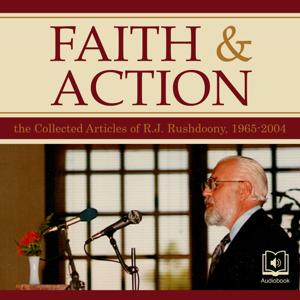
Faith and Action is the complete collection of the essays of R. J. Rushdoony written for the Chalcedon Report between 1965 and 2001 along with several transcripts of his recorded talks. The large…