
Sign up to save your podcasts
Or

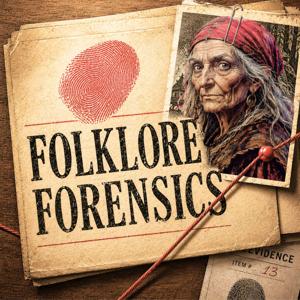


Four confessions.
A woman who claimed to fly, transform into a hare, and feast with the Queen of Fairies.
And a historical record that ends before revealing her fate.
You've heard the story. Now hear the case.
In 1662, Isobel Gowdie, a tenant woman from Auldearn, Scotland, delivered four extraordinary confessions to local authorities. She described encounters with the Devil, journeys into the fairy realm, magical attacks on her neighbors, and a secret network of witches.
Her words became some of the most famous testimony in the history of Scottish witchcraft.
But despite the survival of her confessions, no confirmed verdict or execution record has ever been found.
In the Season 3 finale of Folklore Forensics, we reopen the case of Isobel Gowdie and examine the competing explanations for her remarkable testimony.
Was she coerced? Was she repeating the expectations of her interrogators? Was she preserving the traditional folklore of seventeenth-century Scotland? Or was something more complicated unfolding in those interrogation rooms?
And what does it mean to tell the truth when factual accuracy is not the only kind of truth a story can preserve?
Folklore Forensics returns January 5th, 2027, with Season 4: Fairy Tale Autopsies.
Folklore Forensics reopens myths, legends, and folklore as historical criminal cases. Listener discretion is advised.
Written and hosted by Danielle Christmas and produced by Audio Ellis.
Follow / subscribe for weekly storytelling investigations.
Follow the show on Instagram @folkloreforensics
Case suggestions and research inquiries: [email protected]
Lancaster Castle. August 1612. A nine-year-old girl is lifted onto a table before a crowded courtroom. Her name is Jennet Device.
You've heard the story. Now hear the case.
Standing before the judges, Jennet accuses her own mother, brother, and neighbors of witchcraft, murder, and a conspiracy involving demonic spirits.
Her testimony helps send members of her family to the gallows.
The Pendle Witch Trials would become one of the most notorious witchcraft prosecutions in English history. Ten people were executed, and the surviving court account preserves an extraordinary record of accusations, confessions, neighborhood rivalries, and judicial fear.
But what did Jennet Device actually witness?
This week on Folklore Forensics, we reopen the Pendle Witch Trials of 1612, examining the evidence behind the prosecution of the Device and Chattox families, the mysterious gathering at Malkin Tower, and the legal machinery that turned suspicion into proof.
Were the defendants members of a murderous conspiracy?
Or did frightened witnesses and determined magistrates construct a criminal case out of poverty, folk beliefs, and neighborhood grudges?
What happens when fear becomes evidence?
Folklore Forensics reopens myths, legends, and folklore as historical criminal cases. Listener discretion is advised.
Written and hosted by Danielle Christmas and produced by Audio Ellis.
Follow / subscribe for weekly storytelling investigations.
Follow the show on Instagram @folkloreforensics
Case suggestions and research inquiries: [email protected]
In the hills outside Leicester, children were disappearing. The villagers knew who was responsible.
Black Annis.
You've heard the story. Now hear the case.
According to English folklore, she was a blue-faced hag with iron claws who lived in a cave beneath an ancient oak. She stalked the countryside, seized wandering children, and hung their skins from the branches above her lair.
But what if the story concealed something more complicated than a child-stealing monster?
This week on Folklore Forensics, we reopen the Black Annis legend through a fictional Elizabethan cold-case investigation.
A hidden cave. A bundle of children's clothing. An outcast woman whose tools and appearance seem to match the legend.
At first, the evidence appears damning.
But as the investigation unfolds, a different picture emerges: one shaped by famine, dangerous working conditions, poverty, and a community struggling to account for its missing children.
Was Black Annis a killer?
Or did a frightened town invent a monster to explain the children it couldn't protect?
Folklore Forensics reopens myths, legends, and folklore as historical criminal cases. Listener discretion is advised.
Written and hosted by Danielle Christmas and produced by Audio Ellis.
Follow / subscribe for weekly storytelling investigations.
Follow the show on Instagram @folkloreforensics
Case suggestions and research inquiries: [email protected]
A young man disappears from a riverboat after dark.
His lantern is still warm. His coat remains folded on the bench. And in the bottom of the boat, investigators discover a woman's carved horn comb.
The villagers already know who took him.
The Rusalka.
You've heard the story. Now hear the case.
Across Slavic folklore, she is the restless spirit of a young woman who died an unnatural death, returning to the rivers and marshes to lure living men beneath the water.
But in this fictional cold-case investigation inspired by the legend, a pattern of drownings conceals a second mystery: the disappearance of a young woman whose death the community never wanted to investigate.
Was the Rusalka responsible for the men who vanished? Or did dangerous working conditions, powerful families, and a community's shared silence turn an ordinary tragedy into a supernatural curse?
This week on Folklore Forensics, we reopen the legend of the Rusalka and investigate the terrible transformation at its heart:
How does a victim of violence become the monster everyone fears?
Folklore Forensics reopens myths, legends, and folklore as historical criminal cases. Listener discretion is advised.
Written and hosted by Danielle Christmas and produced by Audio Ellis.
Follow / subscribe for weekly storytelling investigations.
Follow the show on Instagram @folkloreforensics
Case suggestions and research inquiries: [email protected]
A servant boy stole three drops of divine wisdom from a Welsh sorceress. She hunted him across land, water, and sky and when she finally caught him, she swallowed him whole.
You've heard the story. Now hear the case.
His name is Gwion Bach. And according to Welsh folklore, he has accidentally swallowed three drops of divine wisdom, knowledge intended for the son of the powerful sorceress Cerridwen.
What follows is one of Celtic mythology's most extraordinary pursuits: a chase across land, river, and sky, as Cerridwen hunts the boy through a series of impossible transformations.
But beneath the magic lies a darker question.
What happens when a powerless servant acquires knowledge that his employer believes belongs to her?
In this episode of Folklore Forensics, we investigate Cerridwen's cauldron, the disappearance of Gwion Bach, and the strange journey that ultimately gives birth to the legendary Welsh bard Taliesin.
Was this a story of stolen wisdom, a desperate escape, or a struggle over who has the right to possess knowledge?
And can an idea ever truly belong to one person?
Folklore Forensics reopens myths, legends, and folklore as historical criminal cases. Listener discretion is advised.
Written and hosted by Danielle Christmas and produced by Audio Ellis.
Follow / subscribe for weekly storytelling investigations.
Follow the show on Instagram @folkloreforensics
Case suggestions and research inquiries: [email protected]
Morgan le Fay poisoned kings, kidnapped knights, stole Excalibur's scabbard, and plotted the destruction of Camelot. At least, that's what the prosecution says.
You've heard the story. Now hear the case.
Arthurian legend remembers Morgan as Camelot's great villain—a sorceress who poisoned kings, trapped knights, stole magical weapons, and conspired to destroy her own brother's kingdom.
But the earliest traditions remember Morgan very differently: as a healer, an educated woman, and the guardian of the sanctuary where the mortally wounded Arthur is taken for care.
So what happened?
This week, Folklore Forensics reopens the case against Morgan le Fay.
We investigate the poisoned cup, the missing knights, the burning mantle, the political rebellions—and the centuries of storytelling that transformed a powerful woman associated with healing into the witch supposedly responsible for Camelot's destruction.
Was Morgan le Fay really the villain of Arthur's story?
Or did a collapsing kingdom need someone else to blame?
Folklore Forensics reopens myths, legends, and folklore as historical criminal cases. Listener discretion is advised.
Written and hosted by Danielle Christmas and produced by Audio Ellis.
Follow / subscribe for weekly storytelling investigations.
Follow the show on Instagram @folkloreforensics
Case suggestions and research inquiries: [email protected]
A farmer dies beside an unidentified bottle of poison and the ghost haunting his family claims responsibility. Was the Bell Witch America's strangest unsolved murder?
You've heard the story. Now hear the case.
This week on Folklore Forensics, we reopen one of the most famous supernatural mysteries in American folklore and investigate the Bell Witch as a possible crime.
Was the haunting an elaborate hoax? Could fear and psychological stress explain what witnesses experienced? Did decades of storytelling transform an ordinary family tragedy into a paranormal legend? Or could someone have used belief in the Bell Witch as the perfect cover for murder?
From frontier Tennessee and American folklore to disputed eyewitness testimony, the famous Andrew Jackson story, Betsy Bell, Kate Batts, and the mysterious death of John Bell, we're separating the historical record from two centuries of ghost stories.
Because behind one of America's most famous hauntings lies a question that has never been conclusively answered:
Who killed John Bell?
Folklore Forensics reopens myths, legends, and folklore as historical criminal cases. Listener discretion is advised.
Written and hosted by Danielle Christmas and produced by Audio Ellis.
Follow / subscribe for weekly storytelling investigations.
Follow the show on Instagram @folkloreforensics
Case suggestions and research inquiries: [email protected]
For more than two thousand years, grieving families blamed the same woman for the deaths of their children. Her name was Lilith.
You've heard the story. Now hear the case.
Across ancient Mesopotamia, Jewish folklore, medieval Europe, and generations of household tradition, Lilith became an immortal woman of the night: an enemy of childbirth, a killer of infants, and one of folklore's most enduring female monsters.
But there was never a single crime scene. There were only thousands of families confronting the same terrifying reality: mothers and newborns who could become sick and die without warning.
This week, Folklore Forensics reopens the case against Lilith.
From ancient Mesopotamian spirits and the Hebrew Bible to the Alphabet of Ben Sira, protective amulets, incantation bowls, and medieval birth rituals, we investigate how centuries of folklore transformed unexplained death into an enemy families could fight.
And we ask a more difficult question:
When grief refuses to explain itself, why do we need to give it a face?
Folklore Forensics reopens myths, legends, and folklore as historical criminal cases. Listener discretion is advised.
Written and hosted by Danielle Christmas and produced by Audio Ellis.
Follow / subscribe for weekly storytelling investigations.
Follow the show on Instagram @folkloreforensics
Case suggestions and research inquiries: [email protected]
Two starving children walked out of a forest carrying a dead woman's food, money, and wedding ring. The story says they escaped a witch. The evidence is much less certain.
You've heard the story. Now hear the case.
This week, Folklore Forensics reopens one of the most famous cases in European folklore. Two children are abandoned in a German forest. Days later, they emerge barefoot and burned, carrying food, silver, and a dead woman's wedding ring. Behind them is an isolated cottage, a cold oven, and the body of the woman they claim intended to eat them.
But the surviving evidence complicates the fairy tale.
Was the woman in the woods really a predator? Did two terrified children kill her in self-defense? Or did famine, abandonment, and desperation turn a violent encounter into a story about an evil witch?
Through folklore, fairy tales, history, witness testimony, and forensic reconstruction, we investigate the possible crime behind Hansel and Gretel, and ask why a starving community might have needed the witch to be guilty.
Folklore Forensics reopens myths, legends, and folklore as historical criminal cases. Listener discretion is advised.
Written and hosted by Danielle Christmas and produced by Audio Ellis.
Follow / subscribe for weekly storytelling investigations.
Follow the show on Instagram @folkloreforensics
Case suggestions and research inquiries: [email protected]
Forty-seven pairs of children's shoes hanging from a tree led investigators into the Bryansk Forest. What they found transformed a fairy tale into a homicide investigation.
You've heard the story. Now hear the case.
For centuries, parents warned their children not to wander into the forest.
An old woman lived there. She had iron teeth. She lived in a strange hut. And if children crossed her path, they might never return.
But what if the story preserved more than a warning?
In this episode of Folklore Forensics, we reopen the Baba Yaga case and investigate one of the most famous figures in Russian folklore. Following the discovery of dozens of children's shoes hanging from a tree in the Bryansk Forest, investigators uncovered evidence suggesting that the legend may have been shaped by something horrifyingly real.
Through folklore, mythology, fairy tales, history, witness testimony, and historical reconstruction, we ask a difficult question:
Did communities create a monster because the truth was too painful to remember any other way?
Folklore Forensics reopens myths, legends, and folklore as historical criminal cases. Listener discretion is advised.
Written and hosted by Danielle Christmas and produced by Audio Ellis.
Follow / subscribe for weekly storytelling investigations.
Follow the show on Instagram @folkloreforensics
Case suggestions and research inquiries: [email protected]