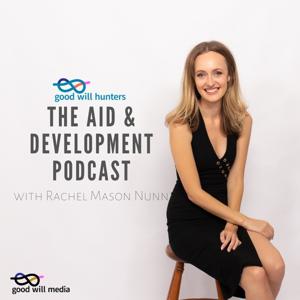
Good Will Hunters

Good Will Hunters

By Good Will HuntersNews
Download on the App Store

Good Will Hunters episodes

  • Jonathan Glennie - Have we outgrown aid?
    Welcome to Episode 76 of Good Will Hunters from the Development Policy Centre. Today on the show I’m speaking with Jonathan Glennie.
    Jonathan is the Director of the Ipsos Sustainable Development Centre. He is also a prominent writer and researcher on international development and cooperation, and has been a Visiting Fellow at the International Development Institute at King’s College London, as well as worked at the Overseas Development Institute, Save the Children UK and Christian Aid.
    I interviewed Jonathan in February - pre Covid-19 - at the Australasian Aid Conference hosted by the Devpolicy Centre in partnership with the Asia Foundation. Jonathon gave a keynote address on ‘The Future of Aid in the 21st century - five paradigm shifts’. Jonathan spoke at the conference about global public investment in aid and the future of concessional international public finance, as we move from what he refers to as the ‘old fashioned aid mentality’.
    In this interview, we take a deep dive into some of those points. We discuss the measurement of inequality versus poverty. We also discuss why development is a concern for all countries at all times, and why aid is permanent, not temporary, meaning we shouldn’t be concerned with exit strategies. We also discuss why all countries can contribute to aid, and be both donors and recipients. Lastly, we discuss why we need more accountability in governance of aid, and why private and public money are not the same, though both could be classed as investments. Jonathan is provocative and contentious in his arguments, and this conversation will certainly provoke some deeper reflections on how we do aid. A lot of the issues he raises have only become more not less relevant with the COVID19 pandemic.
    The Australasian Aid Conference feels like a lifetime ago now, but many of the the insightful conversations that were had have been preserved through the Devpolicy blog and Good Will Hunters.
    Conference wrap-up - https://devpolicy.org/insights-from-the-australasian-aid-conference-2020-20200310/
    Devpolicy Talks - https://podcasts.apple.com/au/podcast/2020-australasian-aid-conference-keynote-address-future/id576275861?i=1000472388895
    Other conference episodes - https://goodwillhunterspodcast.com.au
    We’ve got one last conference episode to air with Graham and Glennys Romanes, which is a fascinating and inspirational story so stay tuned for that. But next week we’re looking at Covid-19 in Papua New Guinea with two local experts.
    Enjoy,
    The GWH Team
    35 min
  • Dan McGarry and Odo Tevi - What will Cyclone Harold, COVID-19 and a new PM mean for Vanuatu?
    Welcome to Episode 75 of Good Will Hunters from the Development Policy Centre. Today I'm speaking with Odo Tevi and Dan McGarry.
    Odo is Vanuatu’s Representative to the United Nations based in New York, and Dan is an independent journalist living in Vanuatu since 2003. Both Odo and Dan contribute to the Devpolicy blog, on matters relating to development in Vanuatu and the broader Pacific region.
    It’s been a big month for Vanuatu. They’re one of the few remaining countries on Earth without Covid-19, but at the beginning of April, were hit with by Category 5 Tropical Cyclone Harold, which caused widespread destruction through the North of the country. Due to travel restrictions, the usual surge response didn’t occur, and so Vanuatu has been left to deal with the aftermath of Cyclone Harold without the usual international actors flying it. At the same time, Vanuatu has formed a new Government and has a new PM as of a few days ago, and has announced a stimulus package to support the country to recover from the economic impacts of both Covid-19 and Cyclone Harold.
    But, will it be enough?
    Odo and I discuss the stimulus package, and why Vanuatu may still need an international bail-out and what this could mean for the country. Odo shares his concerns around the conditions associated with a bail-out. We also discuss the role of the multilateral system, as well as bilateral donors including Australia and China. Dan acknowledges that he is not an objective voice in the wake of Cyclone Harold, given many of his family members are without urgent medical assistance on affected islands. Dan discusses why the response to Cyclone Harold is weeks behind Cyclone Pam, and how the Vanuatu Government has been slow to accept support from international actors including the UN and the World Food Programme. Dan shares his grave concerns about the welfare of so many in Vanuatu if the Government continues to respond inadequately.
    More optimistically, Dan is confident that Vanuatu does not have Covid-19 due to the comprehensive testing and prevention measures that have been undertaken. Despite several Pacific countries not having Covid-19, the economic impacts will still be felt widely, and Dan recommends that a restructure of development assistance to the Pacific occurs.
    As noted earlier, both Dan and Odo have contributed to the Devpolicy blog and we’ve included links to their recent articles here.
    https://devpolicy.org/author/dan-mcgarry/
    https://devpolicy.org/author/odo-tevi/
    The Devpolicy blog has extensive coverage of the impacts of both Covid-19 and Cyclone Harold on the Pacific. You can read more at Devpolicy.org
    Enjoy,
    The GWH Team
    49 min
  • Lyn Morgain and Anthea Spinks - Can developing countries recover from COVID-19?
    Welcome to Episode 74 of Good Will Hunters, from the Development Policy Centre.
    Today on the show I’m speaking to newly appointed Oxfam Australia CEO Lyn Morgain, and Director of Programs Anthea Spinks.
    Oxfam of course is one of Australia’s and the world’s biggest and most influential development NGOs. But it’s had some rough times lately with a decline in donations, and in Australia the closure of the iconic Oxfam shops.
    In this interview, we discuss how the organisation is responding to the challenges it is facing. Lyn unveils Oxfam Australia’s new strategy that focuses on the connection between poverty and climate change, champions the integral role Indigenous Australians play in Oxfam, and outlines how Oxfam will transform its operating model as the world of INGOs continues to be “utterly redefined” as Lyn puts it.
    Of course, we also discuss COVID19. In the last few weeks, Oxfam Australia has called on G20 Leaders to cancel or postpone the debt repayments of developing countries to help their economic recovery from COVID19. Oxfam has also been advocating for Australia to contribute just over 80m to the UN’s COVID19 Global Humanitarian Response Plan.
    Anthea and I also discuss Oxfam’s programming response. As we have in recent programs, we look at the localisation agenda, and whether local actors are ready for the task at hand. In particular, we zero in at Cyclone Harold which has hit some Pacific Island Countries, and compare it to the response to Cyclone Pam in 2015, and the key difference that this time there are no international actors flying-in.
    Here is some of Oxfam’s recent research and advocacy around COVID19 - https://www.iaran.org/covid19-scenarios
    Here is a link to Devpolicy analysis on donations to Australian development NGOs - https://devpolicy.org/ngo-donations-winners-and-losers-since-2000-20200203/
    And here is a link to the IMF’s most recent press briefing on the economic outlook - https://www.imf.org/en/News/Articles/2020/04/14/tr041420-transcript-of-april-2020-world-economic-outlook-press-briefing
    For more coverage on COVID19, check out the Devpolicy website at devpolicy.org.
    There is comprehensive coverage of the Pacific, but there are also some great articles from The Asia Foundation on the response in the Philippines and Nepal, and on the intersection of the pandemic with domestic violence and with civil conflict. We’ll be going into more depth on some of those issues in some of our upcoming episodes.
    Please share any comments with us via our social media channels, which you can find @goodwillpod - we’d love to hear your feedback.
    Enjoy the episode,
    The GWH Team
    48 min
  • Shane McLeod - Could COVID-19 spark a humanitarian emergency in Papua New Guinea?
    Welcome to Episode 73 of Good Will Hunters from the Development Policy Centre. Today’s guest is Shane McLeod. Shane is a Research Fellow working with the Lowy Institute’s Australia-PNG Network.
    Before joining the Institute, he was a senior editor at ABC News in roles where he managed its Sydney newsroom and the flagship radio programs AM, The World Today, and PM. He is a former foreign correspondent with postings in Japan and Papua New Guinea, as well as reporting assignments throughout the Asia-Pacific region. He has also worked as a journalist in regional Queensland, Melbourne, Sydney, and Canberra.
    As we go to air today, PNG has two confirmed cases of COVID19. Whilst the first case was brought in by a foreigner who had recently arrived in the country, the second case is of a Papua New Guinean.
    In this episode, Shane and I discuss the relationship between Australia and PNG since independence in 1975, including whether Australia is in fact an “embarrassed" former colonialist. We also discuss, as we have on a few podcasts now, whether aid to PNG should come at the expense of aid elsewhere, and how much of our support for infrastructure and other sectors is driven by increasing competition with China.
    Then of course we address COVID-19 in PNG, as well as Cyclone Harold which has already hit Fiji and Vanuatu. We discuss how misinformation and fake-news have impacted PNG’s response to COVID19. We also discuss the ongoing needs of PNG, including economic assistance and balancing concerns about health with concerns about economic growth.
    Shane is firmly an optimist when discussing PNG and believes the country has good reason to be positive about its future.
    Shane and I went to East Sepik in November last year with the Lowy Institutes Australia-PNG Emering Leaders Dialogue. Whilst there, we met with Governor Alan Bird, who is doing much to transform the economy of East Sepik Province during his time in office. You’ll hear us discuss Governor Bird in this episode, and the steps the Province is taking to reduce COVID19 transmission from the Indonesian Border.
    Meanwhile, if you’re interested in the impact of COVID-19 on the region, check out devpolicy.org, which covers blogs on the pandemic and … Fiji, PNG, Solomon Islands, Tuvalu, the Pacific as a whole, the Philippines, agriculture, gender-based and other forms of violence, and implications for Australian aid, with more being added every day.
    Enjoy,
    The GWH Team
    36 min
  • Terence Wood - Should aid to the Pacific come at the expense of aid elsewhere?
    Welcome to Episode 72 of Good Will Hunters from the Development Policy Centre. Our guest today is Terence Wood.
    Terence is a Research Fellow at the Development Policy Centre, at the Australian National University. Terence undertakes research on Australia and New Zealand’s aid programs, in particular the domestic political economy of aid. He also undertakes research on Melanesian politics, with a focus on the Solomon Islands.
    We recorded this episode in late February, before COVID19 was declared a pandemic and before mass unemployment began in Australia, so naturally the context in which we had this conversation six weeks ago is very different to the context we find ourselves in today. None the less, we address some topical issues, including the effectiveness of aid in the Pacific versus in the rest of the world, and why many donors and NGOs find working in the Pacific more difficult than working in other regions.
    We also discuss Terence’s view that the main motivator behind Australia’s focus in the Pacific is the rising influence of China, and whether it’s reasonable that aid to the Pacific is being delivered at the expense of aid to other places. We also discuss whether we need to worry about our comparative advantage, or our unique “brand” of aid, rather than focusing now what and where the greatest need is - it’s an interesting paradigm shift for us all to consider.
    We also address Terence’s work tracking Australian government aid transparency, as well as a discussion of gender and diversity on NGO Boards in Australia. Lastly, Terence tells us about his work in the Solomon Islands and broadly the impacts of poor governance, and whether aid can actually fix it.
    Terence’s work features prominently on the Devpolicy blog. On March 30 he wrote an article on what COVID19 will mean for the Pacific.
    You can read the full article on the Devpolicy blog here, https://devpolicy.org/what-will-covid-19-mean-for-the-pacific-a-problem-in-four-parts-20200330/.
    Enjoy,
    The GWH Team
    33 min
  • Fiona Tarpey and Chris Roche - Does COVID19 mean the end of the aid and development sector?
    Welcome to Episode 71 of Good Will Hunters from the Development Policy Centre. This episode is focused on the impact COVID19 will have on both developing countries and the aid and development sector.
    This week, I spoke on ABC’s Radio National Saturday Extra Program, on the topic of the Pacific and COVID19.
    https://www.abc.net.au/radionational/programs/saturdayextra/
    In today’s episode I’m speaking to Fiona Tarpey and Chris Roche.
    Fiona Tarpey is the Head of Advocacy for the International Programs Department of the Australian Red Cross. She is also Co-Chair of ACFIDs Development Practice Committee. Chris Roche is the Director of the Institute for Human Security and Social Change at La Trobe University, and a Senior Research Partner of the Developmental Leadership Program.
    Chris and Fiona jointly authored an article for the Devpolicy blog this week, titled ‘COVID19, localisation and locally led development: A critical juncture’. In sum, the article argued that COVID19 will force a large-scale transformation of the international development sector, and that this may actually be a good thing for local and international actors in the long term.
    https://devpolicy.org/covid-19-localisation-and-locally-led-development-a-critical-juncture-20200323/
    Int he interview, Fiona, Chris and I discuss why a reimagining of the development sector could be a good thing, including why restrictions on travel mean that local organisations suddenly have a more critical role to play. We discuss whether the development sector is equipped to work digitally, and subsequent to that, whether local organisations and local governments in the Pacific are adequately skilled and resourced to manage this new workload.
    We also talk about the expected downturn in funding for the international development sector, including both NGOs and contractors, before finally discussing what will happen if developing countries including in the Pacific need economic bail-outs. Lastly, I ask Chris and Fiona whether, given the unprecedented scale of health and economic impacts that COVID19 is causing, is there any way that developing countries come out of this better than before?
    I’ve also written an article on the support developing countries will require due to the sudden and complete loss of tourism revenue - https://www.lowyinstitute.org/the-interpreter/no-planes-cruise-ships-crucial-regional-industry-will-need-aid
    We’ll continue to bring you coverage of the impact of COVID19 in our region as well as for the aid and development sector. If there’s anything you’d really like us to address, please get in touch.
    Devpolicy Blog also continues to provide extensive coverage of COVID19 impacts on aid and international development, and in the Pacific and in Asia. Check it out at Devpolicy.org, and subscribe to their daily email and fortnightly digest here https://devpolicy.org
    Enjoy,
    Rachel and the GWH Team
    41 min
  • Radhika Coomaraswamy - What do women, peace and security have in common?
    Welcome to Episode 70 of Good Will Hunters from the Development Policy Centre.
    Today’s guest is Radhika Coomaraswamy. Radhika is a Sri Lankan lawyer, diplomat and human rights advocate. She has held a range of appointments within the United Nations, including as Special Representative for Children and Armed Conflict from 2006 to 2012, as lead author on a global study into Women, Peace and Security in 2014, and most recently as a Member in the United Nations Fact Finding Mission to Myanmar, following atrocities committed against the Rohinyga.
    Radhika was a keynote speaker at the recent Australasian Aid Conference hosted by the Development Policy Centre and The Asia Foundation on the Women, Peace and Security Agenda, which we discuss in this episode.
    It was an incredibly powerful speech. You can listen to it here: https://www.youtube.com/watch?v=J6eQlF5MYUQ#t=26m20s
    Radhika and I talk about her experience growing up in Sri Lanka, including her reflections on having Indian independence leader Mahatma Gandhi as a family friend. We then talk about violence against women as a toxic expression of power, and how the continued use of gender based violence as part of conflict and war, has shaped the Women, Peace and Security Agenda. It’s a critical agenda, but Radhika argues that it is also one that needs reform. In her words, it needs to “get real”.
    Radhika has visited every war zone in recent history, and she reflects on her recent experiences in Myanmar, and her conversations with the Rohinyga. She also talks about the fears of the Buddhist population in Myanmar and attempts to decipher the social and cultural factors that enable a genocide. Ultimately, this episode gets to the heart of fear, oppression and intolerance and how it impacts on the safety and security of all people but especially women.
    Enjoy,
    The GWH Team
    32 min
  • Mark Sullivan - How do you develop a pharmaceutical drug for a neglected disease?
    Welcome to Episode 69 of Good Will Hunters from the Development Policy Centre. Today's guest is Mark Sullivan.
    Mark is a drug development expert and the founder of Medicines Development for Global Health (https://www.medicinesdevelopment.com). Along with his colleague John Reeder, Mark was featured in the Development Policy Centre’s Aid Profile Series in 2019 and was nominated for the Mitchell Humanitarian Award, which he they jointly won in Canberra in February of this year.
    Mark’s Aid Profile, authored by Robin Davies of the Indo-Pacific Centre for Health Security, detailed the incredible efforts Mark and John have undertaken to end river blindness, a debilitating and historically neglected diseases afflicting tens of millions of people in Sub-Saharan Africa.
    https://devpolicy.org/aidprofiles/2020/01/31/really-ending-river-blindness-mark-sullivan-and-john-reeder/
    In this episode we discuss what river blindness is, and why some diseases are neglected by the pharmaceutical sector. Mark explains why he founded a not for profit organisation dedicated to developing drugs that are unlikely to be commercially viable in the long term. We discuss moxidectin, the drug Mark has developed to treat river blindness.
    It’s a fascinating insight into the drug research, development and licensing process, and the pivotal role that both the WHO and the FDA play in this equation, plus a great example of how the aid effort and the private sector can work together for transformational development outcomes, especially in Australia where we have so much medical expertise.
    Although we recorded this episode in mid-february before we knew that coronavirus would be declared a pandemic by the WHO, this is a very topical episode. Mark shines a light on how equipped global health systems are to respond to disease outbreaks, and how this manifestly different in more developed and less developed countries.
    As well as disease outbreaks, this episode looks at health equity and how Mark has dedicated his career to using his very technical skillset to make big changes to healthcare accessibility globally. Moving forward, Mark is turning his attention even more to diseases here in Australia, including scabies which continues to afflict Indigenous communities.
    We're proud to present this episode from the Development Policy Centre, a leading think tank for aid and development at the Australian National University serving Australia, the region and the global development community.
    Check out all the Centre’s Aid Profiles at devpolicy.org/aidprofiles. If you know someone whose made an outstanding contribution to development, nominate them for a future Aid profile by writing to [email protected].
    Enjoy,
    The GWH Team
    http://www.goodwillhunterspodcast.com.au
    37 min
  • Sally Lloyd - How do you tell the world about a humanitarian emergency?
    Welcome to Episode 68 of Good Will Hunters from the Development Policy Centre.
    Today’s guest is Sally Lloyd. Sally was featured in the Development Policy Centre’s 2019 Aid Profiles, and was shortlisted for the 2020 Mitchell Humanitarian Award. Cleo Fleming documented Sally’s life in Mogulu, PNG, as part of the Devpol Aid Profiles series:
    https://devpolicy.org/aidprofiles/2019/09/12/sally-lloyd-the-essence-of-community-development/
    I interviewed Sally at the Australasian Aid Conference hosted by the Development Policy Centre and the Asia Foundation a few weeks back - we were lucky to get her in Canberra for a few days, as she spends much of her time in PNG.
    Sally grew up in Mogulu, in the Western Province of PNG, after her parents moved there as missionaries in the late 1960s. At the time, PNG was still under Australian administration, which it remained until independence in 1975. By the age of 9, Sally had learned to assist her mum in delivering babies, and by age 16 Sally had established the first pre-school in the area and was teaching children in both English and the local language of Bedamuni.
    Sally has remained a part of the community ever since, and splits her time between Mogulu and Brisbane, although as Sally says, it’s far more of Mogulu and far less of Brisbane these days.
    In this episode, Sally and I discuss the 2015 drought in PNG. As that drought worsened, starved and malnourished people were arriving en masse at Mougulu’s health clinic, having spent days traversing the harsh and rugged terrain.
    In response, Sally began to document the unfolding crisis and was instrumental in gaining the attention of both the international media, and the humanitarian sector who could come to the aid of the people of the Western Province. Sally was instrumental in the local and national response to the drought, and it was an honour to hear that story in or conversation.
    In this episode we also discuss the state of rural healthcare in PNG broadly, including the important role of Community Health Workers and how there aren’t enough of them, and those that are working are in many instances not being paid adequately. For this reason, Sally and her team are looking at how they can work directly with Community Health Workers and bypass the bureaucracy.
    As we celebrate International Women’s Day this week, I can’t think of a better woman to have on the show on this day than Sally Lloyd. Sally’s shares an insight into a life in PNG that most of us would otherwise never know or experience.
    Before we go, we’re proud to present this episode from the Development Policy Centre, a leading think tank for aid and development serving Australia, the region and the global development community.
    The Centre is hosting two major conferences in the next 6 months. The first is the Pacific Update from 24 - 26 June in Suva, Fiji, and the second is the PNG Update from 20-21 August in Port Moresby, PNG. Both events address the most pressing challenges and opportunities for economic and social development in our region, and proposals for presentations at the two conferences are now being accepted. If you’d like to share work with the development community, then we invite you to submit an abstract. All details can be found at devpolicy.anu.edu.au.
    Sally Lloyd was featured in one of the three Aid Profiles released by the Devpolicy Centre in 2019. In the coming weeks, I’ll also be interviewing the other inspiring individuals featured in the series, each making enormous contributions to the development sector.
    If you enjoy today’s episode, please leave us a review on iTunes or Spotify, and join our online communities on Twitter, Facebook and Instagram.
    Enjoy,
    The GWH Team

    35 min
  • Lant Pritchett - Why do good intentions and good policies lead to bad outcomes?
    Welcome to Episode 67 of Good Will Hunters from the Development Policy Centre.
    Today’s guest is Lant Pritchett. Lant is described as a ‘Rock Star’ of the aid world. He is an American development economist, famous for challenging contemporary beliefs on development. Lant recently spoke at the Australasian Aid Conference, hosted by the Development Policy Centre, on why great intentions and great policies don’t always lead to great outcomes - he speaks about the importance of contextualising development approaches, or in other words, why we all can’t just adopt Finland’s education policies.
    What works in one spot, may fail to work in another, if it doesn’t account for the real, lived experience of locals and the nuances of the social, economic and political system - it sounds rather obvious - we’d all agree that development approaches need to be relevant for the local context - but it doesn’t always play out in practice.
    Lant’s views are challenging, and often controversial, and he delivers each point with his characteristic humour and light-heartedness, which made for a fun conversation.
    Once again, this episode is from the Development Policy Centre, a leading think tank for aid and development based at the Australian National University. We’re thrilled to be working with the Development Policy Centre, and continuing to be the leading media platform dedicated to aid and development globally.
    The Development Policy Centre is hosting the Pacific Update from 24-26 June in Fiji, and the PNG Update from 20 - 21 August in Port Moresby. I’ll be attending both conferences, and hope to see many of you there! Abstracts are now open for both conferences, so we’d love you to submit a paper on a topic relevant to aid and development, and hopefully share your ideas and experience with our community! You can find more info at devepolicy.anu.edu.au
    Enjoy,
    The GWH Team

    42 min

About Good Will Hunters

From the publisher's feed

Join us as Rachel Mason Nunn explores the nuanced world of international development by talking to experts and game-changers whose voices and work are critical to radically transforming the sector and…

More shows like Good Will Hunters

Lowy Institute by Lowy Institute

Lowy Institute

20 Listeners

Big Ideas by ABC Australia

Big Ideas

100 Listeners

Late Night Live — Full program podcast by ABC Australia

Late Night Live — Full program podcast

97 Listeners

Late Night Live - Separate stories podcast by ABC Australia

Late Night Live - Separate stories podcast

45 Listeners

Saturday Extra - Separate stories podcast by ABC Australia

Saturday Extra - Separate stories podcast

7 Listeners

Radio National Breakfast by ABC Australia

Radio National Breakfast

15 Listeners

Follow The Money by The Australia Institute

Follow The Money

14 Listeners

Australian Politics by The Guardian

Australian Politics

48 Listeners

Politics with Michelle Grattan by The Conversation

Politics with Michelle Grattan

12 Listeners

ABC News Daily by ABC Australia

ABC News Daily

137 Listeners

The National Security Podcast by ANU National Security College

The National Security Podcast

25 Listeners

Democracy Sausage with Mark Kenny by The Australian National University

Democracy Sausage with Mark Kenny

28 Listeners

7am by Solstice Media

7am

109 Listeners

Full Story by The Guardian

Full Story

162 Listeners

The Fin by Australian Financial Review

The Fin

29 Listeners