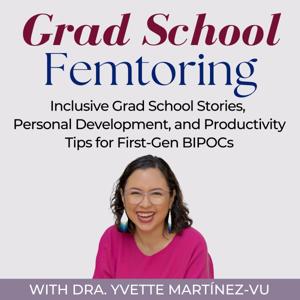
Grad School Femtoring: Inclusive Grad School Stories, Personal Development, and Productivity Tips for  First-Gen BIPOCs

Grad School Femtoring: Inclusive Grad School Stories, Personal Development, and Productivity Tips for First-Gen BIPOCs

By A podcast on thriving in graduate school for first-generation BIPOC students, offering insights on academic success, career development, mental health, and navigating diversity and inclusion in higher education.Society & CultureBusinessEducationSelf-ImprovementRelationshipsCareers
Download on the App Store

Grad School Femtoring: Inclusive Grad School Stories, Personal Development, and Productivity Tips for First-Gen BIPOCs episodes

  • 395: Grad School Horror Stories: Why People Regret Their Degrees (and How to Avoid It)

    In this episode of the Grad School Femtoring podcast, I explore five common reasons people regret their graduate degrees and what we can learn from their experiences. Drawing on stories shared on Reddit, my coaching work, and my own educational journey, I discuss the financial, professional, and personal costs of graduate education. Whether you’re considering applying, questioning your current program, or reflecting on a degree you’ve already earned, this episode offers questions to help you clarify your next steps.

    I unpack opportunity costs, changing career interests, disillusionment with academia, the relationship between academic achievement and personal fulfillment, and the sunk cost fallacy. I also share five reflection questions to help you evaluate how graduate school fits into the work and life you want to build. Throughout the episode, I encourage you to approach regret with self-compassion, recognize your transferable skills, and give yourself room to redefine success as your priorities evolve.

    In this episode, you will learn:

    • Five common reasons people regret their graduate degrees, including experiences in fully funded programs.
    • How to assess the costs of graduate school, including lost income, retirement contributions, time, and energy.
    • How to research whether your desired career requires an advanced degree.
    • Why program culture, daily responsibilities, and support systems matter when evaluating fit.
    • How to recognize the sunk cost fallacy when deciding whether to continue, change programs, or leave.
    • Five reflection questions to clarify your motivations, needs, and personal definition of success.

    Work with me

    • Get individualized support with deciding whether grad school fits your goals, reassessing your path, or navigating what comes next. Explore 1:1 coaching: https://gradschoolfemtoring.com/coaching/

    Free resource

    • Download your Grad School Femtoring Resource Kit: https://gradschoolfemtoring.com/kit/

    Explore more

    • Listen to more episodes on Applying to Grad School: https://gradschoolfemtoring.com/podcast_catergory/applying-to-grad-school/
    • Support the podcast with a one-time or monthly donation: https://donate.stripe.com/bJedR8dGRcs6ewGdwq38401
    • Access transcripts and additional resources: https://gradschoolfemtoring.com/podcast/
    • Audio and transcript edited by Yessi Sanchez: https://www.linkedin.com/in/yessisanchez/
    • This podcast is a proud member of the Genuina Media network.
    • The Grad School Femtoring Podcast is for educational purposes only and is not a substitute for therapy or other professional services.

    Hosted by Simplecast, an AdsWizz company. See pcm.adswizz.com for information about our collection and use of personal data for advertising.

    32 min
  • 394: Toxic Advisor Horror Stories That Keep Grad Students Up at Night

    In this episode of the Grad School Femtoring podcast, I share five toxic advisor horror stories inspired by recurring themes from coaching conversations and online graduate student discussions. These anonymous composite stories explore humiliating feedback, hurtful comments after qualifying exams, advisors who disappear, constantly changing expectations, and delayed dissertation signatures. Along the way, I reflect on my own experience receiving a painful comment about my writing and affirm that graduate students deserve respectful communication and meaningful support.

    I also discuss what you can reasonably expect from an advisor, including constructive feedback, clear turnaround times, guidance through academic milestones, and appropriate boundaries. I share ways to clarify expectations, seek additional mentorship, explore changing advisors, and process difficult experiences while rebuilding your sense of agency.

    In this episode, you will learn:

    • How to recognize constructive academic feedback and identify humiliating comments.
    • What communication, feedback, and guidance you can reasonably expect from an advisor.
    • How to clarify revision priorities and feedback timelines when expectations keep changing.
    • What to consider before changing advisors, including funding, research, and graduation timelines.
    • How to seek support and regain a sense of agency after a hurtful advising experience.

    Work with me

    • If you’re navigating a difficult advising relationship or preparing for a major academic milestone, I offer personalized support to help you clarify your options and create a plan aligned with your capacity and goals. Learn more about my coaching services here: https://gradschoolfemtoring.com/coaching/

    Free resource

    • Download your Grad School Femtoring Resource Kit: https://gradschoolfemtoring.com/kit/

    Explore more

    • Listen to more episodes on Grad School Hidden Curriculum: https://gradschoolfemtoring.com/podcast_catergory/grad-school-hidden-curriculum/
    • Support the podcast with a one-time or monthly donation: https://donate.stripe.com/bJedR8dGRcs6ewGdwq38401
    • Access transcripts and additional resources: https://gradschoolfemtoring.com/podcast/
    • Audio and transcript edited by Yessi Sanchez: https://www.linkedin.com/in/yessisanchez/
    • This podcast is a proud member of the Genuina Media network.
    • The Grad School Femtoring Podcast is for educational purposes only and is not a substitute for therapy or other professional services.

    Hosted by Simplecast, an AdsWizz company. See pcm.adswizz.com for information about our collection and use of personal data for advertising.

    31 min
  • 393: How to Write an Inclusion and Belonging Statement, Formerly Known as Diversity Statement

    In this episode of the Grad School Femtoring podcast, I share how to write an inclusion and belonging statement, an application essay you may or may not recognize as a diversity statement. If you’re applying to graduate school and wondering how to approach this prompt, I walk you through a sample 250-word essay question and explain how to identify experiences that demonstrate your contributions to a community.

    Drawing on my work supporting graduate school applicants, I offer brainstorming questions about your identities, lived experiences, research, leadership, and service. I also share my “what, how, and so what” framework to help you describe the context, explain your role, and communicate your impact. These strategies can help you choose meaningful examples, show your values through action, and address each part of the prompt within the word limit.

    In this episode, you will learn:

    • How to recognize an inclusion and belonging prompt that resembles a traditional diversity statement.
    • How to brainstorm connections between your lived experiences and your contributions to community.
    • How research, mentorship, employment, and service can provide meaningful essay examples.
    • How to use the “what, how, and so what” framework to explain your actions and impact.
    • How to select focused examples, reflect on what you learned, and respond to the full prompt.

    Work with me

    • Get strategic, culturally informed support with your graduate school applications: https://gradschoolfemtoring.com/consulting/

    Free resource

    • Download your Grad School Femtoring Resource Kit: https://gradschoolfemtoring.com/kit/

    Explore more

    • Listen to more episodes on Applying to Grad School: https://gradschoolfemtoring.com/podcast_catergory/applying-to-grad-school/
    • Support the podcast with a one-time or monthly donation: https://donate.stripe.com/bJedR8dGRcs6ewGdwq38401
    • Access transcripts and additional resources: https://gradschoolfemtoring.com/podcast/
    • Audio and transcript edited by Yessi Sanchez: https://www.linkedin.com/in/yessisanchez/
    • This podcast is a proud member of the Genuina Media network.
    • The Grad School Femtoring Podcast is for educational purposes only and is not a substitute for therapy or other professional services.

    Hosted by Simplecast, an AdsWizz company. See pcm.adswizz.com for information about our collection and use of personal data for advertising.

    16 min
  • 392: Money Trauma, Wealth Culture, and the BIPOC Grad Student Experience with Esther Saehyun Lee

    In this episode of the Grad School Femtoring podcast, I’m joined by Esther Saehyun Lee, founder of Elevate Philanthropy Consulting and a Trauma of Money certified fundraiser, to explore money trauma, wealth culture, and the financial struggles of first-generation and BIPOC graduate students. Drawing on our experiences navigating higher education, we discuss how hidden costs, unequal access to resources, and family responsibilities shape students’ choices and sense of belonging.

    Together, we explore how scarcity develops through experiences of survival and can continue influencing our decisions as our circumstances change. We discuss recognizing the systemic roots of financial shame, honoring the full context of our money stories, and reclaiming agency within our current circumstances. Esther also shares guidance for graduate students interested in transitioning into nonprofit and philanthropic work.

    In this episode, you will learn:

    • How wealth culture shows up in higher education and shapes your sense of belonging.
    • Why graduate school’s hidden costs create financial, emotional, and capacity burdens.
    • How real and internalized scarcity can affect future planning and career decisions.
    • How family financial responsibilities and immigrant experiences shape money stories.
    • Ways to understand financial shame in its systemic context and recognize your agency.
    • How informational interviews, courses, and writing practice can support a transition into nonprofit work.

    Work with me

    • Join the Grad Empowerment Coaching Circle for community, compassionate accountability, and support navigating graduate school’s hidden curriculum: https://gradschoolfemtoring.com/group-coaching/
    • Express your interest by October 8 for a cohort tentatively beginning October 26. If the cohort moves forward, enroll by October 19 to receive my Sustainable Productivity Toolkit, a $99 value.

    Connect with today’s guest

    • Connect with Esther Saehyun Lee on LinkedIn: https://ca.linkedin.com/in/esther-saehyun-lee
    • Scarcity vow article, “Are nonprofit leaders unknowingly taking a ‘scarcity vow’?”: https://candid.org/blogs/nonprofit-leaders-scarcity-vow/
    • Wealth culture article, “Money, Power, Respect: What Fine Dining Taught Me About Fundraising”: https://communitycentricfundraising.org/2024/12/02/money-power-respect-what-fine-dining-taught-me-about-fundraising/
    • Book recommendations: The Psychology of Money by Morgan Housel, Loaded by Sarah Newcomb, and Scarcity Brain by Michael Easter.

    Free resource

    • Download your Grad School Femtoring Resource Kit: https://gradschoolfemtoring.com/kit/

    Explore more

    • Listen to more episodes on Financial Literacy and Grad Funding: https://gradschoolfemtoring.com/podcast_catergory/financial-literacy-and-grad-funding/
    • Support the podcast with a one-time or monthly donation: https://donate.stripe.com/bJedR8dGRcs6ewGdwq38401
    • Access transcripts and additional resources: https://gradschoolfemtoring.com/podcast/
    • Audio and transcript edited by Yessi Sanchez: https://www.linkedin.com/in/yessisanchez/
    • This podcast is a proud member of the Genuina Media network.
    • The Grad School Femtoring Podcast is for educational purposes only and is not a substitute for therapy or other professional services.

    Hosted by Simplecast, an AdsWizz company. See pcm.adswizz.com for information about our collection and use of personal data for advertising.

    43 min
  • 391: How to Choose the Right Graduate Program Beyond Rankings and Prestige

    In this episode of the Grad School Femtoring Podcast, I share how to choose a graduate program based on the outcome you're seeking and the people you hope to learn from. When I help applicants build a program list, I encourage them to look beyond rankings and get clear on the conditions that will help them succeed. I walk through how to identify your non-negotiables, research potential faculty mentors, examine funding and program conditions, and learn from current students and alumni. This research takes time, especially when program information is hard to find, but it can help you build a list of schools you would seriously consider attending.

    In this episode, you will learn:

    • How to distinguish your non-negotiables from strong preferences and bonuses.
    • Why you should identify at least two potential faculty mentors at each program.
    • What to ask about stipends, funding duration, health insurance, and other program conditions.
    • How to connect with faculty, current students, and alumni for firsthand perspectives.
    • How to track your findings and build a graduate program list that reflects your goals.

    Work with me

    • If you would like support clarifying your goals and navigating graduate applications, explore my coaching services: https://gradschoolfemtoring.com/coaching/

    Free resource

    • Download your Grad School Femtoring Resource Kit: https://gradschoolfemtoring.com/kit/

    Explore more

    • Listen to more episodes on Applying to Grad School: https://gradschoolfemtoring.com/podcast_catergory/applying-to-grad-school/
    • Support the podcast with a one-time or monthly donation: https://donate.stripe.com/bJedR8dGRcs6ewGdwq38401 
    • Access transcripts and additional resources: https://gradschoolfemtoring.com/podcast/
    • Audio and transcript edited by Yessi Sanchez: https://www.linkedin.com/in/yessisanchez/
    • This podcast is a proud member of the Genuina Media network.
    • The Grad School Femtoring Podcast is for educational purposes only and is not a substitute for therapy or other professional services.

    Hosted by Simplecast, an AdsWizz company. See pcm.adswizz.com for information about our collection and use of personal data for advertising.

    29 min
  • 390: Low-Energy Writing Strategies: How to Keep Writing with Limited Capacity

    In this episode of the Grad School Femtoring Podcast, I share low-energy writing strategies for college students, graduate students, and professionals completing major projects with limited capacity. Whether you are navigating chronic illness, disability, burnout, caregiving, sleep deprivation, travel, or an especially demanding season, these strategies can help you keep making progress to meet a hard deadline.

    I explain how to assess your capacity, match tasks to your available energy, break long-term projects into specific actions, and prioritize the work that matters most. I also discuss writing triage, a process for completing high-energy tasks during periods when higher-capacity moments may never come.

    In this episode, you will learn:

    • How to assess your energy and focus using a low-, medium-, or high-capacity scale
    • How to sort writing tasks according to the energy they require
    • How to define a project’s starting point, required outcome, and short-term timeline
    • How to turn broad goals into specific, manageable actions
    • How to reduce unnecessary scope and protect your highest-priority sections
    • How to complete demanding work through writing triage, scaffolding, and community support

    Work with me

    • Receive personalized structure and compassionate support for your academic, professional, or personal goals through one-on-one coaching: https://gradschoolfemtoring.com/coaching/

    Free resource

    • Download your Grad School Femtoring Resource Kit: https://gradschoolfemtoring.com/kit/

    Explore more

    • Listen to more episodes on Dissertation and Writing Strategies: https://gradschoolfemtoring.com/podcast_catergory/dissertation-and-writing-strategies/ 
    • Support the podcast with a one-time or monthly donation: https://donate.stripe.com/bJedR8dGRcs6ewGdwq38401 
    • Access transcripts and additional resources: https://gradschoolfemtoring.com/podcast/
    • Audio and transcript edited by Yessi Sanchez: https://www.linkedin.com/in/yessisanchez/
    • This podcast is a proud member of the Genuina Media network.
    • The Grad School Femtoring Podcast is for educational purposes only and is not a substitute for therapy or other professional services.

    Hosted by Simplecast, an AdsWizz company. See pcm.adswizz.com for information about our collection and use of personal data for advertising.

    25 min
  • 389: Dopamine, Rewards, and Novelty: How to Keep Writing When the Excitement Fades

    In this episode of the Grad School Femtoring Podcast, I discuss why the excitement surrounding a long-term writing project can fade and how dopamine, executive functioning, and your working conditions can shape motivation. I offer a more compassionate approach for academics, students, and other writers who are struggling to return to work that still matters to them. I share practical ways to make writing more approachable. You will learn how to build a personalized menu of writing tasks and rewards that reflects your energy and capacity while recognizing when you may need rest, accommodations, redistributed labor, or additional support.

    In this episode, you will learn:

    • How dopamine, feedback, novelty, and executive functioning can influence your ability to begin and sustain writing
    • Why fading interest can point to your conditions, workload, health, access needs, or an unclear next step
    • How to add supportive cues and sources of comfort, purpose, or connection before and during a writing session
    • Ways to make progress visible beyond word counts 
    • How to create novelty by changing your medium, environment, sequence, social setting, or level of challenge
    • Four questions for building a flexible writing menu that includes options for low-capacity days

    Work with me

    • If you want structure and compassionate support as you work toward a dissertation, qualifying exam, writing project, career transition, or another important goal, learn more about one-on-one coaching: https://gradschoolfemtoring.com/coaching/

    Free resource

    • Download your Grad School Femtoring Resource Kit: https://gradschoolfemtoring.com/kit/

    Explore more

    • Listen to more episodes on Dissertation and Writing Strategies: https://gradschoolfemtoring.com/podcast_catergory/dissertation-and-writing-strategies/
    • Support the podcast with a one-time or monthly donation: https://donate.stripe.com/bJedR8dGRcs6ewGdwq38401
    • Access transcripts and additional resources: https://gradschoolfemtoring.com/podcast/
    • Audio and transcript edited by Yessi Sanchez: https://www.linkedin.com/in/yessisanchez/
    • This podcast is a proud member of the Genuina Media network.
    • The Grad School Femtoring Podcast is for educational purposes only and is not a substitute for therapy or other professional services.

    Hosted by Simplecast, an AdsWizz company. See pcm.adswizz.com for information about our collection and use of personal data for advertising.

    25 min
  • 388: Exploring STEM PhD Careers Through a GSF Externship with Reem Salem

    In this episode of the Grad School Femtoring Podcast, I speak with Reem Salem, a fourth-year molecular engineering PhD candidate at the University of Chicago, about career development for STEM PhD students. Drawing from the research she conducted during her Grad School Femtoring externship, Reem shares why graduate students need greater access to career guidance, mentorship, and opportunities to explore the many paths available beyond academia. We discuss how to identify and communicate the transferable skills you are already developing through your doctoral training. Reem also offers practical steps for exploring careers that align with your strengths and values.

    In this episode, you will learn:

    • What research reveals about the career development needs and pathways of STEM PhDs
    • How limited mentorship and professional networks affect historically excluded and first-generation graduate students
    • How to identify transferable skills within your doctoral research and training
    • Why career exploration can begin before you know exactly where you want to end up
    • How to approach career planning as a gradual and systematic process grounded in your strengths and values

    Work with me

    • If you are exploring new career paths or navigating a major academic or professional transition, I offer personalized coaching to help you clarify your goals, communicate your strengths, and create an action plan aligned with your capacity and values. Learn more at: https://gradschoolfemtoring.com/coaching/

    Connect with today’s guests

    • Connect with Reem Salem on LinkedIn: https://www.linkedin.com/in/reem-yasser-salem

    Free resources

    • Download the Career Development Brief for STEM PhDs: https://gradschoolfemtoring.com/career-development-brief-stem-phd-students/
    • Download the Grant-Writing Toolkit for STEM Graduate Students: https://gradschoolfemtoring.com/grant-writing-toolkit-stem-graduate-students/
    • Download your Grad School Femtoring Resource Kit: https://gradschoolfemtoring.com/kit/

    Explore more

    • Listen to more episodes on Career and Professional Development: https://gradschoolfemtoring.com/podcast_catergory/career-and-professional-development/ 
    • Support the podcast with a one-time or monthly donation: https://donate.stripe.com/bJedR8dGRcs6ewGdwq38401 
    • Access transcripts and additional resources: https://gradschoolfemtoring.com/podcast/
    • Audio and transcript edited by Yessi Sanchez: https://www.linkedin.com/in/yessisanchez/
    • This podcast is a proud member of the Genuina Media network.
    • The Grad School Femtoring Podcast is for educational purposes only and is not a substitute for therapy or other professional services.

    Hosted by Simplecast, an AdsWizz company. See pcm.adswizz.com for information about our collection and use of personal data for advertising.

    35 min
  • 387: Seven Graduate School Myths That Hold Students Back

    In this episode of the Grad School Femtoring podcast, I unpack seven common graduate school myths that can leave students questioning their abilities, belonging, support systems, timelines, and career prospects. These myths can be especially harmful for historically excluded students—including those who are first-generation, BIPOC, disabled, neurodivergent, chronically ill, parenting, caregiving, and nontraditional students—who are navigating uneven access to resources and insider knowledge.

    I explain why graduate school success depends on learned skills, supportive relationships, and sustainable practices rather than intelligence, independence, constant productivity, or a perfectly linear path. You will also learn how to treat struggle as information, build a broader support team, ask for help before challenges become a crisis, account for your changing capacity, and begin exploring career possibilities before the final year of your program.

    In this episode, you will learn:

    • Why academic confidence often reflects prior exposure, resources, mentorship, and insider knowledge
    • How to interpret struggle as information about the support, accommodations, strategies, or rest you may need
    • Why one advisor cannot meet every need and how a broader support team can fill important gaps
    • How to ask for help by sharing relevant context, explaining what you have tried, and making a specific request
    • Why rest, revised timelines, pauses, and redirection can all be part of a successful graduate journey
    • How to begin translating your skills and exploring career options before completing your degree
    • Work with me

      • Explore my coaching services for culturally relevant support as you navigate graduate school, build sustainable systems, strengthen your support network, and plan your next steps: https://gradschoolfemtoring.com/coaching/
      • Free resource

        • Download your Grad School Femtoring Resource Kit: https://gradschoolfemtoring.com/kit/
        • Explore more

          • Listen to more episodes on Grad School Hidden Curriculum: https://gradschoolfemtoring.com/podcast_catergory/grad-school-hidden-curriculum/
          • Support the podcast with a one-time or monthly donation: https://donate.stripe.com/bJedR8dGRcs6ewGdwq38401
          • Access transcripts and additional resources: https://gradschoolfemtoring.com/podcast/
          • Audio and transcript edited by Yessi Sanchez: https://www.linkedin.com/in/yessisanchez/
          • This podcast is a proud member of the Genuina Media network.
          • The Grad School Femtoring Podcast is for educational purposes only and is not a substitute for therapy or other professional services.

          • Hosted by Simplecast, an AdsWizz company. See pcm.adswizz.com for information about our collection and use of personal data for advertising.

            30 min
          • 386: How to Calculate the ROI of Grad School

            In this episode of the Grad School Femtoring Podcast, I explain how to calculate the return on investment, or ROI, of graduate school. As admissions season begins, many prospective students are asking whether an advanced degree makes financial sense. I walk you through the data you can use to make a more informed decision, including expected salaries, the full cost of attendance, lost wages, completion rates, and time to degree.

            I also invite you to consider the personal, professional, and community returns that may matter alongside salary. Through a simplified break-even calculation and a set of values-based questions, you can evaluate whether a particular program will bring you closer to the work, impact, autonomy, and long-term well-being you want.

            In this episode, you will learn:

            • How to compare your earning potential with a bachelor’s degree and an advanced degree
            • Which expenses to include when calculating the full cost of graduate school
            • Why lost wages, retirement contributions, and time away from the workforce matter when calculating the ROI of grad school
            • How completion rates, attrition, and time to degree affect a program’s potential return
            • How to estimate the number of years it may take to recover your graduate school investment
            • How to weigh financial outcomes alongside intellectual fulfillment, professional autonomy, community impact, and personal values
            • Work with me

              • Explore grad admissions consulting support as you clarify your goals and decide whether grad school aligns with the future you want: https://gradschoolfemtoring.com/consulting
              • Free resource

                • Download your Grad School Femtoring Resource Kit: https://gradschoolfemtoring.com/kit/
                • Explore more

                  • Read the full blog post on "How to Calculate the ROI of Grad School": https://gradschoolfemtoring.com/how-to-calculate-the-roi-of-graduate-school/
                  • Listen to more episodes on Financial Literacy and Grad Funding: https://gradschoolfemtoring.com/podcast_catergory/financial-literacy-and-grad-funding/
                  • Support the podcast with a one-time or monthly donation: https://donate.stripe.com/bJedR8dGRcs6ewGdwq38401
                  • Access transcripts and additional resources: https://gradschoolfemtoring.com/podcast/
                  • Audio and transcript edited by Yessi Sanchez: https://www.linkedin.com/in/yessisanchez/
                  • This podcast is a proud member of the Genuina Media network.
                  • The Grad School Femtoring Podcast is for educational purposes only and is not a substitute for therapy or other professional services.

                  • Hosted by Simplecast, an AdsWizz company. See pcm.adswizz.com for information about our collection and use of personal data for advertising.

                    18 min

                  About Grad School Femtoring: Inclusive Grad School Stories, Personal Development, and Productivity Tips for First-Gen BIPOCs

                  From the publisher's feed

                  The Signal Award-winning Grad School Femtoring Podcast provides first-generation BIPOC students and professionals with conversations about graduate school and growth to help you sustainably achieve your goals. 

                  More shows like Grad School Femtoring: Inclusive Grad School Stories, Personal Development, and Productivity Tips for First-Gen BIPOCs

                  Hidden Brain by Hidden Brain, Shankar Vedantam

                  Hidden Brain

                  43,363 Listeners

                  The Moth by The Moth

                  The Moth

                  26,815 Listeners

                  The Read by Loud Speakers Network

                  The Read

                  27,357 Listeners

                  collegepreppodcast's podcast by Megan Dorsey & Erin Tempest

                  collegepreppodcast's podcast

                  171 Listeners

                  Latino USA by My Cultura, Futuro and iHeartPodcasts

                  Latino USA

                  3,784 Listeners

                  The Daily by The New York Times

                  The Daily

                  111,864 Listeners

                  The Cal Newport Show by Cal Newport

                  The Cal Newport Show

                  1,342 Listeners

                  The Mel Robbins Podcast by Mel Robbins

                  The Mel Robbins Podcast

                  18,907 Listeners

                  The Psychology of your 20s by iHeartPodcasts

                  The Psychology of your 20s

                  1,439 Listeners