
Sign up to save your podcasts
Or

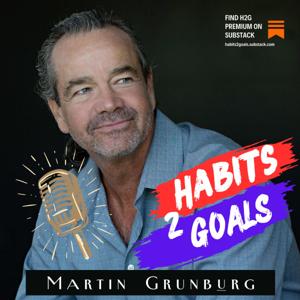


Trying to create new, effective habits is often associated with first trying to kill-off any existing bad habits that are holding us back. In this quick, high-value episode, Martin and I identify the three most important “MENTS” when it comes to busting those bad habits!
“Birds of a feather flock together."
Why would our environment influence our habits? Well, as our energy wanes throughout the day (along with our willpower), it is essential that your environment is tailored to support your new habits and goals. For example, if you're trying to lose weight, throwing out all of the potato chips in the pantry is a great start. The environMENT applies to all things--not just a new diet. When you surround yourself with like-minded people it provides a great support system to help you craft new habits.
“A nail is driven out by another nail. Habit is overcome by habit." ~Desiderius Erasmus
2. ReplaceMENT
Quitting any habit cold turkey is often difficult and ineffective because it leaves a void. When it comes to removing a bad habit it's important to remember that nature abhors a vacuum. Instead, try replacing any bad habit with a new, positive one. When Martin wanted to cut back on his coffee habit, rather than stop drinking coffee, he replaced his morning cup of joe with green tea.
“All life is an experiment. The more experiments you do, the better.”
3. Experiment
This podcast, writing The Habit Factor, and even his new book, The Pressure Paradox as well as The Habit Factor app have all been, in some form or fashion, an experiments. It takes trial and error (action to create information) in order to find out what will work best for you. In many ways, this idea brings us back to #2 (replacement) since you will need to try things, make some mistakes before you find what will actually stick!
[Tweet "“Good habits happen when planned, bad habits on their own.” @TheHabitFactor"]
When trying to craft any new habit or BREAK ANY BAD HABIT, take a quick run through this checklist to ensure that you are setting yourself up for success. With these three "MENTS", you'll be certain to break bad habits and craft new powerful habits that will help you take charge of your life.
While many do not consider the importance of habit development when it comes to goal achievement, those that do unfortunately are subject to the many great myths which surround the topic. In this episode, Martin and I review and dispel four monster myths about positive habit formation.
1. It takes 21 days to develop a habit.
This originated decades ago with, Psycho Cybernetics a terrific book by Dr. Maxwell Maltz. While it does not take 21 days to develop a habit it is safe to say you can START to develop a habit in 21 days. According to a study from the European Journal of Social Psychology, it takes, on average, 66 days. Research tells us though that it depends upon all sorts of criteria including; desire, skill and knowledge related to any particular habit.
2. Cue- Routine-Reward
Cue, routine, reward and the related, "habit-loop" were largely popularized by The Power of Habit. The habit loop helps to illustrate what triggers and environments have been supporting past behaviors (habits) but the habit loop fails to provide any guidance about how to actually form good habits intentionally. Cue, routine, reward may address half the battle but leaves out the significance of TRACKING and REASSESSING as well as using Target Days, Minimum Success Criteria and Tracking Periods, all which help greatly when developing good habits and constitute P.A.R.R.
3. Consecutive Days
Positive habit development is NOT an all or nothing proposition. In fact, the study referrenced above supports something that The Habit Factor introduced over five years ago, that you can and should use Target Days to develop habits and that habit development depends far more upon consistency over time than consecutive days.
4. All habits will last forever once established.
People often view habits as static and unchanging. Habits do need to be maintained, but it's important to constantly reevaluate your life and your goals to make sure that your habits remain aligned with your goals. As your life progresses your goals will change and its likely you'll want to reassess what habits you will need to help you achieve those goals. This is why habit tracking and the PARR methodology are so important!
This episode has us turning the tables... in the coming weeks we'll begin to weave-in interviews of domain industry experts so we figured we might as well start with Nick Palkowski, podcast guru, expert in online marketing strategy and all-around-great guy!
Things weren't always sunshine and rainbows for Nick. The first business he started in college, while a great learning experience, ultimately left him with $2 in his bank account and a jar of peanut butter. A jar of peanut butter. Those important lessons (from failure) taught Nick what not to do and what he needed to do differently. They proved invaluable and led him to launch his booming, full-time business Your Podcast Guru.
"The best way to grow your business is to consistently add value to your audience." @NickPalkowski
One of the most important factors for Nick was understanding that success is a habit, meaning he recognized the importance of becoming a consistent and disciplined professional. Nick even shared his top three character traits and supportive habits on the show... (23:45):
We discuss an important principle, "The Principle of Maximum Error" and how Nick's story is a great, real-life example. So, if you're interested in podcasting and self-improvement (with some inspiration) listen now and check out his custom page for THF listeners: www.yourpodcastguru.com/thf.
Are you pushing yourself hard enough? Most people would respond with a resounding yes. While the idea of a second wind is fairly common, Martin and I explore the possibilities of having a third, fourth, fifth (even an eighth!) wind in this episode of The Habit Factor.
“If you're going to doubt something, doubt your own limits.”
Ever notice during exercise that even when you're tired, you can always dig a little deeper and find energy reserves to get you through to the finish line? By changing your state of mind you can radically change and increase your energy levels and persevere to the end of any project!
Challenge your assumptions, your biases, and challenge the perceived limits that you have set for yourself. If you feel that you've been lulled in to a comfort zone of limitations, set increasingly extreme challenge for yourself and discover your eighth wind. You’ll be amazed at what you can achieve.
“Life doesn't get easier. We just get stronger.”
No matter how close you live to big, green spaces, many of your struggles can be traced to how aligned you are with nature. Sparked by a conversation with his teenage daughter Martin and I delve review some clues that can very well make our life easier.
“Every action has an equal and opposite reaction.”
Anytime there is frustration and friction in your life it's important to check and compare how aligned your affairs and thoughts are with the natural world. In this episode, Martin shares some of his observations about nature and just how we might adapt them to our own situation. (12:00):
This week, we challenge you to take one of these observations and apply it to your life. Track it and see for yourself how effective you can be when you align yourself and your efforts with nature!
“Never does wisdom say one thing and nature another.”
For more on the link between productivity and nature, check out the episode on the Physics of Productivity at TheHabitFactor.com/013
“There is nothing in a caterpillar that tells us it is going to be a butterfly.”
The word “philosophy” comes from Ancient Greek and means “love of wisdom”.
Unfortunately, the modern translation appears to have become slightly twisted to the point where the word might only connote some impractical college major.
Yet, philosophy ought to be embraced by all who seek to live in a more "favorable" world for it is our own mental constructs (our own philosophy) that dictates how we think, feel and act. So, philosophy isn't just about talking or even thinking, its true meaning lies in the execution of the ideas and ideals.
Today, Nick and I revisit the essence of philosophy and review some of the framework behind The Habit Factor franchise.
“All men’s natures are alike, it's their habits that carry them far apart.”
In this episode, Martin shares a handful of his favorite quotes and a few books that helped him to form a foundation for thought and action (a mixed philosophy that spans; Thoreau and Socrates to Kurt Vonnegut.
Enjoy!
“Give me a long enough lever and a place to stand and I can move the world.”
In the battle to get ahead, often the first step is finding a better way to leverage the only limiting resource everyone shares, TIME.
Understanding how to properly leverage your time and ideas is a game changer and it's sure to boost your productivity. In this episode, Martin and I review some strategies to optimize your personal power (your ability to act on ideas) to help get the results you want!
Touching on Dr. Stephen Covey’s "Quadrants of Effectiveness", Martin shares a few tips for deciding when and how to outsource (contract labor) to allow yourself more time to focus on the things most important to you.
Or, if you're not quite ready to source other experts, there are simply more effective ways to plan and use your days.
When you leverage your time more wisely, you simply take longer, more efficient steps toward your goal which accelerates your achievement and of course will have a life time effect on your achievements.
Enjoy!
“Good things happen when planned, bad things happen on their own.” ~Quality is Free Tweet This
The path to leading a more efficient life is simply to harness the power of positive habits and rituals.
Chances are very good you already have a set number of habits and rituals (particularly in the morning or evening). The question is, have they developed by choice or by chance? Are they by design or by default?
Intentionally establishing positive routines in the morning and evening will help you to feel refreshed, balanced, connected and even, as a bi-product far more productive.
In this episode, Martin and I review 6 reasons rituals are powerful and various tips for establishing them to help foster your efficiency and peace of mind. (7:10):
This week, Martin and I challenge you to create a ritual and to track your progress--that's it!
By tracking the ritual, you will reinforce its behavior and habit becomes the gateway rituals to foster an environment where you can be your most productive and successful self.
“Goals are just dreams with deadlines.”
A man named C. Northcote Parkinson once claimed that work expands to fill the time for its completion. While its human nature to procrastinate, there aren't enough people using deadlines to their advantage. Join author Martin Grunburg on this episode of Habits to Goals as he shares his strategies for accelerating productivity with deadlines.
When you don't understand how deadlines can help you, sometimes they can hurt you. Avoid thinking in terms of all or nothing and accept that there will be times that you will need an extension. Maintain perspective and persevere with accountability groups and realistic timelines to transform deadlines into a positive force to empower your life.
“There are no unreadable goals, just unreasonable deadlines.”
One of the great inspirations for Grunburg’s The Habit Factor is Dr. Stephen Covey’s classic, bestselling book, The Seven Habits of Highly Effective People. In this episode, Martin reviews some of the similarities and differences between the two works. (10:20).
If, by chance you haven't read Covey's masterpiece (do so!) and, in the meantime, here is a quick synopsis (12:45):
Martin then explains one of the reason The Habit Factor "had" to be written and how The Habit Factor "bookends" and complements The Seven Habits 11:52.
Later we discuss how the first three habits focus on the "self" and the next three habits focus on fostering inter-dependence and teamwork. Finally, the seventh habit, "Sharpen the saw" is about renewal and allows for never ending growth and the ability to continually cycle and master each habit.
Now, it's your turn! Are you being proactive? Are you beginning with the end in mind? Are you following the seven habits? And, are you tracking the core habits that will help you to achieve your goals?
Consider getting these books, studying and understanding better how habit and the seven habits can help to improve your life!
Enjoy!
From the publisher's feed
30,213 Listeners

75 Listeners

2,573 Listeners
1,152 Listeners

19,270 Listeners

3 Listeners