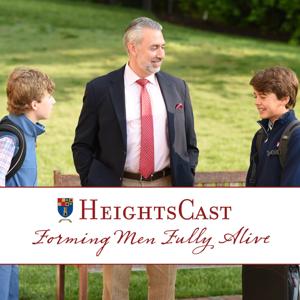
HeightsCast: Forming Men Fully Alive

HeightsCast: Forming Men Fully Alive

By The Heights SchoolEducation
Download on the App Store
  • Favorites

    26

    Followers

  • Typical duration

    58 min

    per episode

Based on Podcast App listening data

HeightsCast: Forming Men Fully Alive episodes

  • Why Sing: Pat Love on Brotherhood and Song

    From the boys' choir in the lower school to the men's chorus in the upper school, informal performances at faculty dinners to songs at the annual Maryland Day Gala, singing echoes throughout the whole of The Heights experience. This week, we sit down with Mr. Patrick Love, music teacher at The Heights since 2004, to discuss not only when and where we sing at The Heights but why we love to sing so much.

    As you'll hear, singing—broadly understood—is at the heart of our school's mission. Cantare amantis est, St. Augustine tells us: singing belongs to the one who loves. And as Arthur Clutton-Brock wrote, "education ought to teach us how to be in love always and what to be in love with." In educating our boys to become men fully alive, then, we are ultimately helping them to love, to find their voice, and to fall in love with One who sings them into existence.

    Chapters
    • 3:40 Where does singing happen at The Heights?
      • 4:30 A musical history of The Heights
    • 8:00 Where does singing happen amongst the faculty?
    • 12:27 What motivates us to sing? Why do we sing?
      • 13:45 Only the lover sings
      • 15:30 From The Magician's Nephew
      • 18:40 Singing: the real deal
    • 21:00 Love, education, and singing at the crossroads
    • 22:23 Fr. Luigi Giussani and the CL Songbook
      • 23:30 Singing in the home
      • 25:28 John Senior
      • 29:45 Cal Newport on technology fasts
    • 31:10 On iTunes
    • 32:46 Singing in the homeroom: teaching as singing
    • 39:00 Singing and silence
    Also on The Forum
    • Leisure and Acedia: R.J. Snell on Contemplative Homes in a Frenetic Age with R.J. Snell
    • Digital Minimalism: Creating a Philosophy of Personal Technology Use with Cal Newport
    • What Is the Difference between Free Time and Leisure? by Joe Bissex
    • Fall Poems We Love to Memorize by Tom Cox
    Additional Resources
    • Only the Lover Sings: Art and Contemplation by Josef Pieper
    • In Tune with the World: A Theory of Festivity by Josef Pieper
    • The Risk of Education: Discovering Our Ultimate Destiny by Fr. Luigi Giussani
    • The Restoration of Christian Culture by John Senior
    • Education at the Crossroads by Jacques Maritain
    • The Magician's Nephew by C.S. Lewis
    45 min
  • Science Education: Michael Moynihan on the Need for a New Synthesis

    This week on HeightsCast we talk with upper school head, Michael Moynihan, about a new initiative of his on the Forum: the Initiative for the Renewal of Science Education. In the episode, Michael discusses the need for a new synthesis in the liberal arts, combining the best of modern science with the wisdom of ages. In particular, he explains how the recent tendency in science education to begin with theory and then proceed to phenomena is unscientific, producing students with a habit of intellectual surrender, rather than the inspiration to become great scientists.

    42 min
  • Self-Mastery: Alvaro de Vicente on Fostering Interior Freedom in Schools

    In this week's episode, we talk with headmaster Alavaro de Vicente about a central theme from our faculty workshop: self-mastery. As Alvaro explains, self-mastery is a certain integration of action, words, thoughts, and desires that gives one the interior freedom to not only do the good but to want to do the good.

    What does this self-mastery look like for teachers, for students, and for parents? How do we help our boys develop self-mastery? What is the role of a school in assisting parents with this great endeavor?

    As man is not made virtuous in a day, Mr. de Vicente encourages us to think long term. At the same, he reminds us to focus on the little things, those small, daily realities where aspiration becomes actuality. In particular, he suggests dress code, punctuality, and language as three battlefields on which we can wage war alongside our sons—not against them—as they grow in interior freedom.

    Self-mastery, Alvaro explains, is not about mastering the world or others. It is rather about mastery of oneself so as to be able to steward the little piece of creation which the Creator has given us. For some, this may be a team. For others, it could be a whole company or even a country. For most, this will be a family, for whom the father has a special kind of care—a care which is best lived out when he recognizes that he is both a father and the Father's son.

    Chapters

    • 0:57 What is self-mastery?
    • 2:30 The role of the school in developing self-mastery of students
    • 5:00 Practical advice for developing self-mastery in students
      • 6:23 Dress code
      • 9:35 Punctuality
      • 10:30 Language
    • 13:12 School tone and self-mastery
      • 14:54 Advice for teachers
    • 15:45 Armando Valladares and interior freedom
    • 19:20 Trusting our students
    • 22:52 John Henry Cardinal Newman and the education of boys
      • 23:30 Two applications of Newman's educational philosophy
    • 26:45 Self-mastery and the order of creation
    • 30:00 Living life to the fullest: how self-mastery can help us enjoy life more
    • 31:15 Advice for parents
      • 35:20 Implementing change in the home
    • 39:38 Stories from Alvaro's upbringing
    • 42:20 Recommended reading
    • 43:50 A question to spark discussion

    Also on The Forum

    Respectful Dominion: Colin Gleason on Discipline with Colin Gleason

    Learn to Turn: Tom Royals on Parental Prudence with Tom Royals

    Manners: The Art of Happiness by Robert Greving

    Why My Computer Science Students Should Master the Guitar by George Martin

    Training the Hand to Train the Mind by Robert Greving

    Additional Resources

    A Catholic Eton? Newman's Oratory School by Paul Shrimpton

    Against All Hope: A Memoir of Life in Castro's Gulag by Armando Valladares

    50 min
  • When to Fight: Kyle Blackmer on Fisticuffs and the Peacemaking Protector

    In this week's episode we discuss fights. Most boys, especially at a young age, have a beautiful need for rough and tumble physical play. But what happens when it's not play? What happens when egos are insulted and the fists go up? Or when there's an unjust aggression? At what point is a young lad–or an older one–justified in puttin' up his dukes? Teacher and Coach, Kyle Blackmer, gives us some points for consideration as we coach our sons on the use of physical force. In the end, this is another one of those areas where parents–most often, but not always, dad–are the primary educators of boys learning the proper employment of one of God's great gifts: their strength.

    32 min
  • Leisure and Acedia: R.J. Snell on Contemplative Homes in a Frenetic Age

    In many quarters of contemporary society, busy-ness has become a sort of cliche greeting. To the question "How are you?", the response, "So busy," is often automatic. To borrow the words of Dr. R.J. Snell, many of us are conspicuously busy; and we wear our busy-ness as a sort of badge of honor, rooting our worth in our work.

    In last week's episode, we talked with Dr. Snell about work and acedia. This week, we round out that episode with a discussion of what is ultimately the point of work, namely leisure. While we may often think of leisure as ordered toward work—we rest so that we may work more—Dr. Snell explains how the reverse is nearer the truth, not only etymologically but also metaphysically. Work is for the sake of leisure, as instrumental goods are for the sake of intrinsic goods.

    As you'll hear, if we take the Eucharistic feast seriously on Sunday, then the rest of our days will be caught up into that Eucharastic feast. Monday will be different, for though we may be just as busy as before, our activity will no longer be so frenetic. It may even take on the mysterious rhythm of a divine dance.

    • 0:20 Relationship between leisure and acedia
      • 0:35 Acedia as frenetic busy-ness
      • 1:05 Total work and workaholism
      • 1:44 School as leisure
      • 2:30 Leisure is not an absence of activity
      • 3:02 Sabbath work and goods for their own sake
    • 5:04 Modern education and its discontents
      • 5:52 Education as the feast
      • 6:35 Mistake 1: Not respecting students as sovereign knowers
      • 7:56 Mistake 2: Olympian vision of education
    • 10:55 Overscheduling as a form of acedia
      • 12:05 Conspicuous busy-ness
      • 12:45 A culture of having and doing, rather than being
      • 13:35 Sin as loving a lower good at the expense of a higher good
      • 14:40 Sloth as a flattening of the Sabbath
    • 14:56 Where do we begin?
      • 15:40 Suggestions for the Sabbath
    • 17:00 Sabbath overflowing into the work week
      • 17:30 A Eucharistic life
      • 18:25 Another sort of leisure
    • 18:50 Leisure and contemplation in the work-a-day world
      • 19:20 Living in and approving of the good
      • 20:11 Dance as contemplation
      • 21:53 Backyard sports as contemplation
    • 23:50 A good question for conversation
      • 24:10 What can we do to enjoy our time with each other more?
      • 24:25 Catching the little foxes

    Also on The Forum

    • Work and Acedia: R.J. Snell on Our Original Vocation with R.J. Snell
    • OptimalWork series with Kevin Majeres
    • What Is the Difference between Free Time and Leisure? by Joe Bissex

    Additional Resources

    • Leisure: The Basis of Culture by Josef Pieper
    • In Tune with the World by Josef Pieper
    • Portsmouth Institute
    • Family, Leisure, and the Restoration of Culture by R.J. Snell
    • Acedia and Its Discontents: Metaphysical Boredom in an Empire of Desire by R.J. Snell
    • Summa Theologiae, II.2.35: Sloth by St. Thomas Aquinas
    31 min
  • Work and Acedia: R.J. Snell on Our Original Vocation

    A certain distinguished school leader, when asked when he would retire from his work, replied, "the day that I wake up and do not want to go to work." A reply such as this perhaps strikes the modern ear as senseless. For many of us, work fills the greater portion of our daily lives, but do we feel ourselves thereby fulfilled? Especially today, we may often feel trapped in what seem like unspectacular sisyphean cycles.

    This week, R. J. Snell, editor-in-chief of Public Discourse and director of the Center on the University and Intellectual Life at the Witherspoon Institute in Princeton, New Jersey, talks to HeightsCast about the virtues of work and its opposing vice, acedia. Drawing on insights from his book, Acedia and Its Discontents, R. J. helps us think through how these concepts are realized in the context of family life and life on campus.

    As we will hear, our everyday work is the ordinary means by which we participate not only in the perfection of God's creation but also in the perfection of our very selves. Our work is where the rubber meets the road; it is where mere aspiration is turned into actual reality. Ultimately, work is where heaven and earth merge. In realizing this often hidden truth, we may thereby discover that divine drama which is not a sisyphean cycle, but a spiral staircase.

    Chapters

    • 1:17 Work as a gift
      • 2:22 Error of thinking that work is a result of the Fall
    • 3:23 Garden of Eden as in a state of potency: Adam and Eve are called to fill it
    • 5:30 Work as part of being made in the image of God
    • 7:15 How work fulfills us
    • 7:35 Husbandry of the self
    • 8:25 God's rule through our own self rule: participated theonomy
    • 10:08 Work as the primary way of exercising self-governance
    • 12:50 Cultivating the soil: on the way to beauty
    • 14:25 The friendly universe
      • 15:50 Grace perfects nature
    • 16:41 The three tests of good work
      • 18:45 The integrity of work and the worker's integrity
      • 19:30 Bright-eyed children
      • 21:25 Work as furnishing God's house
    • 24:03 Education as cooperating with Grace
    • 26:07 Acedia: a hatred of reality
    • 27:05 Judge Holden and the desire for radical self-autonomy
    • 30:00 Desert Fathers on acedia and the refusal of God's friendship
    • 31:00 Sloth as the vice of our age
    • 31:36 Natural history as the counter to acedia and reductionism
    • 35:03 The little foxes: recognizing acedia creeping in
    • 35:55 What you are doing now is where God is calling you
    • 37:40 The divine drama of the most mundane things
    • 38:50 Sabbath and rest

    Also on The Forum

    • OptimalWork series with Kevin Majeres
    • Why We Need Exposure to Nature by Eric Heil
    • What Is the Difference between Free Time and Leisure? by Joe Bissex

    Additional Resources

    • Portsmouth Institute
    • Family, Leisure, and the Restoration of Culture by R. J. Snell
    • Acedia and Its Discontents: Metaphysical Boredom in an Empire of Desire by R. J. Snell
    • Summa Theologiae, II.2.35: Sloth by St. Thomas Aquinas
    45 min
  • Why a Liberal Arts Education Today? Michael Moynihan on Realism, Reductionism, and the Need for a New Synthesis in Liberal Education

    This episode features Mr. Michael Moynihan's lecture at last year's Teaching Vocation Conference. Our Upper School Head shares why a liberal arts education is needed more today than in times past. And the reasons are not simply that classics majors can code too. To the contrary, an authentic liberal education gives us not only truth, but also a ground upon which to stand. Many of our current social crises are rooted precisely in such a poverty: we mistrust much of our ability to know, and consequently we don't know much of what gives life purpose and meaning.

    Michael goes on to share four characteristics of a good liberal arts education. According to our Upper School Head, such an education:

    1. Teaches the right use of reason (grounding empirical sciences in realism at the bottom, and opening them to philosophy and transcendence at the top. In this vein, Michael challenges the current trends that simply limit the liberal arts to the humanities);
    2. Conveys meaning through a narrative approach, and in particular, meanings that offer a foundation resistant to materialism;
    3. Connects us to our tradition in such a way that facilitates authentic freedom; and
    4. Is firmly rooted in a realism that allows students to engage the real in a meaningful way.

    More on the Forum:

    • "Fact or Opinion?": Roots of Relativism in an Ethical Dilemma
    • Freedom in Quarantine: Daniel Bernardus on Leonardo Polo
    32 min
  • Seeing Our Boys with Loving Eyes with Tom Royals: Not Projects, but Persons

    In last week's episode, we considered how beauty is a special combination of order and surprise. To behold beauty, we learned, is to contemplate the dynamism of a being on the way to its perfection. It is to see the rose emerging from its seed.

    This week we talk with assistant headmaster, Tom Royals, about learning to see the beauty—albeit often messy beauty—of our own growing children. To be sure, in this adventure, we may find more surprise than order. Nevertheless, in learning to see our children with loving eyes, we learn to better understand them. And in better understanding them, we are better able to accompany them along their paths, each of which has its own peculiar order.

    In this episode, Tom encourages us to avoid thinking of our children as projects and instead to learn to contemplate them as free persons. For it is only in becoming contemplatives of our children that they will know themselves to be understood and loved, as they are. This knowledge, more than anything, will become the basis of their growth. Like Chesterton said of Rome, they are not loved because they were first great; they will become great because they have first been loved.

    Chapters

    • 4:00 Not projects, but persons
    • 5:43 To be seen and known
    • 6:25 To be accompanied, not managed
    • 7:20 To be contemplated
    • 7:45 Charity as seeking to understand
    • 9:30 Only the beloved sings
    • 10:30 Accompanying as flowing from contemplating
    • 11:50 The importance of knowing our stress points
    • 13:08 ​​We are always teaching
    • 15:30 Why we should "waste time" with our children
    • 16:35 The importance of being available
    • 19:15 The need for simplicity when attending to our children
    • 21:00 The dangers of "search and destroy" mode
    • 25:00 Why we should welcome guests into our homes
    • 26:20 Storytelling around the dinner table
    • 27:05 Limiting corrections at the dinner table
    • 28:20 Parents and teachers are always learning
    • 28:55 The long view in parenting and education
    • 29:30 Loving your children as a manifestation of loving your spouse
    • 31:12 Parenting and teaching: overflows of the interior life

    Also on The Forum

    20 Ways to Improve the Family Dinner by Rich Moss

    Against Indifference by Tom Longano

    Ways to Foster a Family Culture by Alvaro de Vicente

    On Home as Social Hub: The Importance of Hosting Our Sons and Their Friends with Tom Royals

    Learn to Turn: Tom Royals on Parental Prudence with Tom Royals

    Cultivating Friendship in the Classroom by Austin Hatch

    Our Little Protectors: How Do WE See Our Boys? with Alvaro de Vicente

    34 min
  • Order and Surprise: Lionel Yaceczko on Beauty and the Western Tradition

    It sounds nice to say, using Dostoevsky's words, that beauty will save the world. But is this claim true? If so, in what sense is it true? What even is beauty? And what would it mean for it to save the world?

    This week, we welcome Dr. Lionel Yaceczko back to HeightsCast to discuss beauty: what it is and what the Western tradition can tell us about it. Today's episode is rooted in a previous discussion we had with Dr. Yaceczko, in which he spoke with us about Western civilization. In that episode, we considered what Western civilization is and why it is still worth studying today. This week, we look at one reason why the study of the West is a fruitful endeavor: it can help us better appreciate beauty.

    As we hear from Dr. Yaceczko, beauty consists in the marriage of order and surprise. It is the fruit of keeping the commandments and breaking the conventions. As such, seeing part of a beautiful work of art first invites our prediction—there is order and we can discern it—and then astounds our expectation—but that order is not mere slavish repetition.

    Whenever we find beauty in this world, we glimpse eternity. Each glimpse spurs us on to find the fullness of that beauty, which is our perfection and which will surpass all predictions: eye has not seen, nor ear heard what has been prepared for those who truly love. And when, God-willing, we find that Beauty—or perhaps, better yet, when He finds us— we will finally be at home. And yet, if our intuition about beauty here is on track, then we will forever be astonished with Whom we find.

    Chapters

    • 2:33 What is the classical style?
      • 2:53 From the web
      • 2:43 Neoclassical architecture in D.C.
      • 6:33 Balance and classical architecture
    • 8:15 What is beauty?
      • 11:44 On forms and the form
    • 13:18 Can we have a common conception of beauty?
      • 14:07 Subjective aspects of beauty
      • 15:00 Beauty as movement toward the final cause
      • 16:10 Use and abuse
      • 17:28 Personal taste and beauty
    • 19:17 What is nature?
      • 20:18 Ancient philosophers against nature
      • 21:38 Beyond mere accidental arrangement: objective nature
    • 23:08 Beauty: the balance of order and surprise
      • 24:05 Chesterton's Manalive
    • 27:03 How does beauty relate to happiness?
      • 28:11 The philosopher as teacher of happiness
      • 29:38 The spontaneity of beauty
    • 31:00 Lessons from Classical sculpture: a brief introduction
      • 32:14 Contrapposto and the movement toward perfection
      • 34:23 Verism
      • 35:03 Architecture
    • 38:43 Beauty and the liberal arts

    Also on The Forum

    A Study for All Seasons: Lionel Yaceczko on the Western Tradition with Dr. Lionel Yaceczko

    What Is the Difference between Free Time and Leisure? by Joe Bissex

    Five Fruits of a Poetic Education by Nate Gadiano

    The Way of Encounter by Joe Breslin

    Matter and Form, Substance and Accidents by Michael Moynihan

    Additional Resources

    The Making of Europe: An Introduction to the History of European Unity by Christopher Dawson

    Beauty: What It Is and Why It Matters by John-Mark L. Miravalle

    The Idiot by Fyodor Dostoevsky

    Manalive by G. K. Chesterton

    42 min
  • Endless Growth: Kevin Majeres on Addictions and Setting Challenges

    In this week's episode, we continue our conversation with Dr. Kevin Majeres, turning our attention to the importance of setting challenges and the way actions shape emotions. Drawing on these two topics, Dr. Majeres helps us think through how parents can best help a son that is struggling with an addiction of any sort.

    In particular, Dr. Majeres responds to the following questions:

    1. What is addiction?
    2. What is the neuroscience behind addiction?
    3. How does the particular addiction of pornography tie into this general understanding of addiction?
    4. How can we—or our sons—set challenges?
    5. How is flow the ultimate in self-mastery?
    6. For the adolescent boy struggling with addiction, what sorts of challenges are we trying to help him craft? How do we help him frame out the sort of challenge that will free him?

    As we hear from Dr. Majeres, true freedom consists in the ability to form a deep bond and faithfully maintain it over time. Rather than a mere negation—a freedom from some outside force—the deepest freedom lies in a freedom for, the ability to give of oneself to another. We might well say, then, that there is no greater freedom than the freedom of friendship, and that the greatest of friends is He who leads us in libertatem gloriae filiorum Dei: into the glorious freedom of the sons of God.

    Chapters
    • 3:22 Defining Addiction
      • 5:40 The Neuroscience of Addiction and the Divided Brain
      • 8:12 When the Left Hemisphere Takes Over
    • 9:15 Neuroscience and The Virtues
    • 10:11 Addiction to Pornography
      • 11:35 The Danger of Responding with Mere Rules
      • 12:30 Freedom as the Ability to Form Faithful Bond
      • 13:10 Growing Up Brave
      • 14:27 How Goods are Communicated through Bonds
    • 16:18 Parenting and Growth
      • 17:18 Controlling the Controllable
    • 18:54 The Physiology of Bonding
    • 19:10 The Neuroscience of Ends and Means
      • 19:55 Order in the Home
      • 20:37 Focus on the Bond: People are not Projects
    • 21:52 Growth in Mastery: Endless Dopamine
    • 25:30 Types of Challenges and the Divided Brain
      • 26:25 Quality Challenges
      • 28:04 Left Brain and Addictions
    • 30:12 Flow as the Ultimate in Self-Mastery
      • 30:48 Love as a Form of Flow
      • 31:20 Contemplation as a Form of Flow
      • 32:25 Contemplation and Work
    • 33:40 Helping Our Sons Craft Challenges
      • 34:20 The Importance of Deep Listening
      • 35:50 The Danger of Problem Solving for Our Sons
    • 38:34 How Should Parents Approach Challenges?
      • 39:23 Outcomes vs. Growth
    • 41:10 Classical Virtue Theory and Neuroscience
    • 48:05 OptimalWork Resources
    Additional Resources

    The Master and His Emissary by Iain McGilchrist

    Growing Up Brave by Donna Pincus

    OptimalWork on YouTube

    OptimalWork MasterClass

    Also on The Forum

    On Freedom and Phones with Alvaro de Vicente

    Why Boys Need to Be Given Freedom by Andrew Reed

    Freedom in the Upper School by Rich Moss

    52 min

About HeightsCast: Forming Men Fully Alive

From the publisher's feed

Welcome to HeightsCast, the podcast of The Heights School. With over 200 episodes, HeightsCast discusses the education of young men fully alive in the liberal arts tradition. The program engages…

More shows like HeightsCast: Forming Men Fully Alive

Catholic Stuff You Should Know by J. 10 Initiative

Catholic Stuff You Should Know

3,833 Listeners

Bishop Barron’s Sunday Sermons - Catholic Preaching and Homilies by Bishop Robert Barron

Bishop Barron’s Sunday Sermons - Catholic Preaching and Homilies

4,984 Listeners

The Word on Fire Show - Catholic Faith and Culture by Bishop Robert Barron

The Word on Fire Show - Catholic Faith and Culture

5,712 Listeners

Messy Family Podcast : Catholic Conversations on Marriage and Family by Mike and Alicia Hernon : Catholic Marriage Parent and Family

Messy Family Podcast : Catholic Conversations on Marriage and Family

817 Listeners

The Thomistic Institute by The Thomistic Institute

The Thomistic Institute

809 Listeners

St. Josemaria Institute Podcast by St. Josemaria Institute

St. Josemaria Institute Podcast

597 Listeners

Pints With Aquinas by Matt Fradd

Pints With Aquinas

6,761 Listeners

The Lila Rose Show by Lila Rose

The Lila Rose Show

2,643 Listeners

Godsplaining by Dominican Friars Province of St. Joseph

Godsplaining

1,275 Listeners

10 Minutes with Jesus by 10 Minutos con Jesús

10 Minutes with Jesus

233 Listeners

The Liturgy of the Hours: Sing the Hours by Paul Rose

The Liturgy of the Hours: Sing the Hours

817 Listeners

Saints Alive Podcast by Saints Alive

Saints Alive Podcast

1,287 Listeners

The LOOPcast by CatholicVote

The LOOPcast

750 Listeners

The Saints by The Merry Beggars

The Saints

850 Listeners

Arroyo Grande with Raymond Arroyo by iHeartPodcasts

Arroyo Grande with Raymond Arroyo

159 Listeners