History Ireland

History Ireland

By History IrelandSociety & CultureHistory
Download on the App Store

History Ireland episodes

  • Kenmare: History and survival—Fr John O’Sullivan and the Famine Poor
    Listen to author Colum Kenny in conversation with History Ireland editor, Tommy Graham, as he discusses the story of a remarkable man’s efforts to help starving people during the Irish Great Famine. He reveals their terrible experiences inside and outside one of the national ‘workhouses’ and throws new light on the relationship between class, religion and poverty in Ireland before independence. 

    John O’Sullivan (1807-1874) was an independent-minded priest who clashed with bishops and landlords. He kept journals that have not been published. The author mines these and other sources, including eyewitness accounts, UK archives and Kerry’s workhouse minutes, for new insights into aspects of Irish society, including politics, proselytism and the status of women.
    Dr Colum Kenny BL is Professor Emeritus, Dublin City University, a journalist and an honorary bencher of King’s Inns. Awarded the Irish Legal History Society’s Gold Medal, his books include histories of King’s Inns, an account of Irish emigration to the USA and, most recently, a biography of Arthur Griffith.
    Kenmare: History and survival—Fr John O’Sullivan and the Famine Poor Is available from all good bookshops and online from wordwellbooks.com
    https://wordwellbooks.com/index.php?route=product/product&product_id=1983
    The Hedge School series of podcasts is produced by History Ireland and the Wordwell Group.

    For more information or to subscribe, visit historyireland.com
    28 min
  • Fingal in the revolutionary decade
    To what extent did the military tactics of Thomas Ashe's (5th) Fingal battalion of the Irish Volunteers in 1916 prefigure those of the IRA in the War of Independence, 1919-21? To what extent did the sack of Balbriggan in September 1920 provide the template for subsequent reprisals by Crown force? To discuss the role of Fingal (North County Dublin) in the revolutionary decade join History Ireland editor, Tommy Graham, in discussion with John Dorney, Marie Bashford Synnott, and Frank Whearity.
    The Hedge School series of podcasts is produced by History Ireland and the Wordwell Group. For more information or to subscribe, visit historyireland.com

    This Hedge School is supported by Fingal County Council and the Creative Ireland Programme 2017–2022.

    Image: The aftermath of the sack of Balbriggan by Black and Tans on 20 September 1920
    55 min
  • The propaganda war in the revolutionary decade
    According to British Prime Minister David Lloyd George Irish nationalists were ‘natural propagandists’. How accurate was this description? How did they breach what Arthur Griffith called the ‘paper wall’ of British news coverage? How important was the new medium of film? And what was the role of women as both the disseminators and objects of propaganda? To address these and other questions tune in to History Ireland editor, Tommy Graham, in discussion with Ciara Chambers, Darragh Gannon, Maurice Walsh and Margaret Ward.

    The Hedge School series of podcasts is produced by History Ireland and the Wordwell Group. For more information or to subscribe, visit historyireland.com

    This podcast is supported by the Department of Tourism, Culture, Arts, Gaeltacht, Sport and Media under the Decade of Centenaries 2012-2023 Initiative.

    Image attached. Caption: Irish-American women protest in Washington DC, 1920.
    1 hr 9 min
  • Faith and Fury: the evangelical campaign in Dingle and West Kerry 1825–45
    Author Bryan MacMahon in conversation with Tommy Graham (editor, History Ireland)
    In West Kerry between 1825-45, the work of Protestant evangelicals was widely hailed as a model of a successful missionary campaign; however, it evoked a furious response from Catholic priests. The war of words between clergymen of both persuasions was fomented by rival local newspapers, reaching a climax in a notorious libel case in March 1845.
    Listen to author and historian Bryan MacMahon in conversation with History Ireland editor, Tommy Graham, as he discusses the origins and progress of the campaign and the backlash during these years, in particular, how the Church of Ireland missionaries were motivated by a desire to save Irish-speaking Catholics from what they saw as superstitious practices and enthralment to Rome.
    Bryan MacMahon is an author and historian whose previous books include The Great Famine in Tralee and North Kerry (2017) and Ascend or Die: Richard Crosbie, Pioneer of Balloon Flight (2010). He has contributed to a range of historical journals, including History Ireland, Dublin Historical Record and The Irish Sword.
    Faith and Fury: the evangelical campaign in Dingle and West Kerry 1825–45Is available from all good bookshops and online from wordwellbooks.com
    https://wordwellbooks.com/index.php?route=product/product&product_id=1978
    The Hedge School series of podcasts is produced by History Ireland and the Wordwell Group. For more information or to subscribe, visit historyireland.com
    32 min
  • Kilkenny in the Revolutionary Decade
    Kilkenny was described by Ernie O’Malley as ‘slack’ during the War of Independence.  Was this really the case? Kilkenny has a notable revolutionary history—as crucible of the Tithe War (1830s), birthplace of one the founders of the IRB, James Stephens (1858), and a rebel turnout, albeit small (1916). Also, the attack and capture of Hugginstowm RIC barracks by the IRA in March 1920 was one of the earliest of such attacks in the country, and the county was to the fore in the ‘counter state’, with particularly active Dáil Courts. To address the question of Kilkenny’s role in the revolutionary decade, including the role of women, listen to History Ireland editor, Tommy Graham, in discussion with Mary McAuliffe, Orla Murphy and Eoin Walsh.
    The Hedge School series of podcasts is produced by History Ireland and the Wordwell Group. For more information or to subscribe, visit historyireland.com

    This Hedge School is commissioned by Kilkenny County Council and funded by the Department of Tourism, Culture, Arts, Gaeltacht, Sport and Media under the Decade of Centenaries 2012-2023 initiative.

    Image attached (Hugginstown RIC barracks, Co. Kilkenny, attacked and captured by the IRA on 8 March 1920)

    1 hr 10 min
  • The Truce
    A century ago, at noon on 11 July 1921, a truce came into effect in the Anglo-Irish war between the IRA and Crown forces. Why did it happen then—and why had peace feelers in late 1920 failed? What motivated each side to sue for peace? What were their expectations? To address these and other questions tune in to History Ireland editor, Tommy Graham, in discussion with John Dorney, David McCullagh, Eve Morrison and Padraig Óg Ó Ruairc.  The Hedge School series of podcasts is produced by History Ireland and the Wordwell Group. For more information or to subscribe, visit historyireland.com
     This podcast is supported by the Department of Tourism, Culture, Arts, Gaeltacht, Sport and Media under the Decade of Centenaries 2012-2023 Initiative.
    1 hr 14 min
  • George V’s opening of the Northern Ireland parliament
    On 22 June 1921 King George V officially opened the Northern Ireland parliament, thus confirming the existence of Northern Ireland as set out in the 1920 Government of Ireland Act. Moreover, since the formation of the Ulster Special Constabulary in autumn 1920 it also had the means to defend itself. To discuss these and related matters tune in to History Ireland editor, Tommy Graham, in discussion with Elaine Callinan, Seán B. Newman, Mike Rast and Brian Walker.
      The Hedge School series of podcasts is produced by History Ireland and the Wordwell Group. For more information or to subscribe, visit historyireland.com
     This podcast is supported by the Department of Tourism, Culture, Arts, Gaeltacht, Sport and Media under the Decade of Centenaries 2012-2023 Initiative.
    1 hr 7 min
  • Mayo in the Revolutionary Decade
    Despite a notable revolutionary pedigree—scene of a French invasion in support of the 1798 Rebellion and cradle of the Land League in 1879—Mayo was a ‘slow starter’ in the War of Independence, with major IRA engagements with Crown forces only starting in the spring of 1921. It was also the scene of major agrarian unrest. Listen to History Ireland editor, Tommy Graham, in discussion with James Laffey, Sinéad MacCoole, Cormac O’Malley and Dominic Price. The Hedge School series of podcasts is produced by History Ireland and the Wordwell Group. For more information or to subscribe, visit historyireland.com
     This Hedge School is supported by The Department of Tourism, Culture, Arts, Gaeltacht, Sport and Media and Mayo County Library

    Image: The IRA’s West Mayo flying column after the successful ambush at Carrowkennedy, 2 June 1921. (Courtesy of the Leonard Collection.)
    1 hr 16 min
  • The First Irish Cities: an eighteenth-century transformation
    Author David Dickson in conversation with Tommy Graham (editor, History Ireland) The untold story of a group of Irish cities and their remarkable development before the age of industrialization. A backward corner of Europe in 1600, Ireland was transformed during the following centuries. This was most evident in the rise of its cities, notably Dublin and Cork. David Dickson explores ten urban centers and their patterns of physical, social, and cultural evolution, relating this to the legacies of a violent past, and he reflects on their subsequent partial eclipse. 
    The First Irish Cities: an eighteenth-century transformation is published by Yale University Press.Further information:  https://www.yalebooks.co.uk/display.asp?K=9780300229462
     The Hedge School series of podcasts is produced by History Ireland and the Wordwell Group. For more information or to subscribe, visit historyireland.com
    45 min
  • The burning of the Custom House, 25 May 1921
    On 25 May 1921, Dublin’s Custom House, headquarters of the Local Government Board of Ireland, was occupied and then burnt in an operation involving over 100 IRA volunteers. It has long been regarded as a propaganda coup but a military disaster for the IRA. But are either of these assumptions correct? Did it disrupt British administration? Did it disable Dublin’s IRA subsequently? What does it tell us about how the IRA conducted operations in an urban environment? Listen to History Ireland editor, Tommy Graham in discussion with Joe Connell, John Dorney, Liz Gillis and Bill Kautt.
    The Hedge School series of podcasts is produced by History Ireland and the Wordwell Group. For more information or to subscribe, visit historyireland.com
     This podcast is supported by the Department of Tourism, Culture, Arts, Gaeltacht, Sport and Media under the Decade of Centenaries 2012-2023 Initiative.
    1 hr 12 min

About History Ireland

From the publisher's feed

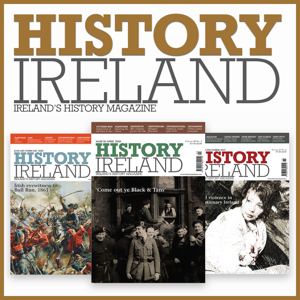
History Ireland magazine has now been in production for over 27 years. 

More shows like History Ireland

Irish History Podcast by Fin Dwyer

Irish History Podcast

1,339 Listeners

Documentary on One Podcast by RTÉ Documentary on One

Documentary on One Podcast

183 Listeners

The Last Word with Matt Cooper by Today FM

The Last Word with Matt Cooper

48 Listeners

Callan's Kicks by RTÉ Radio 1

Callan's Kicks

50 Listeners

Inside Politics with Hugh Linehan by The Irish Times

Inside Politics with Hugh Linehan

141 Listeners

The Pat Kenny Show by Newstalk

The Pat Kenny Show

58 Listeners

The David McWilliams Podcast by David McWilliams & John Davis

The David McWilliams Podcast

346 Listeners

Three Castles Burning by Donal Fallon

Three Castles Burning

134 Listeners

The Other Hand by Jim Power & Chris Johns

The Other Hand

40 Listeners

In The News by The Irish Times

In The News

48 Listeners

The Indo Daily by Irish Independent

The Indo Daily

108 Listeners

Free State with Joe Brolly and Dion Fanning by Gold Hat Productions

Free State with Joe Brolly and Dion Fanning

70 Listeners

Path to Power by Matt Cooper

Path to Power

24 Listeners

The BelTel by Belfast Telegraph

The BelTel

53 Listeners

The Troubles Podcast by Oisin Feeney

The Troubles Podcast

520 Listeners