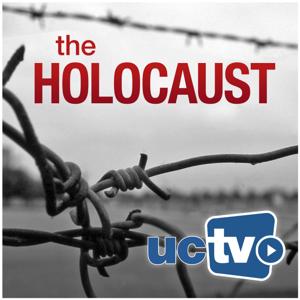
Holocaust (Audio)

Holocaust (Audio)

Download on the App Store
  • Favorites

    104

    Followers

  • Typical duration

    59 min

    per episode

Based on Podcast App listening data

Holocaust (Audio) episodes

  • Rain of Ash: Roma Jews and the Holocaust
    What paradoxes arise when victims of related persecution tell their stories next to, and after, each other? This question is at the heart of Ari Joskowicz’s highly acclaimed book “Rain of Ash,” which examines the unlikely entanglement of the histories of Jews and Romani people—the only two racialized groups the Nazis targeted for wholesale extermination. Joskowicz, professor of Jewish Studies at Vanderbilt University, explores the encounters between Jews and Romani people on the killing fields of Europe and seeks to understand how survivors and historians have discussed Romani and Jewish suffering during World War II in relational terms. Series: "Library Channel" [Humanities] [Show ID: 40533]
    1 hr 7 min
  • Addressing Antisemitism on Campus: Lessons from History Challenges for Today
    John A. Pérez, Regent Emeritus of the University of California, sits down with Robert Williams, Ph.D., CEO and Finci-Viterbi Executive Director of the USC Shoah Foundation, for a critical conversation about the rise of antisemitism on college campuses. They explore how history shapes present-day challenges, the dangers of misinformation, and the role of higher education in confronting hate. Drawing on lessons from the Holocaust and other historical atrocities, they discuss the urgent need for courage and action to combat antisemitism. Series: "Education Channel" [Humanities] [Education] [Show ID: 40249]
    1 hr
  • My Droplet of Fate Reflects the Jewish Ocean: The Legacy of Béla Pásztor
    In the early 20th century, Budapest was the second-largest Jewish city in Europe, and Jewish artists and intellectuals played a major role in the city’s cosmopolitan cultural life. Among them was theater and cinema director and producer Béla Pásztor, whose career was marked by early success and later oppression. In a conversation with UC San Diego history professor Deborah Hertz, Béla’s son, Rafael Pastor, explores his family’s history before, during, and after the Nazi occupation of Hungary, including his parents’ emigration to Israel, where he was born.
    In commemoration of the 80th anniversary of the deportations and annihilations of Hungarian Jews in 1944, which Béla survived in hiding, the conversation is preceded by a brief historical overview and survivor testimonies of this harrowing—and unforgettable—tragedy.
    Series: "Library Channel" [Humanities] [Show ID: 40227]
    1 hr 11 min
  • The Kindness of Strangers: Survival in Linz London and Shanghai
    What does it take to survive persecution and exile? The story of Greta Taussig and Rudy Gans offers answers to this tantalizing question. Born in Linz, Austria, Greta emigrated to London after the country’s incorporation into the Third Reich, eventually enduring the horrors of the Blitz. Rudy was able to make his way to Shanghai after imprisonment in the notorious Dachau concentration camp. Along their arduous journey, each experienced the life-saving kindness of courageous strangers. As part of the UC San Diego Holocaust Living History Workshop, their son, Bob Gans, shares their thought-provoking story, supplemented by a display of artifacts and original documents. Series: "Library Channel" [Humanities] [Show ID: 39008]
    54 min
  • An Antisemitic Double-Murder: The Forgotten History of Right-Wing Terrorism in Postwar West Germany
    On December 19, 1980, Shlomo Lewin, the former chairman of the Jewish community in Nuremberg, and his partner Frida Poeschke were shot dead in their house in Erlangen. Instead of pursuing the leads that led to the right-wing extremist group Wehrsportgruppe Hoffmann, investigators concentrated on Lewin’s social environment for a long time. As part of UC San Diego's Holocaust Living History Workshop, German historian Uffa Jensen reconstructs the crime and its motivations, in the process unearthing a history of violence, trivialisation and repression that continues to this day. Jensen is a historian of modern history and serves as the deputy director at the Centre for Research on Antisemitism at the Technische Universität in Berlin. Series: "Library Channel" [Humanities] [Show ID: 38976]
    58 min
  • The Pope at War: The Secret History of Pius XII Mussolini and Hitler
    When Pope Pius XII died in 1958, his papers were sealed in the Vatican Secret Archives, leaving unanswered questions about what he knew and did during World War II. In 2020, the archives were finally opened. Based on thousands of never-before-seen documents, Brown University Professor Emeritus David Kertzer’s book “The Pope at War” paints a dramatic portrait of what the Pope did and did not do as war enveloped Rome and the continent, and as the Nazis began their systematic mass murder of Europe’s Jews. Kertzer's earlier book, “The Pope and Mussolini: The Secret History of Pius XI and the Rise of Fascism in Europe,” won the Pulitzer Prize. Series: "Library Channel" [Humanities] [Show ID: 38975]
    57 min
  • In the Midst of Civilized Europe: The Pogroms of 1918-1921 and the Onset of the Holocaust
    Between 1918 and 1921, Ukrainian peasants, townsmen, and soldiers who blamed the Jews for the turmoil of the Russian Revolution murdered over a 100,000 Jews. Aid workers warned that six million Jews were in danger of extermination. Twenty years later, these dire predictions would come true. In his new book “In the Midst of Civilized Europe,” acclaimed historian Jeffrey Veidlinger shows for the first time how this wave of genocidal violence created the conditions for the Holocaust.
    Veidlinger is Joseph Brodsky Collegiate Professor of History and Judaic Studies at the University of Michigan and the author of multiple prize-winning books, including “The Moscow State Yiddish Theater: Jewish Culture on the Soviet Stage” (2000), “Jewish Public Culture in the Late Russian Empire” (2009), and “In the Shadow of the Shtetl: Small-Town Jewish Life in Soviet Ukraine” (2013). Series: "Library Channel" [Public Affairs] [Humanities] [Show ID: 39078]
    1 hr
  • German Big Business and the Holocaust
    Among the most striking exhibits at the Auschwitz museum are undoubtedly the mountains of loot stolen from Jews murdered upon arrival. Shoes, suitcases, spectacles, and more fill entire rooms in the former barracks of the main camp. Surviving the Shoah when their owners did not, they constitute a potent proof of the Nazis’ abiding concern with material gain. In this talk, author and historian Peter Hayes traces the ways by which the German corporate world became deeply implicated in—and in many respects indispensable to—the Nazi regime’s persecution, exploitation, and murder of Europe’s Jews. He argues that these developments stemmed inexorably from decisions made and actions taken by the nation’s leading corporate executives in 1933, at the very outset of Nazi rule.
    Hayes is author or editor of 13 books, including the best-selling “Das Amt und die Vergangenheit” and “Why? Explaining the Holocaust,” which has been translated into several foreign languages including German, Slovak, Spanish, and Chinese. He is currently completing (with Stephan Lindner of Munich) “Profits and Persecution: German Big Business, the Nazi Economy, and the Holocaust.” Series: "Library Channel" [Humanities] [Show ID: 38423]

    1 hr 29 min
  • What’s Fascism Got to Do With It? The Ideological Origins of the Holocaust
    Twentieth-century fascism was a political ideology encompassing totalitarianism, state terrorism, imperialism, racism, and, in Germany’s case, the most radical genocide of the last century: the Holocaust. Historians of the Holocaust tend to reject the notion of fascism as a causal explanation for its origins. Conversely, scholars of fascism present the Shoah as a particular event that is not central to fascist historiography. In this lecture Federico Finchelstein examines the challenge the Holocaust presents to the transnational history of ideology and politics.
    A leading contemporary authority on global fascism, Finchelstein is Professor of History at the New School for Social Research and Eugene Lang College and Director of the Janey Program in Latin American Studies at NSSR. Series: "Library Channel" [Humanities] [Show ID: 38422]
    59 min
  • Death and Survival in Holocaust Landscapes
    How does the concept of space enhance our understanding of the Holocaust? In this talk, British historian Tim Cole tells the story of the Shoah through an exploration of landscapes victims moved—and were moved—through across Europe. His exploration of the “Holocaust landscapes” shines a powerful light on the geographic dimensions of the Shoah. Series: "Library Channel" [Humanities] [Show ID: 37452]
    56 min

About Holocaust (Audio)

From the publisher's feed

Scholars and witnesses present evidence documenting the mass atrocities that took place from 1933 through to the end of World War II in 1945, giving voice to the memories of the 6 million Jews and 5…

Best of Holocaust (Audio)

Ranked by our users in the last 21 days

More shows like Holocaust (Audio)

Osher WISE: Well-being and Integrative Science for Everyone (Audio) by UCTV

Osher WISE: Well-being and Integrative Science for Everyone (Audio)

60 Listeners

Aging and Senior Health (Audio) by UCTV

Aging and Senior Health (Audio)

21 Listeners

Evolution by UCTV

Evolution

17 Listeners

Health Policy (Audio) by UCTV

Health Policy (Audio)

5 Listeners

Oceanography (Audio) by UCTV

Oceanography (Audio)

38 Listeners

CARTA - Anthropogeny (Video) by UCTV

CARTA - Anthropogeny (Video)

5 Listeners

CARTA - Anthropogeny (Audio) by UCTV

CARTA - Anthropogeny (Audio)

7 Listeners

Public Policy and Society (Audio) by UCTV

Public Policy and Society (Audio)

1 Listeners

Robert Reich by UCTV

Robert Reich

34 Listeners

Science (Audio) by UCTV

Science (Audio)

12 Listeners