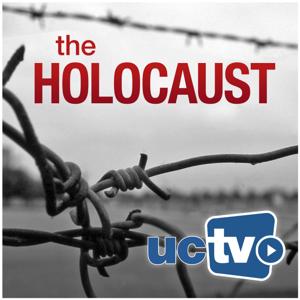
Holocaust (Audio)

Holocaust (Audio)

Download on the App Store
  • Favorites

    104

    Followers

  • Typical duration

    59 min

    per episode

Based on Podcast App listening data

Holocaust (Audio) episodes

  • Hugo Marcus: A Muslim Jew Under the Swastika
    Hugo Marcus (1880–1966) was a man of many names and identities. Born a German Jew, he converted to Islam and took the name Hamid, becoming one of the most prominent Muslims in Germany prior to World War II. Renamed Israel by the Nazis, he was sent to the Sachsenhausen concentration camp before escaping to Switzerland. In exile, he fought for homosexual rights and wrote queer fiction under the pen name Hans Alienus.
    Marc David Baer discusses his new book “German, Jew, Muslim, Gay” in which he tells the story of a highly unconventional man and reveals new aspects of the interconnected histories of Jewish and Muslim individuals and communities, including Muslim responses to Nazism and Muslim experiences of the Holocaust. Series: "Library Channel" [Humanities] [Show ID: 37451]
    52 min
  • The Moral Triangle: Germans Israelis Palestinians with Sa’ed Atshan and Katharina Galor
    When the Second World War came to an end, Berlin, the capital of the Third Reich, lay in ruins. Few contemporaries, if any, could have anticipated that 70 years later, Berlin would boast large diaspora communities of Palestinians and Israelis who have made a home among Germans.
    In “The Moral Triangle,” Sa’ed Atshan and Katharina Galor draw on ethnographic fieldwork and interviews with Israelis, Palestinians and Germans in Berlin to explore the fraught relationship between the three groups in the context of official German policies, public discourse and the private sphere.
    Atshan is author of “Queer Palestine: Empire of Critique.” Galor, an art historian and archaeologist, is the Hirschfeld Senior Lecturer of Judaic Studies at Brown University. Her publications include ”The Archaeology of Jerusalem: From the Origins to the Ottomans” (co-authored with Hanswulf Bloedhorn) and ”Finding Jerusalem: Archaeology Between Science and Ideology.” Series: "Library Channel" [Humanities] [Show ID: 37751]

    59 min
  • Franci’s War – with Helen Epstein - Holocaust Living History Workshop
    Helen Epstein, a prolific journalist and author, discusses her mother's memoir about her life in Nazi-occupied Europe. "Franci's War" starts in 1942 when 22-year-old Franci Rabinek began a three-year journey that would take her from Terezin, the Nazis’ “model ghetto,” to the Czech family camp in Auschwitz-Birkenau, slave labor camps in Hamburg, and finally Bergen Belsen. Trained as a dress designer, Franci survived the war and would go on to establish a fashion salon in New York. Series: "Library Channel" [Humanities] [Show ID: 37412]
    59 min
  • Mengele: Unmasking the Angel of Death with David Marwell - Holocaust Living History Workshop
    Who was Josef Mengele? After the end of the Holocaust, the German physician has been increasingly viewed as the personification of supreme evil both in the minds of survivors and the public at large. In this lecture based on his highly acclaimed book “Mengele,” David Marwell untangles history and myth surrounding the man known variously as the Angel of Death and the good uncle, suggesting that Mengele was not so much a uniquely monstrous perpetrator, but more a willing part of a monstrous machine of destruction.
    Marwell has had a distinguished career as chief of investigative research at the US Department of Justice, associate museum director at the United States Holocaust Memorial Museum, and director and CEO of the Museum of Jewish Heritage in New York City. Series: "Library Channel" [Humanities] [Show ID: 36713]
    59 min
  • Sexual Barter in Times of Genocide: Reflections on Sexual Violence Agency and Sex Work with Anna Hajkova- Holocaust Living History Workshop
    What is everyday life, and how is it experienced under extreme stress? This is the broader question that animates the research of Anna Hájková, an associate professor of Modern Continental European History at the University of Warwick. In her talk, Hájková examines sex work, sexual violence, and coercion of Jewish women and men in concentration camps, ghettos, and in hiding. She is the author of many journal articles and books, including her current project, “Boundaries of the Narratable: Transgressive Sexuality and the Holocaust.” This pioneering study seeks to contribute to our understanding of gender and sexual violence during the Holocaust and explores the erasure of narratives of gays and lesbians who were deported as Jews and who subsequently vanished from the historical record. Series: "Library Channel" [Humanities] [Show ID: 36710]
    49 min
  • Yiddish Glory: The Lost Songs of World War II with Anna Shternshis and Psoy Korolenko - Holocaust Living History Workshop
    At the height of World War II, a team of Soviet scholars embarked on an ambitious goal to collect recently written songs dealing with the Holocaust. Lost until the early 1990's, these songs were rediscovered and recorded with an ensemble of recognized soloists. Thanks to the painstaking labor of Anna Shternshis and the talent of Psoy Korolenko, audiences worldwide can now enjoy and reflect upon this treasure trove of songs that offer a precious glimpse into an unfolding tragedy and the artistic reaction to it. Series: "Library Channel" [Humanities] [Show ID: 36542]
    1 hr 21 min
  • Trauma Memory and the Art of Survival with Gabriella Karin - Holocaust Living History Workshop
    As a child, Gabriella Karin was separated from her parents and placed in a Slovakian convent for three years. Although physically safe, she did not emerge unscathed. Suppressed memories of her past came flooding back once she began to fashion sculptures related to the Holocaust later in life. Her journey offers important insight into trauma and how creativity can be used as a tool to process memories of oppression, persecution, and loss. Karin is a docent at the Los Angeles Museum of the Holocaust and participates in the Righteous Conversations Project, which unites survivors and students through art. Series: "Library Channel" [Humanities] [Show ID: 36071]
    1 hr
  • Transmitted Wounds: Media and the Mediation of Trauma with Amit Pinchevski - Holocaust Living History Workshop
    In his new book, Transmitted Wounds, Amit Pinchevski explores the ways media technology and logic shape the social life of trauma both clinically and culturally. Drawing on a number of case studies such as radio broadcasts of the Eichmann trial, videotapes of Holocaust survivor testimonies, and the recent use of digital platforms for holographic witnessing, he demonstrates how the technological mediation of trauma feeds the traumatic condition itself. His insights have crucial implications for media studies and the digital humanities field as they provide new ways to understand the relationship between technology and human suffering. Pinchevski is an associate professor in the Department of Communication and Journalism at The Hebrew University of Jerusalem. Series: "Library Channel" [Humanities] [Show ID: 35017]
    58 min
  • Racism in German and American Cinema of the Twenties: From The Ancient Law to The Jazz Singer with Charles Musser - Holocaust Living History Workshop
    Yale University professor and filmmaker Charles Musser explores the historical and contemporary perspectives of race relations in German and American cinema from the 1920s by examining The Ancient Law (1923) and The Jazz Singer (1927). He evaluates how each film addresses anti-Semitism as well as the burning question of the history of blackface as a theatrical convention. Series: "Library Channel" [Public Affairs] [Humanities] [Show ID: 35016]
    1 hr 15 min
  • Learning from the Germans: Race and the Memory of Evil with Susan Neiman - Holocaust Living History Workshop
    As an increasingly polarized America fights over the legacy of racism, Susan Neiman, author of the contemporary philosophical classic Evil in Modern Thought, asks what we can learn from the Germans about confronting the evils of the past. In the wake of white nationalist attacks, the ongoing debate over reparations, and the controversy surrounding Confederate monuments and the contested memories they evoke, Susan Neiman’s Learning from the Germans delivers an urgently needed perspective on how a country can come to terms with its historical wrongdoings. She combines philosophical reflection, personal stories, and interviews with both Americans and Germans who are grappling with the evils of their own national histories. Series: "Writers" [Public Affairs] [Humanities] [Show ID: 35015]
    55 min

About Holocaust (Audio)

From the publisher's feed

Scholars and witnesses present evidence documenting the mass atrocities that took place from 1933 through to the end of World War II in 1945, giving voice to the memories of the 6 million Jews and 5…

Best of Holocaust (Audio)

Ranked by our users in the last 21 days

More shows like Holocaust (Audio)

Osher WISE: Well-being and Integrative Science for Everyone (Audio) by UCTV

Osher WISE: Well-being and Integrative Science for Everyone (Audio)

60 Listeners

Aging and Senior Health (Audio) by UCTV

Aging and Senior Health (Audio)

21 Listeners

Evolution by UCTV

Evolution

17 Listeners

Health Policy (Audio) by UCTV

Health Policy (Audio)

5 Listeners

Oceanography (Audio) by UCTV

Oceanography (Audio)

38 Listeners

CARTA - Anthropogeny (Video) by UCTV

CARTA - Anthropogeny (Video)

5 Listeners

CARTA - Anthropogeny (Audio) by UCTV

CARTA - Anthropogeny (Audio)

7 Listeners

Public Policy and Society (Audio) by UCTV

Public Policy and Society (Audio)

1 Listeners

Robert Reich by UCTV

Robert Reich

34 Listeners

Science (Audio) by UCTV

Science (Audio)

12 Listeners